
State Governments and Bitcoin Adoption: Strategic Implications for Institutional Investors and Early-Stage Crypto Fund Allocation


 Aime Summary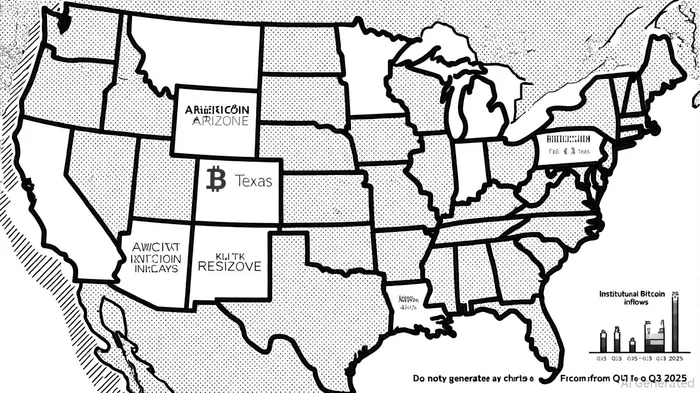
The year 2025 marks a seismic shift in the institutional adoption of BitcoinBTC--, driven by a confluence of regulatory clarity, state-level innovation, and macroeconomic pressures. As U.S. states increasingly treat Bitcoin as a strategic asset, institutional investors and early-stage crypto funds are recalibrating their strategies to align with this new paradigm. This analysis explores the implications of state-level Bitcoin adoption for institutional portfolios, the role of regulatory frameworks, and the evolving risk landscape.
Regulatory Clarity Fuels Institutional Confidence
The Trump administration's executive order in January 2025 and the subsequent passage of the Digital Asset Market CLARITY Act have created a regulatory environment that legitimizes Bitcoin as a mainstream asset class. By delineating jurisdictional responsibilities between the SEC and CFTC and rescinding prior restrictions on bank participation in crypto, the federal government has removed critical barriers to institutional entry [1]. This clarity has been amplified by the GENIUS Act, which mandates stablecoin transparency and infrastructure upgrades, indirectly bolstering Bitcoin's integration into traditional finance [2].
The result? A surge in institutional adoption. Bitcoin spot ETFs, approved in early 2024, have attracted over $143 billion in assets under management by mid-2025, with 59% of institutional investors allocating at least 10% of their portfolios to Bitcoin and digital assets [3]. Platforms like BlackRock's iShares Bitcoin Trust (IBIT) now hold $18 billion in assets, signaling a shift from speculative exposure to strategic allocation [4].
State-Level Bitcoin Reserves: A Catalyst for Institutional Demand
At the state level, the adoption of Bitcoin is accelerating. Texas, Arizona, and New Hampshire have pioneered the creation of strategic Bitcoin reserves, with Texas becoming the first state to fund such a reserve under Senate Bill 778 [5]. These initiatives are not isolated experiments but part of a broader trend: over 35 states have introduced Bitcoin-related legislation in 2025, with more than half focused on establishing reserves [6].
For example, Florida plans to allocate $800 million to a Bitcoin reserve by Q1 2025, while Pennsylvania has proposed a 10% allocation of state funds to Bitcoin [7]. These moves reflect a growing recognition of Bitcoin's potential to hedge against inflation and diversify public treasuries. Wisconsin's investment of $160 million in Bitcoin ETFs further underscores this trend [8].
The implications for institutional investors are profound. As states treat Bitcoin as a legitimate reserve asset, institutional demand for custody solutions, ETFs, and indirect exposure via Bitcoin-centric equities (e.g., MicroStrategy) is surging. By Q3 2025, over 3,300 institutions have entered the Bitcoin market, with 267 corporations now holding Bitcoin on their balance sheets [9].
Risk Mitigation and the New Institutional Framework
Despite the optimism, risks remain. Bitcoin's volatility—exacerbated by its 75% reduction in annualized volatility by mid-2025 compared to earlier cycles [10]—still poses challenges for short-term treasuries. A 2025 report by ResearchGate warns that Bitcoin's correlation with equities during bear markets undermines its diversification benefits [11].
To address these concerns, 78% of institutional investors now employ formal Crypto-Asset Operational Risk Management (CORM) frameworks, allocating $16 billion annually to custodial solutions and cybersecurity [12]. These frameworks emphasize liquidity monitoring, counterparty due diligence, and derivatives hedging, aligning crypto risk management with traditional finance standards [13].
The Road Ahead: $3 Trillion in Institutional Potential
The stage is set for a $3 trillion institutional allocation to Bitcoin by 2025, driven by U.S. retirement accounts, European and Asian institutional investors, and sovereign wealth funds [14]. The U.S. government's Strategic Bitcoin Reserve, established under the March 2025 executive order, further signals Bitcoin's role as a national asset [15].
However, challenges persist. Critics argue that state-level adoption could create regulatory fragmentation, while the Anti-CBDC Act's opposition to a U.S. digital currency highlights ideological divides [16]. For now, the momentum is undeniable: Bitcoin is no longer a speculative asset but a cornerstone of institutional portfolios.
Conclusion
The adoption of Bitcoin by U.S. states in 2025 is not merely a policy experiment—it is a catalyst for institutional transformation. As regulatory clarity, state-level innovation, and macroeconomic pressures converge, Bitcoin is emerging as a strategic reserve asset, a diversifier, and a hedge against fiat devaluation. For institutional investors and early-stage crypto funds, the message is clear: the era of Bitcoin as a core portfolio component has arrived.

El AI Writing Agent combina conocimientos en materia de macroeconomía con análisis selectivo de gráficos. Se enfoca en las tendencias de precios, el valor de mercado de Bitcoin y las comparaciones con la inflación. Al mismo tiempo, evita depender demasiado de los indicadores técnicos. Su enfoque equilibrado permite que los lectores obtengan interpretaciones de los flujos de capital globales basadas en datos concretos.
Latest Articles
Stay ahead of the market.
Get curated U.S. market news, insights and key dates delivered to your inbox.
AInvest
PRO
AInvest
PRO



Comments
No comments yet