
State Farm Stadium: A Beacon of Long-Term Value in Sports Infrastructure Investment
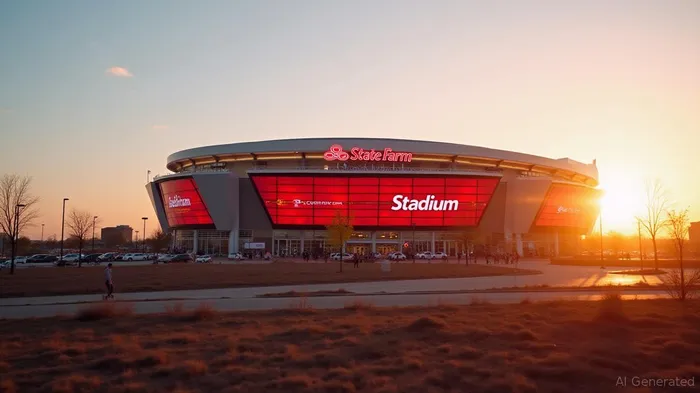
The sports infrastructure landscape is undergoing a transformative shift, driven by the convergence of technological innovation, shifting fan engagement models, and the financial sophistication of venue operators. At the forefront of this evolution stands State Farm Stadium, a 73,000-seat coliseum in Glendale, Arizona, that exemplifies how modern sports venues can be engineered as multifaceted revenue engines. This article dissects the stadium's financial architecture—its naming rights, event hosting prowess, and real estate potential—to reveal why it stands as a compelling long-term investment opportunity.
The Power of Long-Term Naming Rights: A Stable Cash Flow Pillar
The linchpin of State Farm Stadium's financial stability is its 18-year naming rights agreement with State Farm, inked in 2018 and set to expire in 2036. This deal, worth an estimated $200–250 million (surpassing the University of Phoenix's previous $154.5 million 20-year contract), ensures a predictable revenue stream for the Arizona Cardinals and venue operators. Unlike shorter-term deals that introduce renewal risk, this 18-year span allows stakeholders to plan strategically, leveraging the stadium's brand visibility for sustained marketing and community initiatives.
The partnership's longevity is underpinned by strategic alignment: State Farm, a Berkshire Hathaway subsidiary, benefits from deepening its presence in Arizona—a key insurance market—while the stadium gains a financially robust backer. This symbiosis is critical in an industry where naming rights contracts often face volatility due to corporate rebranding or financial strain (as seen with the University of Phoenix's early termination in 2017).
Berkshire's steady stock trajectory (up ~40% since 2020) underscores State Farm's financial stability, reducing investor risk.
Event Hosting: A Revenue Multiplier
Beyond naming rights, the stadium's event portfolio amplifies its value. Hosting marquee events like Super Bowl LVII (2023) and the NCAA Final Four (2024) generates incremental revenue through ticket sales, hospitality, and media rights. These events also amplify the venue's prestige, attracting future high-profile bookings. For instance, Super Bowl LVII injected an estimated $500 million into the Phoenix metropolitan economy, a testament to the stadium's capacity to drive regional economic activity.
The stadium's flexible design—including retractable seating for concerts and field configurations for football/rugby—further broadens its appeal. This adaptability positions it as a versatile asset in an era where sports venues increasingly cater to diverse audiences, from esports to festivals.
Real Estate Value: A Hidden Growth Lever
The stadium's location in Glendale places it at the heart of a rapidly urbanizing Sun Belt market. Proximity to major highways and Phoenix's expanding tech corridor (including companies like IntelINTC-- and GoDaddy) suggests real estate appreciation potential.
While the stadium itself is a fixed asset, its adjacent land holdings could be developed into mixed-use spaces—retail, office, or residential—to capitalize on its centrality. Such developments would create synergies with the venue's event calendar, turning it into a year-round economic hub.
Strategic Investment Case: Stability Meets Growth
For investors, State Farm Stadium offers a rare blend of low-risk cash flow and high-growth upside:
1. Predictable Revenue: The naming rights deal shields against short-term market swings.
2. Event-Driven Upside: Major events provide recurring revenue spikes.
3. Location Appreciation: Sun Belt real estate continues to outperform national averages, with Phoenix's home prices rising 12% annually since 2020.
Risks and Considerations
- Economic Downturns: Slower ticket sales or corporate sponsor pullbacks during recessions could strain margins.
- Competition: New venues (e.g., Las Vegas Stadium) may dilute event demand.
- Naming Rights Renewal: Post-2036, securing a new deal at current rates is not guaranteed.
Conclusion: A Long-Term Bet on Resilience
State Farm Stadium's 18-year naming rights agreement, coupled with its event-hosting clout and strategic location, positions it as a defensive yet growth-oriented investment. For those with a 5–10-year horizon, exposure to this asset—whether through real estate partnerships, equity stakes, or event-related ventures—could yield steady returns.
The stadium's blueprint—long-term contracts, diversified revenue streams, and adaptive infrastructure—is a model for how sports venues can evolve into financial bedrocks in an era of economic uncertainty. Investors who recognize this will find themselves well-positioned to capitalize on the stadium's enduring value.
Gary Alexander is a financial analyst specializing in infrastructure and sports economics. This article reflects independent analysis and is not financial advice.

Stay ahead of the market.
Get curated U.S. market news, insights and key dates delivered to your inbox.


AInvest
PRO
AInvest
PRO



Comments
No comments yet