
Starz's Q3 2025: Contradictions Emerge on IP Ownership, Content Spend, and Cost Strategies
 Aime Summary
Date of Call: None provided
Financials Results
- Revenue: $321M, up $1.2M sequentially
- Operating Margin: Adjusted OIBDA $22M, down $11M sequentially
Guidance:
- Affirmed remainder of 2025 guidance: positive U.S. OTT subscriber growth, positive sequential revenue growth and ~ $200M adjusted OIBDA.
- Expect to exit 2025 with ~3.1x leverage (trailing 12M was 3.4x).
- Canada moving to content-licensing starting Dec quarter; Canadian subscribers will no longer be reported and licensing revenue will be recorded in linear & other.
- Cash content spend expected just under $700M in 2026, targeting $600–650M in subsequent years.
- Long-term targets: 20% margins exiting calendar 2028, convert 70% of adjusted OIBDA to unlevered FCF and delever to 2.5x.
Business Commentary:
- Subscriber and Financial Growth:
Starzreported 12.3 million U.S. OTT subscribers, with a growth of670,000year-over-year.- Financial performance included
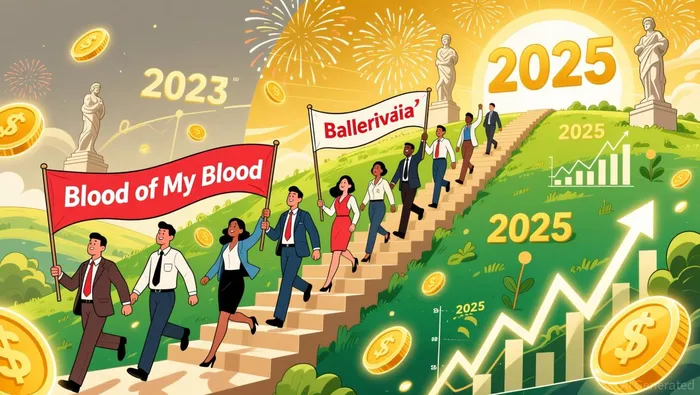
total revenueof$321 million, up$1.2 millionsequentially, withOTT revenuerising by$1.7 millionto$223 million. - Growth was driven by strategic programming moves and increased engagement with key tentpoles like Blood of My Blood and Ballerina.
- Content Strategy and Cost Management:
- Starz announced a shift towards owning half of its content slate by 2027, with Fightland as the first owned original set to premiere next year.
- This move is expected to lower per episode costs and generate international licensing revenue, supporting their goal of reaching 20% margins by 2028.
The strategy involves controlling content economics and exploiting international licensing opportunities.
Operational and Structural Changes:
- Starz modified its Canadian business model from a joint venture to a content licensing agreement with Bell Canada.
The structural change simplifies operations, aligning with Starz's strategy to own content and generate international licensing revenue without directly operating international services.
Content Engagement and Viewership Trends:
- Monthly active viewers reached a 12-month high, with a
7%increase in engagement for Q3. - This was driven by successful content like Blood of My Blood and strategic programming like Ballerina.
- Future key tentpoles include Spartacus and Power: Force, which are expected to further drive viewership and engagement.

Sentiment Analysis:
Overall Tone: Positive
- Management called it a "strong quarter," reported a return to positive revenue and U.S. OTT subscriber growth (added 110k U.S. OTT subs; 12.3M U.S. OTT total), affirmed ~ $200M adjusted OIBDA for 2025 and reiterated confidence in hitting long-term targets (20% margins by 2028) while de-risking via licensing in Canada.
Q&A:
- Question from Brent Penter (Raymond James): Can you go over the mechanics in terms of the cost savings and international revenue when you produce owned shows (you previously mentioned $1M–$2M savings per hour)?
Response: Owning IP reduces per-episode costs by 'de-aging' (newer, cheaper seasons) and by setting strict budgets up front; ownership also enables incremental international licensing/output deals that add revenue on top of domestic economics.
- Question from Brent Penter (Raymond James): Any update on the other shows in writers' rooms and timing—will these drive margin improvement once owned?
Response: Four rooms are progressing (rooms closing, production partners being sought); shows expected to meaningfully come on in 2027 as Starz-owned content, helping reach the target of half the slate owned and improving margins via ownership and partner cost-sharing.
- Question from Brent Penter (Raymond James): Walk through the bridge to the ~$52M needed in Q4 to hit the $200M adjusted OIBDA and confidence in growing off $200M.
Response: Confidence is high; seasonality and content amortization explain quarter-to-quarter swings, Q4 needs ~ $52M; lowering content spend and increasing owned-IP economics will drive margin expansion above the $200M base.
- Question from David Joyce (Seaport Research Partners): Can you provide color on programming viewership trends and how cancellations (e.g., BMF) affect multi-day performance?
Response: Engagement improved—monthly active viewers hit a 12‑month high (up ~7% vs prior quarter) driven by Outlander prequel and Ballerina; early reads for Force show stronger gross adds than prior tentpoles, supporting better acquisition and retention.
- Question from David Joyce (Seaport Research Partners): How much of overall viewership is theatrical content vs originals?
Response: First-title streams are roughly 50/50 on average (varies by platform): Starz retail skews originals, other distributors skew more to movies.
- Question from David Karnovsky (JPMorgan): Thoughts on the streaming landscape and how that ties to confidence in continued OTT subscriber revenue growth?
Response: Landscape is noisy with consolidation, but Starz' broad bundling distribution (Hulu, Amazon) and strong upcoming slate support continued organic subscriber and revenue growth without needing immediate price increases.
- Question from David Karnovsky (JPMorgan): Any more detail on M&A targets and how deals would be financed given deleveraging goals?
Response: Interested in complementary AVOD/linear assets that can be digitized and bundled with Starz; will avoid transactions that meaningfully over-lever the company and will pursue strategically fit, leverage-conservative deals.
- Question from Thomas Yeh (Morgan Stanley): On subscriber momentum, how much is churn improvement vs gross adds?
Response: About two-thirds of recent net growth was gross adds and one-third churn improvement; Starz app churn is at all-time lows and strategies (longer seasons, back-to-back shows) are being used to reduce churn further.
- Question from Thomas Yeh (Morgan Stanley): On the Canadian business-model shift—will licensing revenues cover prior subscription revenues and are fees variable with partner subscriber adoption?
Response: Yes—new licensing revenue more than covers the prior subscriber revenue and is more stable; Canada now treated as an international output/licensing arrangement with revenue recorded in linear & other.
- Question from Thomas Yeh (Morgan Stanley): Is $700M cash spend still the right number for 2026 and will it decline thereafter?
Response: Yes—expect just under $700M in 2026 and plan to reduce toward the $600–650M range in subsequent years as content is de‑aged and owned-IP increases.
- Question from Matthew Harrigan (The Benchmark Company): Does the recent cash burn imply timing pushes into Q4 and normalization next year?
Response: Cash flow is choppy post-separation; Q3 was negative, Q4 and early Q1 may be spotty, with a more normal cadence and improvement through 2026 as timing and production align.
- Question from Matthew Harrigan (The Benchmark Company): On development efficiencies and marketing—do you now have more latitude to optimize development costs and target marketing despite high bundling?
Response: Controlling development/production timing lets Starz align cash spend to air dates and reduce choppiness; bundling isn't a constraint—top-funnel marketing for Starz benefits both the direct app and distribution partners and improves lifetime value.
Contradiction Point 1
International Revenue and IP Ownership
It involves strategic approaches to international revenue generation and IP ownership, which are crucial for the company's growth and financial health.
How do cost savings and international revenue work when producing your own shows with your own IP? - Brent Penter (Raymond James)
20251114-2025 Q3: Owning IP controls costs and creates international revenue streams. - Jeffrey Hirsch(CEO)
How does the structure of IP ownership impact cost savings and international revenue for producing Starz's original shows? - Brent Penter (Raymond James & Associates, Inc., Research Division)
2025Q3: Owning IP creates international revenue through U.S.-based content monetization, similar to HBO's output deals. - Jeffrey Hirsch(CEO)
Contradiction Point 2
Content Spend Outlook for 2026
It involves the company's expectations for content spend, which directly impacts financial planning and investor expectations.
Is the $700 million content spend outlook for 2026 still valid? - Thomas Yeh (Morgan Stanley)
20251114-2025 Q3: Yes, under $700 million in 2026, then a further reduction expected. - Scott MacDonald(CFO)
Is the $700 million cash spend guidance still accurate for 2026? - Thomas Yeh (Morgan Stanley, Research Division)
2025Q3: The expectation remains for content spend below $700 million in 2026, aligning content spend with cash flow. - Scott MacDonald(CFO)
Contradiction Point 3
Content Cost Reduction and Ownership Strategy
It involves inconsistencies in the company's strategy and timeline for reducing content costs and increasing IP ownership, which are key to financial performance and strategic positioning.
Can you explain the cost savings and international revenue from producing in-house shows using your own IP? - Brent Penter (Raymond James)
20251114-2025 Q3: We expect to increase owned content and reduce content costs in 2026 and beyond. The strategy leverages scale and output deal economics to drive international revenue growth. - Jeffrey Hirsch(CEO)
What are the remaining key items to close the separation? How will the Amazon deal impact studio profits when it starts in 2026? - Thomas Yeh (Morgan Stanley)
2025Q3: We plan to move fast as we can to shift to owned IP and reduce cost as soon as possible. - Jon Feltheimer(CEO)
Contradiction Point 4
Subscription Growth and Churn Reduction
It reflects differing views on the drivers of subscription growth and churn reduction, which are crucial for understanding the company's subscription strategy and financial outlook.
Can you provide an update on subscriber growth, churn, and gross add trends? - Thomas Yeh (Morgan Stanley)
20251114-2025 Q3: Subscribers up 670,000 year-over-year. Growth is 2/3 gross acquisition, 1/3 churn reduction. - Jeffrey Hirsch(CEO)
What factors contributed to the significant increase in Studio's segment profit in Q4, such as film performance, TV, library, or a combination? - Steven Cahall (Wells Fargo)
2025Q3: We grew subscribers by 600,000 in the quarter from the prior year... The growth was the result of reduced churn. - Jon Feltheimer(CEO)
Contradiction Point 5
Content Cost Management and Strategic Partnerships
It involves differing perspectives on the benefits and strategic value of cost management and partnerships, which impact the company's financial performance and strategic direction.
How will development and data optimization benefit Starz post-separation? - Matthew Harrigan (The Benchmark Company)
20251114-2025 Q3: Control over production allows for alignment of content with cash flow. The goal is to get cash content spend to align with cash air consistently. - Jeffrey Hirsch(CEO)
What key steps remain to close the separation? How will the Amazon deal impact studio profits starting in 2026? - Thomas Yeh (Morgan Stanley)
2025Q3: We plan to move fast as we can to shift to owned IP and reduce cost as soon as possible. - Jon Feltheimer(CEO)

Discover what executives don't want to reveal in conference calls
Latest Articles
Stay ahead of the market.
Get curated U.S. market news, insights and key dates delivered to your inbox.
AInvest
PRO
AInvest
PRO



Comments
No comments yet