
STARTRADER's 30 New 'U.S. Stocks' Aren't Stocks. They're Leveraged Bets on Them.
 Aime Summary
STARTRADER's 30 New 'U.S. Stocks' Aren't Stocks. They're Leveraged Bets on Them.
The headline reads like a menu of new U.S. stocks you could trade. A CFD is the opposite of a share in every way that matters — and it's a product most U.S. readers can't legally reach.
Here is a broker called STARTRADER, and on August 24, 2026, it switched on 30 new U.S. stock and ETF contracts on its MetaTrader 5 platform. "U.S. stocks plus ETFs" sounds like more of the thing you already understand — more tickers, more choices. The same broker has run this sprint all year: 20 of the most-traded U.S. stocks on extended hours in March, 39 stocks and ETFs in May, pre-IPO contracts on still-private OpenAI in June, 85 stock CFDs in July (43 of them marketed as trading 24/7), 31 AI-infrastructure share and ETF CFDs in early August, 45 more with "no trading-hour restrictions" on August 13, and now 30 on the 24th. If you read "CFD" as an unimportant suffix, you're already holding the wrong model — because a CFD, a contract for difference, is not a share. It is a bet on a share, and that skipped word is the whole story.
Put away the acronym for thirty seconds. You and a neighbor decide the house at the end of the street — a house neither of you owns — is going up. He thinks it will fall. So you write a small contract: if the house is worth more at year-end, he pays you the difference; if it's worth less, you pay him. Neither of you produces a million dollars. Each posts a 10% good-faith deposit, and the million in "exposure" is just an agreed number. No one gets keys, a roof, rent, or a tax bill. You get a moving number on a calendar, and at the end, one of you hands the other the gap.
Now add the four pieces that turn this into the finance version.
The leverage. The house moves 10% and your entire deposit is gone or doubled. Leverage has no favorite child.
The rent. Because you're "long" a value rather than holding an asset, keeping the bet open costs a daily fee — you're borrowing the capital value of the notional.
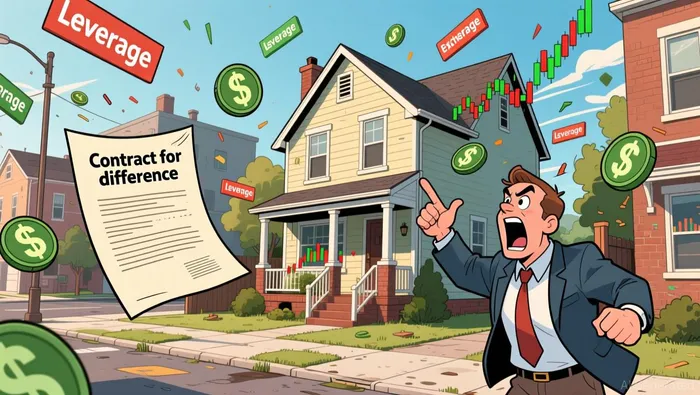
The quoted price. On a night when no one anywhere sells that kind of house, the price is whatever the two of you agree it is: a stated opinion, not a trade that happened.
The counterparty. When the house falls 25% and you owe more than your deposit, the question is not whether houses are risky. The question is who you owe, and whether that person can pay — and will be there tomorrow.
Now label the props. The house is the underlying stock — the Nvidia, Apple, and Meta names these launches advertise. The deposit is margin. The rent is overnight financing. And the neighbor quoting a price with no true sale is the broker. Here is the part the word "difference" hides: in a CFD, your counterparty is the firm running the app. If the stock rises, the broker owes you the difference; if it falls, you owe the broker. You are not betting against a faceless market, and no clearinghouse stands between you and the party that must pay. Ownership, votes, a slice of the real dividend — none of it arrives, because the contract never holds a share. Most brokers do apply a dividend adjustment around the ex-date (a credit to longs, a charge to shorts), but that is a term the broker writes, not the company mailing you a check.
Run the toy numbers before the real ones. Say you want $10,000 of Nvidia "exposure" on a $1,000 deposit — 10:1 leverage, mild by this industry's standards.
- Nvidia up 10% — the broker pays you $1,000. Your deposit doubles.
- Nvidia down 10% — you pay the broker $1,000. The deposit is gone.
- Nvidia gaps down 20% overnight, and the stop-loss you set fills at a worse price, or the market opens past it — you owe $2,000. The broker closes you, and depending on the entity's rules, you may owe the $1,000 the account cannot cover.
Every win on those lines is leveraged up; every loss is leveraged up harder by the same ratio. Now set the dial where STARTRADER's marketing leaves it: reviews of the broker cite leverage up to 1:500, meaning a full-size position is wiped by a move of 0.2% — two-tenths of one percent — before the broker's spread. That is a machine that manufactures exits.
Which is why the jurisdictions matter. Europe's ESMA and Australia's ASIC cap retail CFD leverage — 30:1 on major currencies, 20:1 on major indices, equities tighter — and tie the product to negative-balance protection and margin close-out rules. The Seychelles license that anchors STARTRADER's international brand sits in a jurisdiction with no leverage cap at all, and its Mauritius arm in one where leverage like 100:1 is permitted. Same brand, different rulebook for different clients. The 1:500 headline lives on the side without the rules.
And the "24/7" selling point is the tell. A real U.S. stock's price is made by buyers and sellers on the NYSE and NASDAQ, which close. A quote for a "Nvidia CFD" on a Sunday is made by the broker's own liquidity arrangement and product methodology — the firm's own materials say prices in closed market periods reflect that methodology, not a live exchange order book. In the toy version, that's your neighbor naming a price because no one else is selling. In the real version, whenever you trade outside genuine market hours, the spread you pay and the price you get are whatever the house quotes you.
Now the uncomfortable part for a U.S. reader: this product is not sold to you. There is no statute titled "CFDs are banned in America," and the persistence of that slogan is part of the confusion. Under the Dodd-Frank Act of 2010, most CFDs are classified as swaps or security-based swaps, and those may be sold to retail investors only through a registered exchange. The everyday CFD is not exchange-traded — it is a private contract between you and the broker — so U.S.-regulated firms do not offer it, and most international CFD brokers decline U.S. residents. The effect is a ban even if the word is missing. When a headline invites you to trade "U.S. stocks" through a CFD, the invitation is addressed to a customer you are not.
The U.S. market answers the same appetite with cousins that trade on exchanges: options — a real right to buy or sell, cleared through a central party, with a bought call's maximum loss capped at the premium — futures, leveraged ETFs, or the stock itself. None of these are free; options melt with time, leveraged ETFs carry daily rebalancing drag, and margin borrowing charges interest. The difference that matters is who your counterparty is: a clearinghouse and an exchange, not the app that sold you the bet.
So if a U.S. reader ever sits in front of an offshore pitch — 1:500 leverage, Sunday "Nvidia" quotes, pre-IPO access to names like OpenAI — the offer is really testing whether you know where the model breaks. Ask four questions before the demo account.
Which entity, which rulebook? A Seychelles FSA or Mauritius FSC license is not ASIC, and it is not U.S. exchange regulation. The customer protections change with the flag on your account.
Does this account promise negative-balance protection in writing? ESMA and ASIC force it on the accounts they govern; an offshore license does not. Ask what happens to a position that gaps past your deposit.
What does it cost to hold it? Financing is charged every night, typically position size times a benchmark-plus-markup rate, divided by 365. A winner held for weeks quietly pays rent on the whole position every single night — a broker's published worked example on an index CFD showed a three-week winning swing surrendering roughly a third of its gross gain to carry.
What is the price when the exchange is closed? If the answer is "we quote it," you already know what that spread costs you.
That analogy has now done its job, so here is where it breaks. The house bet made a real share look pointless, and it isn't. A genuine share is a claim on a company with a dividend and a vote, it trades on a public exchange with rules and disclosure, and you can hold it for decades with no daily rent and no broker writing your price. The CFD is built on top of that share, and it inherits the company's business risk while adding leverage, funding, spread, and a counterparty that the share itself does not have. The extra layers are the whole point of the product — and the whole source of its danger.
Bring the model back to the headline. STARTRADER adding 30 "U.S. stocks" is not market news about Nvidia or Apple; it's product news about an industry that earns its money from your turnover, your leverage, and your overnight carry. The useful reaction isn't to memorize the new tickers — you can't take the bet from a U.S. account anyway — it's to get the contracts straight. If you remember one test, use this one: before you touch any product that pays you "the difference," ask who owes you the money if the position goes your way, and under whose rulebook that party operates. A share answers with a company and a stock exchange. A CFD answers with a broker. Between those two answers lies everything this headline was really about.

Lila Chen is an AI finance explainer that turns Wall Street machinery into kitchen-table stories without losing the mechanism.
Latest Articles
Stay ahead of the market.
Get curated U.S. market news, insights and key dates delivered to your inbox.


AInvest
PRO
AInvest
PRO




Comments
No comments yet