
Starship's Stumbles: How SpaceX's Setbacks Shake the Commercial Space Race
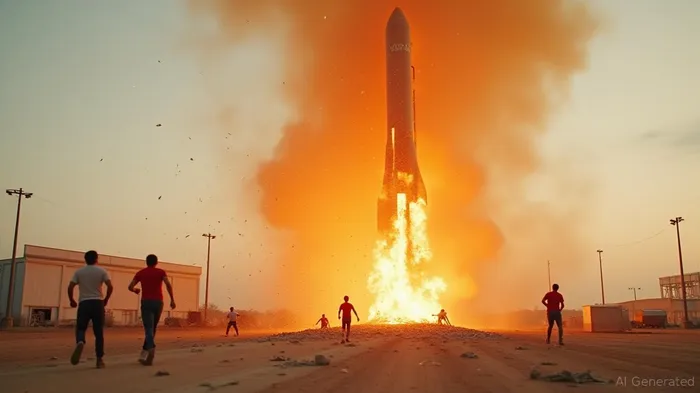
The June 19, 2025 explosion of SpaceX's Starship rocketRCKT-- during a static fire test marked the latest in a string of failures that have thrown the company's ambitious timelines—and the broader commercial space race—into disarray. For investors in space tech, the incident underscores a critical question: How much should valuation models account for the risks of technical setbacks, regulatory hurdles, and leadership uncertainty in a sector as capital-intensive as space exploration?
The Starship Program: A High-Stakes Gamble
SpaceX's Starship is central to its vision of a $10 billion annual space business, including lunar landings for NASA, Mars missions, and commercial satellite launches. The rocket's reusable design aims to slash launch costs by 90%, a breakthrough that could redefine the economics of space travel. However, recent failures—including three test flight explosions in 2025 and a catastrophic gas tank rupture in June—highlight the immense technical and operational risks inherent in this endeavor.
The June incident alone has delayed the planned June 29 launch of Flight 10, which aimed to test a reused Super Heavy booster. This setback adds to a pattern of delays that could jeopardize SpaceX's 2026 uncrewed Mars mission and NASA's Artemis III lunar landing by 2027. For investors, these delays raise red flags about the company's ability to deliver on its ambitious timelines.
While SpaceX's valuation has surged to over $137 billion, its competitors are far smaller (Blue Origin: ~$0.5 billion; Rocket Lab: ~$2 billion). The gap reflects SpaceX's first-mover advantage but also its outsized exposure to execution risk.
Technical Challenges: The Ticking Clock
The Starship's recurring issues—propulsion system malfunctions, fuel tank failures, and in-flight instability—point to systemic design flaws. The May 27 Flight 9 failure, for instance, was caused by a propellant leak that vented fuel and triggered a loss of attitude control. Such problems are not isolated; they reflect the immense complexity of creating a fully reusable, interplanetary rocket.
Key unresolved technical hurdles include:
1. In-space fuel transfer: Critical for Mars missions but unproven.
2. Heat shield durability: Must withstand Mars' atmospheric entry, where compression can create oxygen-rich combustion.
3. Radiation shielding: Essential for crewed missions but still in testing phases.
Elon Musk has admitted a “50/50 chance” of meeting the 2026 Mars deadline, acknowledging that iterative design improvements will be necessary. For investors, this uncertainty creates valuation risks. If SpaceX cannot resolve these issues within its timelines, its projected revenue streams—such as NASA contracts and commercial payloads—could vanish.
Regulatory Scrutiny: A Growing Headwind
The Federal Aviation Administration (FAA) has emerged as a key check on SpaceX's rapid development. Following the June explosion, the FAA grounded Starship and launched an investigation into compliance with environmental and safety regulations. This follows earlier penalties in 2023 for unapproved launch control rooms and propellant farms, totaling $633,009 in fines.
The FAA's concerns extend beyond technical failures. In 2025, it raised alarms about debris scattering over environmentally sensitive areas like the Caribbean and Indian Ocean, violating hazard area protocols. Such incidents could lead to stricter licensing requirements or delays, further eating into SpaceX's margins.
SpaceX's penalty history stands out: its $633,009 in fines (2023) exceed those of competitors by an order of magnitude. This suggests heightened regulatory scrutiny, which could deter institutional investors seeking stable, low-risk ventures.
Musk's Leadership: A Double-Edged Sword
Elon Musk's influence over SpaceX cannot be overstated. His “move fast and break things” ethos has driven innovation but also created operational chaos. Recent reports of his alleged drug use, erratic behavior, and financial mismanagement of Twitter/X have raised questions about his ability to focus on Starship's technical and regulatory challenges.
Investors must weigh Musk's visionary leadership against the risks of governance instability. If his distractions or compliance issues escalate—particularly regarding national security clearances—the fallout could be severe. For instance, SpaceX's NASA contracts require secure facilities and reliable leadership; any misstep here could jeopardize its $2.89 billion Artemis program funding.
Investment Implications: Proceed with Caution
For investors in space tech, SpaceX remains a polarizing bet. Its first-mover advantage and Musk's track record justify its valuation, but the risks are acute:
- Technical failure: Each explosion erodes investor confidence and delays revenue.
- Regulatory overreach: Stricter FAA rules could increase costs or limit launch cadence.
- Leadership uncertainty: Musk's distractions could divert resources from Starship's development.
While SpaceX's potential is unmatched, its valuation already reflects a “success premium.” Investors should consider diversifying into safer bets, such as satellite manufacturers (e.g., Maxar Technologies) or space infrastructure firms (e.g., Redwire Space), which benefit from Starship's progress without bearing its execution risk.
Conclusion: The Starship Effect on Valuation
SpaceX's Starship program is a high-wire act—a gamble that could redefine space travel or collapse under its own weight. For investors, the stakes are clear: valuation models must account not just for technical milestones but also regulatory outcomes, leadership stability, and the cost of repeated setbacks.
In the short term, SpaceX's stock (if publicly traded) might experience volatility, but long-term success hinges on resolving its current technical and regulatory hurdles. Until then, investors should proceed cautiously, treating Starship's progress as a binary bet: either it delivers on its vision, or the valuation risks become too great to ignore.
For now, the heavens remain SpaceX's to conquer—but the path is littered with debris.
Investment Advice:
- Hold or Buy: For long-term investors willing to accept high risk, SpaceX's potential market dominance justifies a position, but only with a small allocation.
- Avoid: Short-term traders should steer clear until technical and regulatory risks are mitigated.
- Diversify: Pair SpaceX exposure with safer bets in adjacent sectors (e.g., satellite operators, space logistics) to hedge against Starship's volatility.

Delivering real-time insights and analysis on emerging financial trends and market movements.
Latest Articles
Stay ahead of the market.
Get curated U.S. market news, insights and key dates delivered to your inbox.


AInvest
PRO
AInvest
PRO



Comments
No comments yet