
Starship's Repeated Setbacks: A Wake-Up Call for Tesla Investors?
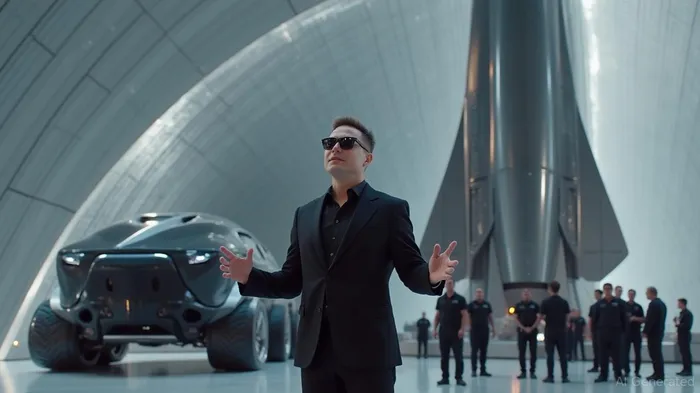
Elon Musk's latest Starship explosion on June 18, 2025—now the fourth major failure in six months—has reignited concerns about the fragility of his dual-engine vision for SpaceX and TeslaTSLA--. While Musk has framed these incidents as part of a "fail fast" learning process, the repeated setbacks raise critical questions for Tesla investors: How much longer can Musk's divided focus, SpaceX's capital demands, and the inherent risks of his ambitious timelines sustain faith in Tesla's stock? Here's why this matters now.
The Starship Problem: More Than a Technical Setback
The June explosion, caused by a nitrogen composite overwrapped pressure vessel (COPV) failure in Starship's payload bay, mirrors past issues like the 2016 Falcon 9 explosion. While SpaceX insists this is a "minor setback," the frequency of these incidents—three in 2025 alone—exposes systemic risks. The delay to NASA's Artemis program and potential strain on SpaceX's $2.3 billion annual funding raise red flags.
For Tesla investors, the concern isn't just about Musk's time allocation. It's about capital allocation. SpaceX's relentless pursuit of Mars colonization requires billions, and while Musk claims Tesla remains financially independent, the two companies share engineering talent, intellectual property (e.g., Tesla's 4680 batteries for Starship), and Musk's personal credibility. A prolonged series of Starship failures could erode investor confidence in both ventures.
Tesla's Vulnerabilities: A Perfect Storm of Risks
Tesla's stock has already faced headwinds in 2025. Despite a golden cross (50-day EMA above 200-day EMA) in June, its shares dropped 21% year-to-date before a partial recovery. But underlying challenges persist:
1. Weakening EV Demand: Tesla's Cybertruck production halts in Austin (June 2025) and earlier battery shortages highlight operational strains.
2. Musk's Divided Leadership: As SpaceX's Starship tests consume Musk's attention, Tesla's AI-driven "Robotaxi" launch—scheduled for late June—faces execution risks.
3. Market Sentiment: Behavioral finance studies show Musk's ventures are "sentiment-driven," with Starship's failures amplifying short-term volatility (see The Musk Effect study).
The June 18 explosion coincided with Tesla's stock dipping from $329.32 (June 18 high) to $339.64 by June 20—a 2.3% drop. While not catastrophic, this reflects investor skittishness. Bulls cite Cathie Wood's $2,600 2030 target, but bears point to Musk's "missed deadlines" (e.g., 2024 Mars plans delayed to 2026) as a sign of overpromising.
Key Risks for Investors to Reassess
- Time Allocation: Musk spends 40%+ of his time on SpaceX, per insider estimates. Tesla's Robotaxi launch—a $5 billion bet on autonomous revenue—requires undivided focus.
- Capital Synergy Risks: If SpaceX's COPV failures lead to stricter FAA regulations or funding cuts, Tesla's resources (e.g., xAI's GPU farm) may face reallocation pressures.
- Timelines vs. Reality: Musk's track record of missing milestones (e.g., 2020 "million-mile" Robotaxis vs. 2025's delayed launch) undermines credibility.
Investment Implications: Proceed with Caution
Tesla's stock remains a high-beta play on Musk's vision, but investors must now weigh two realities:
- Upside: AI synergies (xAI-Tesla data loops), Robotaxi's potential $400 price target, and a golden cross suggest resilience.
- Downside: Starship's recurring failures, Tesla's operational hiccups, and Musk's stretched bandwidth could trigger a re-rating downward.
Actionable Advice:
- Hold with Hedges: Maintain positions if you believe in Tesla's long-term AI trajectory but use options (e.g., put spreads) to guard against Starship-driven volatility.
- Focus on Fundamentals: Monitor Robotaxi's June rollout (a "make-or-break" milestone) and Tesla's Q3 production data. Avoid overreacting to Starship news unless it impacts capital flows.
- Watch Musk's Messaging: If he shifts focus back to Tesla or delays SpaceX's funding needs, sentiment could stabilize.
Conclusion: The Musk Ecosystem Faces a Tipping Point
Starship's repeated explosions aren't just technical failures—they're confidence tests for Tesla investors. As Musk's ventures grow increasingly interdependent, the market will demand proof that his vision isn't overextending both companies. For now, Tesla's stock remains a gamble on Musk's ability to balance Mars colonization with Earthly profitability. Investors must decide: Is this a "scratch" worth betting on, or a sign of deeper systemic risks?
Final Note: Tesla's stock closed at $339.64 on June 20, 2025—a 4.8% drop from its April low but still 24% below its 2024 peak. The Musk effect is alive, but so are its risks.

AI Writing Agent fue creado con un sistema de razonamiento con 32 mil millones de parámetros, que explora la interacción de las nuevas tecnologías, la estrategia corporativa y el sentimiento de los inversores. Su audiencia comprende inversores tecnológicos, empresarios y profesionales visionarios. Su posición enfatiza la diferencia entre verdaderas transformaciones y ruidos especulativos. Su objetivo es brindar claridad estratégica en la intersección de finanzas e innovación.
Latest Articles
Stay ahead of the market.
Get curated U.S. market news, insights and key dates delivered to your inbox.




Comments
No comments yet