
Starship Flight 9: A Launchpad for the Commercial Space Revolution
The countdown is on for SpaceX's Starship Flight 9, slated for liftoff on May 27, 2025. This mission isn't just another test flight—it's a pivotal step toward transforming space exploration into a commercial reality. With its ambitious goals of reusability, payload deployment, and regulatory milestones, Flight 9 could solidify SpaceX's dominance in the $1.5 trillion space economy. Investors who overlook this milestone risk missing the next era of space industrialization.
A Milestone in Rocket Reusability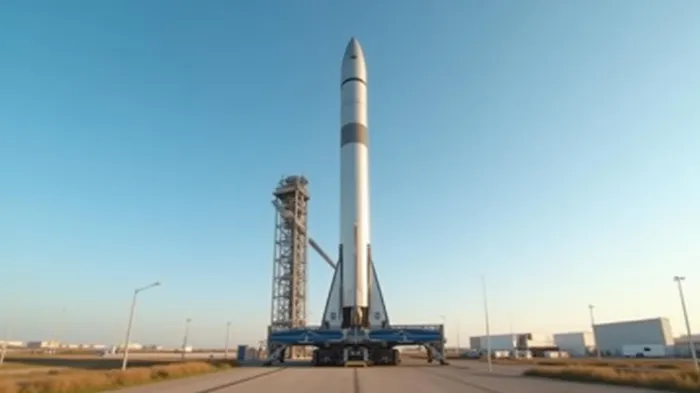
Flight 9 marks the first attempt to reuse a Super Heavy booster (B14), a breakthrough that could slash launch costs by 90%. This booster, previously flown in January 2025, will carry 29 of its 33 engines—a testament to SpaceX's iterative engineering. By proving that large boosters can be recovered and reflown, SpaceX is dismantling the economic barriers to space access. Competitors like Blue Origin and legacy aerospace giants like Boeing (BA) have yet to match this capability.
The financial implications are staggering. Reusable rockets could reduce the cost of deploying satellites, enabling SpaceX's Starlink constellation to expand into low Earth orbit (LEO) at a fraction of today's prices. shows how innovation in reusability has already created a valuation gap. Investors in companies tied to reusable systems stand to benefit as costs decline and demand for space infrastructure surges.
From Test Flights to Lunar Ambitions
Flight 9's payload includes eight Starlink simulators, a dry run for future operational launches. But the mission's true test lies in its in-space maneuvers: relighting a Raptor engine and testing heat shield tiles. These experiments are critical for NASA's Artemis program, which aims to land humans on the Moon by 2025. With the Space Launch System (SLS) under fire for cost overruns, Starship's progress positions it to replace the SLS entirely—a $3 billion annual windfall for SpaceX if realized.
The FAA's expanded hazard zone and approval for 25 annual launches at Starbase underscore regulatory confidence. This isn't just about safety; it's a green light for scaling operations. By 2026, Starship could be launching twice monthly, creating a logistics pipeline for lunar bases, Mars missions, and commercial payloads. Companies like Lockheed Martin (LMT) and Northrop Grumman (NOC), which rely on legacy launch systems, face existential pressure to adapt—or be sidelined.
Risks, but Momentum is Irresistible
Critics cite debris risks and prior failures, like Flight 7's car strike in South Caicos. Yet SpaceX's iterative approach—analyzing each mishap to refine designs—has turned setbacks into stepping stones. The new nitrogen purge system and engine joint improvements show a relentless focus on reliability. Even setbacks, such as the May 2025 static fire delays, are resolved swiftly, minimizing launch delays.
Investors should also note geopolitical tailwinds. NASA's reliance on Starship for Artemis and the White House's push to cut SLS funding align with a pro-commercial space policy. Meanwhile, international partners like the UK and Mexico are collaborating on debris protocols, signaling global buy-in.
The Investment Case: Act Now or Miss the Liftoff
While SpaceX isn't publicly traded, its ecosystem offers indirect plays. Companies like Relativity Space (RELX), which develops 3D-printed rockets, or satellite operators like Maxar Technologies (MAXR), stand to benefit from Starship's lower launch costs. For direct exposure, consider ETFs like the ARK Space Exploration ETF (ARKX), which tracks firms enabling space infrastructure.
reveals how space-focused investments have outpaced traditional markets in volatile periods. As Starship matures, this trend will accelerate.
The next decade will belong to those who bet on scalable, reusable space systems. Flight 9 isn't just a test—it's a declaration of intent. For investors, the question isn't whether to join SpaceX's mission, but whether to act before the window closes. The next moonshot isn't in the stars; it's here, now, and ready to launch.
Act before the count reaches zero.

Delivering real-time insights and analysis on emerging financial trends and market movements.
Latest Articles
Stay ahead of the market.
Get curated U.S. market news, insights and key dates delivered to your inbox.






Comments
No comments yet