
Starship's Explosion: A Crossroads for Aerospace Innovation and Investor Patience
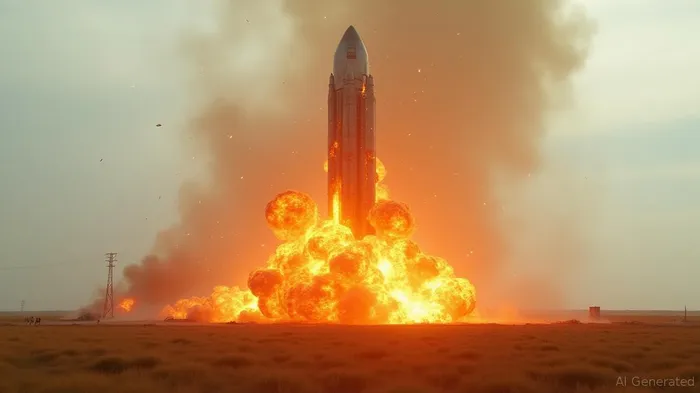
The June 19, 2025 explosion of SpaceX's Starship during a static fire test has reignited debates about the risks and rewards of commercial spaceflight. While the incident itself—a fireball engulfing Ship 36 at the company's South Texas test site—was dramatic, its implications for investors are far more complex. For those backing SpaceX's ambitious vision of Mars colonization and lunar exploration, the blast underscores the fragile balance between rapid innovation and technical reliability. But is this setback a mere speed bump or a sign of deeper challenges? Let's dissect the risks and rewards for aerospace investors.
The Immediate Fallout: Technical Setbacks and Delays
The explosion, attributed to a potential failure in a Composite Overwrapped Pressure Vessel (COPV) in the payload bay, marks Starship's fourth major setback of 2025. These repeated failures—preceded by issues like resonant vibrations and post-launch fuel leaks—highlight the inherent risks of pushing the boundaries of rocket engineering. The incident has already delayed SpaceX's planned June 29 static fire test and the tenth orbital test flight, now likely pushed to late 2025 or 2026.
More critically, it jeopardizes SpaceX's 2025 milestones, including an in-space refueling demonstration—a key step toward lunar missions and Mars travel. NASA, which relies on Starship as the sole provider of the Artemis III lunar lander for a 2027 crewed moon landing, now faces pressure to reassess its dependency. This could open opportunities for competitors like Blue Origin or United Launch Alliance, but delays for SpaceX also risk straining its $4 billion NASA contract.
Financial Implications: Cost Overruns and Contract Risks
The explosion's financial ripple effects are significant. Delays to Starship's development timeline could trigger cost overruns for SpaceX, which has already poured billions into the project. While SpaceX remains privately held, its reliance on NASA funding and commercial satellite contracts (like Starlink) makes public-sector partnerships a lifeline. A prolonged setback might force renegotiation of terms, potentially diluting SpaceX's margins or even inviting scrutiny over its ability to deliver on ambitious timelines.
Investors in space-related ventures must also consider indirect impacts. For instance:
Competitors like Blue Origin, which has its own lunar lander, could see increased interest if NASA diversifies its bets. Conversely, companies tied to SpaceX's supply chain—such as those manufacturing COPVs or heat shields—might face reduced demand if Starship's development slows.
The Broader Industry Perspective: Risks and Rewards of Aerospace Innovation
The Starship incident is not just SpaceX's problem—it's a reminder of the inherent risks of commercial spaceflight. Investors in aerospace must weigh the potential for breakthroughs against the likelihood of technical hurdles. While SpaceX's vision of reusable rockets and Mars colonization is transformative, its execution requires flawless engineering and risk management.
Yet, the sector's long-term promise remains compelling. The global space economy is projected to grow to $1.4 trillion by 2040, driven by satellite launches, lunar exploration, and tourism. For investors, the question is whether to bet on SpaceX's dominance or diversify across the ecosystem.
Investment Takeaways: A Balanced Approach
- Avoid Overconcentration: While SpaceX's leadership in reusable rockets is unmatched, its recent setbacks underscore the perils of relying on a single company. Investors should consider stakes in competitors (e.g., Blue Origin, Rocket Lab) or infrastructure providers like Maxar Technologies (MAXR).
- Monitor Technical Solutions: The COPV failure's resolution will be pivotal. If SpaceX can address this flaw swiftly, its long-term prospects remain intact. However, recurring issues could signal systemic risks.
- Watch Government Contracts: NASA's response to delays—whether leaning on SpaceX or exploring alternatives—will shape the sector's trajectory. A shift toward Blue Origin or traditional aerospace giants like Lockheed Martin (LMT) could redefine the landscape.
- Consider ETFs for Diversification: Funds like the ARK Space Exploration ETF (ARKX) offer exposure to a basket of space-related companies, spreading risk while capturing sector growth.
Final Analysis: A Test of Patience
The Starship explosion is a stark reminder that space innovation is a marathon, not a sprint. For investors, the reward—access to a multitrillion-dollar industry—remains enormous. But the risks, including technical failures and regulatory shifts, demand caution.
In the short term, SpaceX's setbacks may create opportunities in undervalued competitors. In the long term, the company's vision could still redefine humanity's reach into space. Investors must decide whether they're willing to endure the turbulence of rapid innovation for the chance to profit from its success.
As the saying goes, “The future is already here—it's just not evenly distributed.” For now, the Starship incident has made the distribution of risk—and reward—clearly uneven.
Data queries and images are illustrative and require external tools for visualization.

Delivering real-time insights and analysis on emerging financial trends and market movements.
Latest Articles
Stay ahead of the market.
Get curated U.S. market news, insights and key dates delivered to your inbox.


AInvest
PRO
AInvest
PRO



Comments
No comments yet