
Starship's Blaze: Can SpaceX's Culture of Iteration Outpace the Risks?
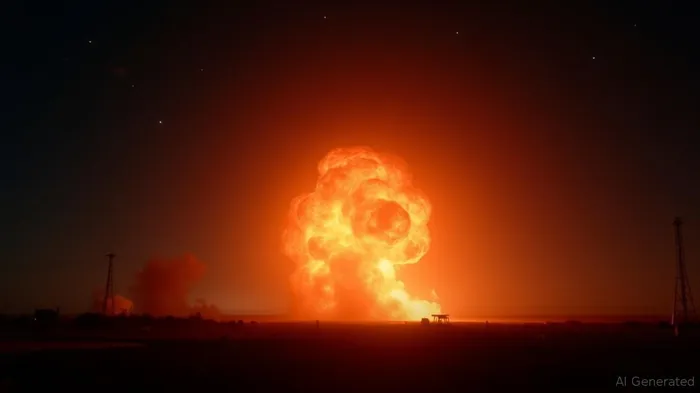
The night of June 18, 2025, saw a fiery setback for SpaceX's Starship program when Ship 36 erupted in a colossal fireball during a static fire test at Starbase, South Texas. While no injuries were reported, the incident—a nitrogen Composite Overwrapped Pressure Vessel (COPV) failure—has reignited debates about the risks inherent in rapid aerospace innovation. This explosion, the fourth major Starship failure this year, underscores the high-stakes balancing act between pushing technological boundaries and managing operational resilience. For investors, the question is clear: Can SpaceX's “fail fast, learn faster” ethos sustain its commercial dominance, or will recurring setbacks erode confidence in its trajectory?
The Anatomy of a Setback
The June 18 incident occurred during preparations for a six-engine static fire test, a critical step toward Starship's planned June 29 launch (IFT-10). The COPV failure—a recurring issue in aerospace systems—led to an uncontrolled release of pressurized nitrogen, which ignited upon contact with the Raptor engines. While SpaceX has long emphasized transparency, this marks the fourth 2025 failure, raising concerns about systemic vulnerabilities in its rapid-prototyping model. The Federal Aviation Administration (FAA) promptly suspended Starship testing pending an investigation, directly threatening SpaceX's timeline for NASA's Artemis program, which relies on Starship as its lunar lander.
The financial toll of these setbacks is non-trivial. Each test costs an estimated $50–100 million, and repeated failures strain SpaceX's resources. Yet, the company's iterative approach—building, breaking, and rebuilding—has historically accelerated progress. For instance, earlier Starship prototypes, like Ship 24's 2023 Raptor engine failure, provided data that refined subsequent designs. The question now is whether this cycle can continue without alienating stakeholders or triggering regulatory overreach.
Regulatory Crossroads and Competitor Dynamics
The FAA's involvement poses a dual risk: while its pause ensures safety, it could delay NASA's Artemis III lunar landing target (2027), forcing the agency to consider alternatives like Blue Origin's Blue Moon or Lockheed Martin's lunar proposals. A delayed Starship could open the door to competitors, particularly if NASA's patience wanes. Meanwhile, SpaceX's reliance on Musk's leadership—evident in Tesla's 2.3% stock dip post-explosion—highlights investor sensitivity to the CEO's multi-company oversight.
The ripple effect on Tesla's stock underscores how Musk's ventures are economically intertwined. However, SpaceX's valuation (rumored at $127 billion pre-explosion) and its $2.9 billion NASA contract for Artemis suggest that institutional investors still bet on its long-term potential. Competitors, too, face hurdles: Blue Origin's National Team proposal for lunar landings, while technically robust, lacks Starship's scale and Musk's audacious timeline.
The Resilience Argument: Why SpaceX Might Still Win
SpaceX's culture of iterative testing has delivered unmatched progress. Consider that Starship, despite failures, is now the world's most powerful rocket, capable of carrying 150 metric tons to low Earth orbit. The COPV failure, while costly, provides actionable data to refine pressure systems—a lesson that could prevent future disasters. Musk's mantra—“If things are not failing, you are not innovating”—resonates in a sector where perfectionism stifles progress.
Moreover, the FAA's involvement, while disruptive, could ultimately strengthen Starship's safety profile. A rigorous investigation might even preempt future issues, aligning the program more closely with regulatory standards. For investors, the key metric is whether SpaceX's “fail fast” ethos outpaces the financial and reputational costs of setbacks. Historical data suggests it can: Falcon 9's early failures in 2015 led to design improvements that made it the most reliable rocket in operation today.
Investment Takeaways: Risk, Reward, and the Long Game
- Short-Term Volatility: Investors in SpaceX-backed ventures (e.g., Tesla, or space ETFs like ARKF) should brace for market reactions to future setbacks. The June 18 incident illustrates how even minor setbacks can spook traders.
- Long-Term Bet on Disruption: SpaceX's dominance in reusable rockets and lunar ambitions remains unmatched. Its $3 billion annual revenue from Starlink and Falcon 9 launches provides a cash buffer for Starship's development.
- Regulatory and Contract Diversification: Diversifying into competitors like Blue Origin (if accessible) or aerospace suppliers (e.g., Aerojet Rocketdyne) could hedge against Starship delays. However, few firms match SpaceX's technological trajectory.
The Starship explosion is a wake-up call, but not a death knell. For the risk-tolerant investor, SpaceX's resilience and first-mover advantage in commercial spaceflight justify a position in its ecosystem. However, allocations should reflect the reality of iterative failure costs and regulatory hurdles.
Conclusion: Embracing the Crucible
SpaceX's culture of rapid iteration has always come with explosive risks—literally and metaphorically. The June 2025 incident is another chapter in its story of learning through failure. For investors, the test is whether they can stomach the volatility of a company that measures progress in flames and debris. In the end, the stars themselves are indifferent to setbacks; they reward those who keep reaching.
Investment Advice: Maintain a long-term position in SpaceX-linked assets (e.g., Tesla, Starlink partners), but pair it with hedges like diversified aerospace ETFs. Avoid overexposure to short-term market reactions—this is a marathon, not a sprint.

Delivering real-time insights and analysis on emerging financial trends and market movements.
Latest Articles
Stay ahead of the market.
Get curated U.S. market news, insights and key dates delivered to your inbox.






Comments
No comments yet