
Starlink's Strategic Infrastructure Growth: Reshaping Global Broadband and Tech Valuations
 Aime Summary
In the past decade, the digital divide has been one of the most persistent challenges in global economic development. However, SpaceX's Starlink satellite program is now at the forefront of a technological revolution that could bridge this gap—and redefine the value of the tech sector in the process. By leveraging strategic infrastructure expansion, advanced partnerships, and a vision for ubiquitous connectivity, Starlink is not only addressing immediate demand for broadband but also laying the groundwork for a future where satellite internet becomes a cornerstone of global communications.
Strategic Infrastructure: Building a Resilient Network
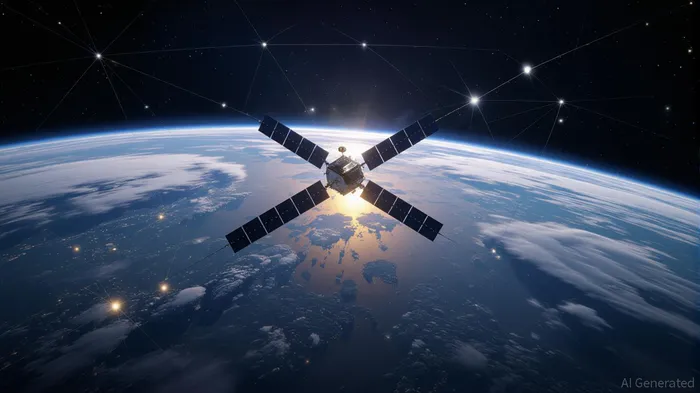
Starlink's growth in 2025 has been nothing short of transformative. With over 7,800 satellites in orbit—primarily in low Earth orbit (LEO)—the program has achieved sub-25 millisecond latency and download speeds of 100s of Mbps, rivaling terrestrial broadband in many regions. This performance is underpinned by a strategic focus on infrastructure:
- Gateway Sites and Optical Links: Over 100 gateway sites in the U.S. alone, coupled with 1,500 advanced antennas, ensure low-latency connections. Starlink's satellites also use optical inter-satellite links to relay hundreds of gigabits of data, creating a self-healing network that adapts to disruptions.
- Polar Orbit Expansion: By 2025, Starlink plans to launch 400 new satellites into polar orbits to enhance coverage in high-latitude regions like Alaska, addressing a critical gap in global connectivity.
- Second-Generation Satellites: These next-gen satellites are four times more powerful than their predecessors, enabling 5 terabits per week of new capacity. This scalability ensures Starlink can meet surging demand as it expands into maritime, aviation, and mobile sectors.
Such infrastructure investments are not just technical feats—they are strategic moves to create a network that is both resilient and adaptable, ensuring Starlink can maintain its edge as demand grows.
Market Dynamics: From Niche to Mainstream
The financial and market implications of Starlink's expansion are profound. By 2025, the satellite internet market is projected to grow from $10.4 billion in 2024 to $22.6 billion by 2030, with a compound annual growth rate (CAGR) of 13.9%. Starlink itself is a key driver of this growth, generating $11.8 billion in 2025 revenue and on track to reach $15.5 billion by year-end. Its subscriber base has surged to 6 million globally, with 2 million in the U.S. alone, and it is projected to reach 7.8 million by 2025.
This growth is not confined to consumer markets. Starlink's partnerships with telecom giants like T-MobileTMUS-- and VodafoneVOD-- are integrating satellite connectivity into 5G networks, while its Direct-to-Cell (DTC) technology is eliminating mobile dead zones. For example, T-Mobile's “T-Satellite” service, launched in July 2025, is being extended to VerizonVZ-- and AT&T customers, signaling a shift toward hybrid terrestrial-satellite networks. These moves position Starlink to capture a significant share of the $1.2 trillion global telecom market by 2030.
Tech Sector Valuations: A New Benchmark
The rise of Starlink is forcing a reevaluation of how the tech sector values connectivity infrastructure. Traditional broadband providers and satellite companies are now racing to match Starlink's performance, driving innovation and competition. For instance, Amazon's Project Kuiper and OneWeb are accelerating their LEO deployments, but Starlink's head start—combined with its cost-effective ground terminals and D2D capabilities—gives it a structural advantage.
Investors are taking note. SpaceX's valuation has surpassed $180 billion, with Starlink accounting for a large portion of this. The program's success has also spurred investment in adjacent sectors:
- Hardware and Ground Equipment: Companies like Kymeta and L3HarrisLHX-- are seeing increased demand for phased-array antennas and terminal components.
- Cloud and Edge Computing: Low-latency satellite networks enable real-time applications like cloud gaming and remote surgery, attracting partnerships with AWS and Azure.
- Regulatory and Sustainability Solutions: As orbital debris and spectrum management become critical issues, firms specializing in compliance and sustainability (e.g., LeoLabs) are gaining traction.
Investment Implications: Where to Position?
For investors, Starlink's trajectory highlights opportunities across multiple sectors:
1. Direct Exposure to SpaceX: While SpaceX remains private, secondary markets and venture capital investments offer indirect access. Its valuation multiple (25.8x 2025 revenue) suggests strong growth expectations.
2. Public Partners and Suppliers: T-Mobile's stock has gained momentum as it integrates Starlink into its 5G strategy. Similarly, ViasatVSAT-- and Hughes Network Systems are adapting to LEO-driven competition by diversifying into hybrid systems.
3. Supply Chain Plays: Semiconductor firms (e.g., NXP Semiconductors) and aerospace manufacturers (e.g., BoeingBA--, Lockheed Martin) are critical to satellite production and ground infrastructure.
4. Thematic ETFs: Funds focused on space technology (e.g., ARKX) or 5G/6G infrastructure (e.g., VGT) offer diversified exposure to the satellite broadband boom.
However, risks remain. Affordability in low-income regions, regulatory hurdles in countries like India and Brazil, and the sustainability of orbital debris management could temper growth. Investors should prioritize companies with strong regulatory partnerships and cost-cutting innovations.
The Long-Term Outlook
By 2030, satellite broadband is expected to become as ubiquitous as cellular networks, driving trillions in economic value. Starlink's strategic infrastructure growth—coupled with its ability to integrate with 5G, AI, and edge computing—positions it as a foundational layer of the global digital infrastructure. For the tech sector, this means a redefinition of connectivity as a core utility, with valuations increasingly tied to scalability, sustainability, and adaptability.
The key for investors is to balance short-term volatility with long-term secular trends. Those who position early in infrastructure, hardware, and regulatory frameworks will be best poised to capitalize on the next decade of disruption. In a world where connectivity is no longer a luxury but a necessity, Starlink's infrastructure is not just a satellite network—it is a blueprint for the future of global communications.

Delivering real-time insights and analysis on emerging financial trends and market movements.
Latest Articles
Stay ahead of the market.
Get curated U.S. market news, insights and key dates delivered to your inbox.




Comments
No comments yet