
Starlink's LEO Dominance: Why SpaceX is Poised to Lead the Satellite Broadband Revolution
 Aime Summary
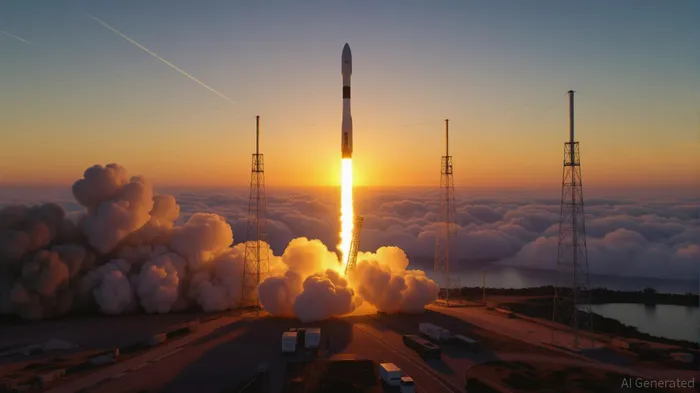
The July 15, 2025, launch of 26 Starlink V2 Mini satellites from Vandenberg Space Force Base marks another critical step in SpaceX's quest to commercialize Low Earth Orbit (LEO). This mission, the 30th orbital launch from California this year, underscores a scalable infrastructure model that could cement SpaceX's long-term market dominance in satellite broadband. Investors should take note: Starlink's rapid network expansion, regulatory head start, and cost-efficient launch cadence position it to capitalize on a $200 billion global broadband market by 2030.
The Catalyst: Network Expansion at Scale
The July 15 launch brought the total number of Starlink satellites in orbit to over 7,950, with 26 more joining the constellation. Notably, these V2 Mini satellites are 3x heavier than their predecessors, equipped with advanced argon Hall thrusters and E-band backhaul capabilities. These upgrades nearly quadruple data capacity per satellite, enabling higher speeds and lower latency—critical for applications like rural healthcare, emergency response, and enterprise cloud computing.
Crucially, SpaceX's reusable Falcon 9 boosters (e.g., B1093's fourth flight) reduce launch costs to ~$30 million per flight, far below competitors like United Launch Alliance's Vulcan (~$80 million). This cost advantage allows SpaceX to deploy satellites at a pace rivals cannot match: Starlink now launches roughly 1,200 satellites annually, compared to OneWeb's 600 and AmazonAMZN-- Kuiper's 400.
Regulatory and Strategic Advantages
The FCC has already greenlit SpaceX to deploy 12,000 satellites, but Elon Musk aims for 30,000+ in the coming decade. This headroom is unmatched: OneWeb has approval for 47,844 satellites but lacks the launch capacity, while Kuiper's 3,236-satellite plan faces delays. Regulatory hurdles, such as spectrum allocation and orbital debris mitigation, favor SpaceX's first-mover status. For instance, Starlink's visors to reduce light pollution address environmental concerns, while its 5-year satellite lifespan ensures most debris burn up on reentry—a stark contrast to competitors' slower regulatory responses.
Competitive Edge: The Tipping Point for Market Share
Amazon's Kuiper and OneWeb are already playing catch-up. Kuiper's first launch was delayed until July 2025, and its satellites lack the propulsion efficiency of Starlink's V2 Minis. OneWeb, partially owned by the UK government, operates a smaller 650-satellite network but struggles with funding and geopolitical tensions (e.g., sanctions limiting its Russian-derived launch sites). Meanwhile, Starlink's direct-to-consumer sales (with over 2 million terminals deployed) and partnerships (e.g., AquaChile's salmon farms) are building brand loyalty in underserved markets.
The addressable market is vast: 3 billion people lack reliable internet access. Starlink's $1,200 terminal cost (planned to drop to $500 by 2026) makes it accessible for rural households and governments. By 2030, SpaceX could capture 60%+ of the LEO broadband market, turning Starlink into a cash flow juggernaut.
Investment Thesis: Buy the Leader in LEO
Investors should consider SpaceX's equity (indirectly via TeslaTSLA-- or potential SPAC listing) or play the ecosystem through suppliers like Maxar Technologies (MAXR) (satellite components) or Rocket Lab (RKLB) (small launch vehicles). However, the clearest path is to back SpaceX's direct growth. Key metrics to watch:
- Satellite deployment pace: Track launches via .
- Regulatory wins: FCC approvals for Starlink's V2 Mega satellites (set for Starship launches in 2026).
- Terminal sales growth: A 50% annual increase would validate mass adoption.
Risks remain—geopolitical pushback (e.g., China's rival constellation), orbital debris lawsuits, and spectrum disputes. Yet SpaceX's engineering prowess and Musk's track record of overcoming obstacles mitigate these concerns.
Conclusion
The July 15 launch wasn't just another rocket flight; it was a demonstration of SpaceX's industrial might. With a constellation nearing 8,000 satellites, a reusable rocket monopoly, and a first-mover advantage in regulatory and commercial domains, Starlink is on course to monopolize LEO broadband. For investors, this is a generational opportunity: back the company redefining global connectivity, or risk missing the next trillion-dollar industry. The LEO gold rush is underway—and SpaceX is already the king of the mine.

Delivering real-time insights and analysis on emerging financial trends and market movements.
Latest Articles
Stay ahead of the market.
Get curated U.S. market news, insights and key dates delivered to your inbox.
AInvest
PRO
AInvest
PRO



Comments
No comments yet