
Starlink's Ascendancy: Why LEO Satellites are Redefining Global Connectivity and Investment Opportunities
The global satellite internet market is undergoing a tectonic shift, driven by SpaceX's relentless expansion of its Starlink constellation. With over 7,950 operational satellites as of July 2025 and a launch cadence that deploys ~2,300 satellites annually, Starlink has solidified its position as the undisputed leader in Low Earth Orbit (LEO) constellations. This article examines the strategic advantages of SpaceX's approach, its regulatory milestones, and the implications for investors seeking exposure to this transformative sector.
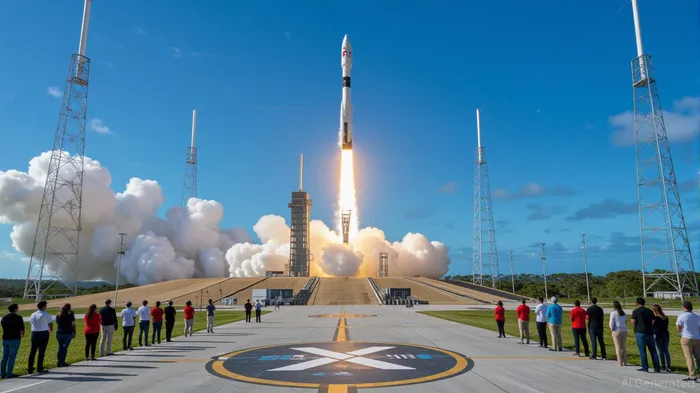
Operational Efficiency: The Rocket Factory Advantage
SpaceX's operational excellence is its cornerstone. By reusing Falcon 9 boosters—such as the B1093 stage that flew its fourth Starlink mission on July 15—SpaceX has reduced launch costs to ~$10M per flight, far below competitors. This efficiency enables Starlink to deploy satellites at a rate of one launch per week, with each mission carrying 26-50 satellites. The result? A constellation that has grown from 1,200 satellites in 2021 to over 7,950 today, outpacing rivals by orders of magnitude.
Regulatory Milestones: A Blueprint for Global Dominance
Starlink's rapid growth is underpinned by its regulatory foresight:- FCC Approvals: The FCC has greenlit 12,000 Starlink satellites, with SpaceX already exceeding this threshold by deploying over 7,950 operational satellites. The company is now seeking approval for 30,000+ additional satellites, aiming to reach 42,000 total.- Global Licensing: Starlink operates in 125 countries, including markets like the EU, India, and Southeast Asia, where it faces minimal regulatory pushback. In contrast, Amazon's Kuiper has only secured 27 satellites in orbit and may need FCC extensions to meet its 2026 deadline.- Environmental Compliance: Despite concerns over alumina pollution during satellite reentry, Starlink's second-generation satellites (V2) now feature burnable components to mitigate atmospheric damage, aligning with regulatory requirements.
Competitive Positioning: The Gap Widens
While Starlink surges ahead, its competitors lag:- OneWeb (Eutelsat): Now part of the Eutelsat Group, OneWeb operates a 648-satellite constellation but faces two key disadvantages: its higher orbital altitude (1,200 km vs. Starlink's 550 km) increases collision risks and reduces latency, while its lack of inter-satellite links limits scalability.- Amazon's Kuiper: Despite $10B+ invested, Kuiper has only launched 27 satellites as of July 2025. Its reliance on SpaceX for launches underscores its logistical challenges, and it may miss its 2026 deployment deadline without FCC leniency.
Revenue Streams: From 6M Users to Enterprise Goldmines
Starlink's recurring revenue model is already robust, with 6M subscribers generating ~$2B/year in revenue. However, its true potential lies in:1. Enterprise & Government Contracts: Starlink is securing agreements with militaries (e.g., U.S. Army's $1.2B deal) and remote industries (mining, shipping) to provide reliable connectivity in harsh environments.2. Global Digital Sovereignty: The EU's €10.6B IRIS² project highlights geopolitical demand to counter Starlink's dominance, creating opportunities for suppliers to IRIS²'s infrastructure.3. 5G and Disaster Recovery: Starlink's low latency (<20ms) makes it ideal for 5G backhaul and emergency networks, with demand surging post-natural disasters.
Investment Opportunities: Beyond SpaceX
While SpaceX itself is not publicly traded, several equities and sectors stand to benefit:1. Satellite Manufacturers: - Maxar Technologies (MAXR): Supplies ground stations and satellite components. - Harris Corporation (HRS): Provides advanced antenna systems for LEO constellations.2. Launch Infrastructure: - Boeing (BA): Partners with United Launch Alliance (ULA) for Kuiper and OneWeb launches.3. Semiconductors: - Analog Devices (ADI): Supplies high-performance chips for satellite electronics.4. Geopolitical Plays: - Eutelsat (ETE.PA): Benefits from OneWeb's merger and EU-funded projects.
Risks and Considerations
- Regulatory Backlash: Ongoing debates over radio interference with astronomy (e.g., Vera Rubin Observatory) could delay approvals for future satellites.
- Environmental Concerns: Alumina pollution from satellite reentries remains unresolved, though Starlink claims its V2 models address this.
- Market Saturation: Competition from IRIS² and regional projects (e.g., China's Hongyan) may limit Starlink's global monopoly.
Conclusion: A New Space Race Economy
LEO constellations are no longer a "moonshot"—they're a $500B+ market by 2030. Investors should focus on supply chain leaders like MAXR and HRS, while monitoring geopolitical plays through ETE.PA. For those willing to take calculated risks, early-stage equities in 5G backhaul or disaster tech could yield outsized returns. As Starlink's third-generation satellites (V3) promise 1 Tbps capacity per satellite, the race to dominate the sky—and the data it carries—is just beginning.
Final thought: The company that controls the LEO bandwidth controls the next digital frontier.

Delivering real-time insights and analysis on emerging financial trends and market movements.
Latest Articles
Stay ahead of the market.
Get curated U.S. market news, insights and key dates delivered to your inbox.


AInvest
PRO
AInvest
PRO



Comments
No comments yet