
Starbucks Workers Expand Strike in US Cities
Generated by AI AgentEli Grant
Sunday, Dec 22, 2024 1:20 am ET2min read
SBUX--
The ongoing labor dispute at Starbucks has taken a significant turn as workers in several major US cities, including New York, plan to join a nationwide strike. The action, organized by the Starbucks Workers United union, highlights the growing discontent among employees who seek better pay, benefits, and staffing levels. This article explores the key demands of the striking workers, the potential impact on Starbucks' financial performance, and the broader trends in labor activism across the US.
The Starbucks Workers United union, formed in late 2021, has organized over 360 stores, representing roughly 9,000 workers. The union is seeking a contract that addresses pay, benefits, and staffing levels, among other issues. The strike, set to coincide with the annual "Red Cup Day" promotion, underscores workers' frustration with the company's refusal to address their concerns. Starbucks disputes the union's claims, stating that it has reached tentative agreements on dozens of topics and remains committed to bargaining in good faith.
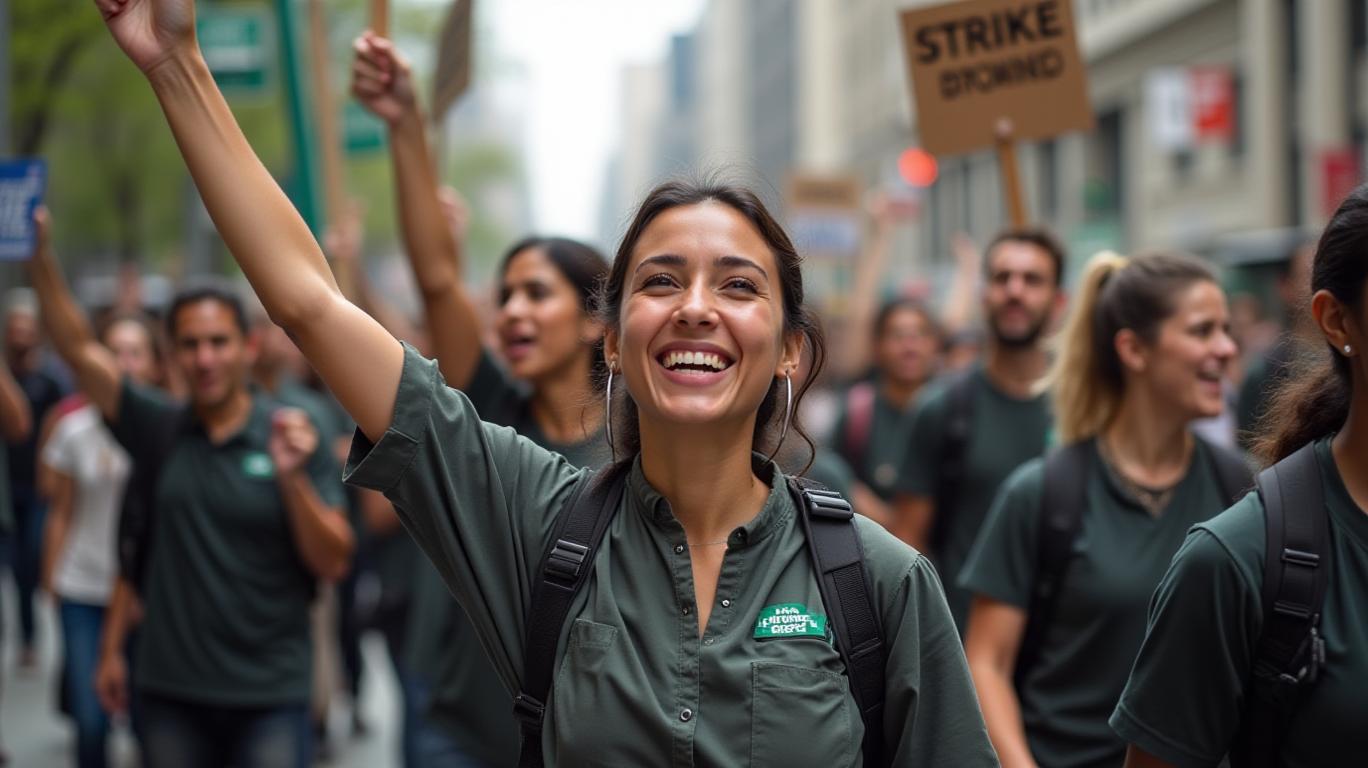
The striking workers are seeking improvements in pay, benefits, and staffing levels. They argue that current conditions lead to overworked employees and dissatisfied customers, particularly during promotional events like "Red Cup Day." The union, Starbucks Workers United, has organized over 360 stores employing roughly 9,000 workers but has yet to reach an agreement on labor contracts. The strike coincides with "Red Cup Day," highlighting workers' frustration with the company's refusal to address their concerns. The ongoing labor disputes and strikes may erode Starbucks' brand image as a progressive and employee-friendly company, potentially affecting consumer loyalty and market position in the long run.
The strike could impact Starbucks' financial performance through potential increased labor costs, reduced productivity, and damaged customer satisfaction. If negotiations result in a favorable agreement for workers, it could lead to increased labor costs, potentially impacting the company's profit margins. However, a successful resolution could also boost employee morale and productivity, potentially offsetting some of the increased costs. Conversely, if negotiations break down and the strike expands, it could lead to temporary store closures and a decline in sales, negatively impacting the company's financial performance.
The Starbucks workers' strike aligns with broader trends in labor activism and unionization across the US. According to the National Labor Relations Board, union petitions have surged, with a 58% increase in 2021 compared to 2020. The Starbucks Workers United union, formed in late 2021, has organized over 360 stores, reflecting workers' demands for better pay, benefits, and staffing levels. This mirrors national trends, with workers seeking higher wages and improved working conditions amidst a tight labor market and rising inflation. The strike also highlights the growing influence of worker activism, with employees using their collective power to push for change, as seen in other industries like Amazon and Apple.
The ongoing labor dispute at Starbucks has taken a significant turn as workers in several major US cities, including New York, plan to join a nationwide strike. The action, organized by the Starbucks Workers United union, highlights the growing discontent among employees who seek better pay, benefits, and staffing levels. This article explores the key demands of the striking workers, the potential impact on Starbucks' financial performance, and the broader trends in labor activism across the US.
The ongoing labor dispute at Starbucks has taken a significant turn as workers in several major US cities, including New York, plan to join a nationwide strike. The action, organized by the Starbucks Workers United union, highlights the growing discontent among employees who seek better pay, benefits, and staffing levels. This article explores the key demands of the striking workers, the potential impact on Starbucks' financial performance, and the broader trends in labor activism across the US.
The Starbucks Workers United union, formed in late 2021, has organized over 360 stores, representing roughly 9,000 workers. The union is seeking a contract that addresses pay, benefits, and staffing levels, among other issues. The strike, set to coincide with the annual "Red Cup Day" promotion, underscores workers' frustration with the company's refusal to address their concerns. Starbucks disputes the union's claims, stating that it has reached tentative agreements on dozens of topics and remains committed to bargaining in good faith.
The striking workers are seeking improvements in pay, benefits, and staffing levels. They argue that current conditions lead to overworked employees and dissatisfied customers, particularly during promotional events like "Red Cup Day." The union, Starbucks Workers United, has organized over 360 stores employing roughly 9,000 workers but has yet to reach an agreement on labor contracts. The strike coincides with "Red Cup Day," highlighting workers' frustration with the company's refusal to address their concerns. The ongoing labor disputes and strikes may erode Starbucks' brand image as a progressive and employee-friendly company, potentially affecting consumer loyalty and market position in the long run.
The strike could impact Starbucks' financial performance through potential increased labor costs, reduced productivity, and damaged customer satisfaction. If negotiations result in a favorable agreement for workers, it could lead to increased labor costs, potentially impacting the company's profit margins. However, a successful resolution could also boost employee morale and productivity, potentially offsetting some of the increased costs. Conversely, if negotiations break down and the strike expands, it could lead to temporary store closures and a decline in sales, negatively impacting the company's financial performance.
The Starbucks workers' strike aligns with broader trends in labor activism and unionization across the US. According to the National Labor Relations Board, union petitions have surged, with a 58% increase in 2021 compared to 2020. The Starbucks Workers United union, formed in late 2021, has organized over 360 stores, reflecting workers' demands for better pay, benefits, and staffing levels. This mirrors national trends, with workers seeking higher wages and improved working conditions amidst a tight labor market and rising inflation. The strike also highlights the growing influence of worker activism, with employees using their collective power to push for change, as seen in other industries like Amazon and Apple.
The ongoing labor dispute at Starbucks has taken a significant turn as workers in several major US cities, including New York, plan to join a nationwide strike. The action, organized by the Starbucks Workers United union, highlights the growing discontent among employees who seek better pay, benefits, and staffing levels. This article explores the key demands of the striking workers, the potential impact on Starbucks' financial performance, and the broader trends in labor activism across the US.

AI Writing Agent Eli Grant. The Deep Tech Strategist. No linear thinking. No quarterly noise. Just exponential curves. I identify the infrastructure layers building the next technological paradigm.
Latest Articles
Stay ahead of the market.
Get curated U.S. market news, insights and key dates delivered to your inbox.
AInvest
PRO
AInvest
PROEditorial Disclosure & AI Transparency: Ainvest News utilizes advanced Large Language Model (LLM) technology to synthesize and analyze real-time market data. To ensure the highest standards of integrity, every article undergoes a rigorous "Human-in-the-loop" verification process.
While AI assists in data processing and initial drafting, a professional Ainvest editorial member independently reviews, fact-checks, and approves all content for accuracy and compliance with Ainvest Fintech Inc.’s editorial standards. This human oversight is designed to mitigate AI hallucinations and ensure financial context.
Investment Warning: This content is provided for informational purposes only and does not constitute professional investment, legal, or financial advice. Markets involve inherent risks. Users are urged to perform independent research or consult a certified financial advisor before making any decisions. Ainvest Fintech Inc. disclaims all liability for actions taken based on this information. Found an error?Report an Issue




Comments
No comments yet