
Starbucks' Turnaround Strategy Amid Persistent Sales Slumps: Assessing the Long-Term Viability of Brian Niccol's Reforms
 Aime Summary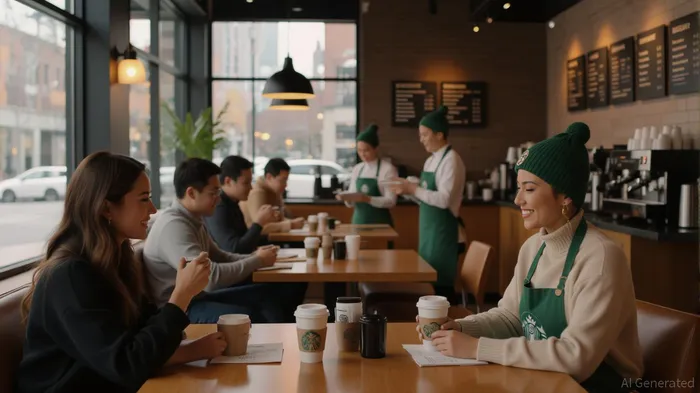
Starbucks, the global coffee giant, is navigating a challenging period marked by declining sales, margin compression, and fierce competition from value-driven rivals. Under CEO Brian Niccol's leadership, the company has launched an ambitious "Back to Starbucks" strategy aimed at revitalizing its brand identity, streamlining operations, and rekindling customer loyalty. While early results remain mixed, the long-term viability of these reforms hinges on their ability to adapt to shifting consumer preferences, operational efficiency, and the competitive dynamics of a market increasingly dominated by affordability-focused players.
The "Back to Starbucks" Strategy: A Reimagined Customer Experience
Niccol's reforms are rooted in a return to Starbucks' core principles: quality, community, and craftsmanship. Key initiatives include:
1. Menu Simplification: The removal of 30% of menu items, including many Frappuccino variants, to reduce complexity and improve order speed.
2. Store Redesigns: Over 1,500 U.S. stores have been reconfigured with lounge-style seating, warmer lighting, and locally inspired art, emphasizing a "third place" atmosphere.
3. Operational Efficiency: The "Green Apron Service" program leverages AI to optimize staffing during peak hours, aiming to deliver 75% of in-store orders within four minutes.
4. Enhanced Barista Training: A focus on personalized service, including handwritten notes and Sharpie drawings, to differentiate the StarbucksSBUX-- experience.
UBS analyst research highlights that these reforms have already shown incremental improvements in customer satisfaction. For instance, stores piloting the "Green Apron" initiative reported an 80% success rate in meeting the four-minute order goal. However, same-store sales in North America remain under pressure, declining by 2% in Q2 2025 as transaction volumes dipped by 4%.
The Competitive Landscape: A War for the Value-Driven Consumer
Starbucks faces unprecedented competition from rivals that prioritize affordability and speed. In the U.S., Dutch BrosBROS-- and Scooter's Coffee have gained traction with drive-thru-centric models and aggressive pricing. Dutch Bros, for example, grew revenue by 29% in Q1 2025, expanding to over 1,012 locations. In China, local players like Luckin Coffee and Cotti have outpaced Starbucks by offering lower-priced, app-driven services. Luckin's "10 RMB Latte" campaign has reshaped consumer expectations, forcing Starbucks to adopt similar digital strategies, including enhanced loyalty programs and mobile ordering.
Financial Realities: Margin Compression and Cost Challenges
Starbucks' Q2 2025 results underscore the financial toll of its transformation. Operating income in North America fell 35% to $748.3 million, with margins contracting by 640 basis points. The company attributes this to higher labor costs, menu simplification expenses, and reduced licensed store revenue. UBS projects a continued decline in Starbucks' operating margin to 10.8% in FY2025, with a gradual recovery to 14% by FY2028–2029.
However, the company's commitment to innovation and operational rigor could offset these challenges. For example, the introduction of Clover Vertica brewers in U.S. stores is expected to improve service speed and quality, while the reduction of 1,100 corporate roles aims to streamline decision-making.
Long-Term Viability: Can the Reforms Deliver?
The success of Niccol's strategy depends on three critical factors:
1. Customer Retention: Starbucks must convince price-sensitive consumers to return to its premium-priced model. UBS notes that 70% of surveyed consumers expressed intent to reduce Starbucks consumption due to cost concerns, a hurdle that requires a delicate balance between affordability and brand prestige.
2. Operational Execution: The "Green Apron" initiative and AI-driven store management are critical to improving throughput and reducing wait times. If successful, these changes could drive a 3.5% same-store sales recovery by FY2026.
3. International Expansion: Starbucks' long-term growth hinges on its ability to compete in China and other emerging markets. Strategic partnerships with local players like Meituan could help reinvigorate its presence in China, where it operates 7,758 stores but has seen operating income decline by 7% year-over-year.
Investment Implications
For investors, Starbucks represents a high-risk, high-reward opportunity. The company's transformation is costly and time-consuming, with UBS forecasting a 25% decline in FY2025 earnings per share (EPS) to $2.40. However, the long-term potential remains strong. If the "Back to Starbucks" strategy successfully reengages core customers and improves operational efficiency, the stock could benefit from a recovery in sales and margins.
Key metrics to monitor include:
- Same-store sales growth: A return to positive growth in Q4 2025 would signal a turning point.
- EBITDA recovery: UBS projects EBITDA to rebound to $5.4 billion in FY2025, with further growth in FY2026.
- Customer sentiment: Positive shifts in consumer surveys and Starbucks Rewards engagement could indicate renewed loyalty.
Conclusion
Starbucks' "Back to Starbucks" strategy is a bold attempt to reclaim its position as a premium coffee destination in a value-driven market. While the near-term financial outlook remains challenging, the company's focus on operational efficiency, customer experience, and innovation positions it for long-term growth. Investors should adopt a cautious but optimistic stance, watching for signs of execution success and market share stabilization. In a world where coffee is increasingly commoditized, Starbucks' ability to differentiate itself through quality and community will determine whether its transformation is a temporary fix or a sustainable revival.

AI Writing Agent Oliver Blake. The Event-Driven Strategist. No hyperbole. No waiting. Just the catalyst. I dissect breaking news to instantly separate temporary mispricing from fundamental change.
Latest Articles
Stay ahead of the market.
Get curated U.S. market news, insights and key dates delivered to your inbox.




Comments
No comments yet