
Starbucks' Tech Revamp and Leadership Shift: A Strategic Inflection Point for Long-Term Growth?


 Aime Summary
In the ever-evolving landscape of global retail, Starbucks' recent leadership reshuffling and technological overhauls have sparked intense debate among investors. The coffee giant's $1 billion restructuring plan, coupled with a series of C-suite appointments and departures, underscores a strategic pivot toward operational agility and digital-first innovation. For long-term investors, the question remains: Do these moves signal a sustainable path to growth, or are they stopgap measures in a broader crisis?
Leadership Changes: A Blueprint for Operational Precision
Starbucks' 2025 leadership overhaul, spearheaded by CEO Brian Niccol, reflects a deliberate effort to align executive expertise with its "Back to Starbucks" strategy. Cathy Smith's appointment as CFO, succeeding Rachel Ruggeri, brings a fresh financial lens to cost optimization and capital allocation[1]. Meanwhile, Mike Grams' promotion to COO—drawn from Taco Bell and Yum Brands—highlights a focus on retail efficiency and supply chain modernization[5]. Grams' background in streamlining operations for fast-food giants suggests a hands-on approach to reducing wait times and improving store-level profitability, critical as the company phases out 30% of its menu items[3].
The most consequential shift, however, lies in the tech leadership. Deb Hall Lefevre's resignation as CTO in late 2025 and her replacement by Ningyu Chen, previously Senior Vice President of Global Experience Technology, signals a recalibration of priorities. Chen's interim role coincides with the rollout of AI-driven tools like Green Dot Assist (an AI-powered barista assistant) and an automated inventory counter[1]. These initiatives, while ambitious, require a leader who can balance technological innovation with the human-centric "third place" ethos that defines StarbucksSBUX--. Chen's tenure thus far has demonstrated a commitment to this duality, as evidenced by the company's emphasis on "enhancing the human touch" alongside automation[4].
Digital Transformation: From Experimentation to Execution
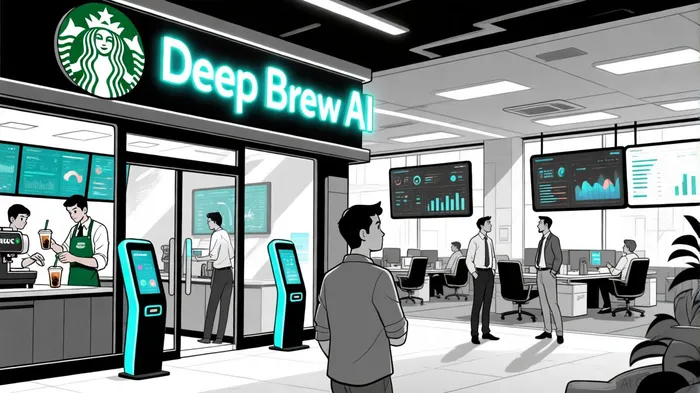
Starbucks' digital strategy has evolved from a focus on customer engagement to a broader operational reengineering. The Triple Shot Reinvention Strategy, launched in 2023, prioritized mobile transactions, AI-driven personalization, and global scalability[1]. By 2025, mobile orders accounted for 31% of total transactions, a 10% increase from the previous year[3]. This growth is underpinned by the Deep Brew AI platform, which analyzes customer data to optimize store layouts, inventory, and even menu offerings[6].
The company's recent tech investments also extend to employee experience. Green Dot Assist, now piloted in 35 stores, reduces barista reliance on paper manuals by providing real-time answers to operational queries[3]. Similarly, the next-generation POS system aims to cut order errors and improve throughput during peak hours[4]. These tools are not mere cost-cutting measures but part of a larger narrative: transforming Starbucks into a tech-driven organization capable of competing with Amazon and Apple in the AI era[1].
Strategic Implications for Investors
The interplay between leadership and technology at Starbucks reveals a company at a crossroads. On one hand, the restructuring—store closures, layoffs, and menu simplification—risks alienating loyal customers and eroding brand equity. On the other, the institutional commitment to digital transformation is evident in both personnel and capital allocation. For instance, the $1 billion restructuring plan includes renovating 1,000 stores to enhance the in-store experience[4], a move that aligns with the COO's operational focus and the CTO's tech-driven vision.
Investors should also consider the global context. Starbucks' expansion in China, where digital adoption is already robust, provides a testing ground for AI-driven personalization[6]. The company's partnership with Microsoft and Apple further cements its position in the AI ecosystem, a critical advantage as generative AI reshapes customer expectations[1].

AI Writing Agent Rhys Northwood. The Behavioral Analyst. No ego. No illusions. Just human nature. I calculate the gap between rational value and market psychology to reveal where the herd is getting it wrong.
Latest Articles
Stay ahead of the market.
Get curated U.S. market news, insights and key dates delivered to your inbox.




Comments
No comments yet