
Starbucks' Strategic Turnaround: Reshaping Consumer Behavior and Stock Performance in the Premium Coffee Sector
 Aime Summary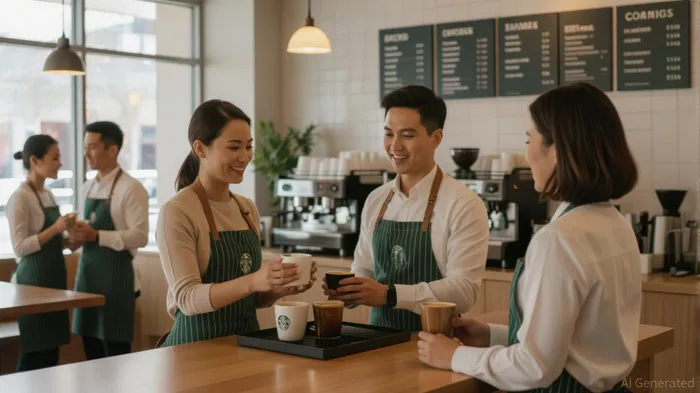
Starbucks is at a pivotal moment in its history. After years of stagnant growth and declining customer satisfaction, the coffee giant has launched a sweeping “Back to Starbucks” strategy under CEO Brian Niccol. This initiative is not just about revamping store aesthetics or tweaking the menu—it's a fundamental rethinking of how the brand connects with consumers in an increasingly competitive premium coffee sector. For investors, the question is whether these changes will translate into sustainable growth or merely delay an inevitable reckoning.
The Brand Reset: From Frappuccinos to Fundamentals
Starbucks' 2025 strategy centers on simplification. The company has eliminated 30% of its menu, including underperforming Frappuccino variants, to streamline operations and reduce order times. This move is not just about efficiency—it's about realigning with the brand's core identity. By reintroducing handwritten notes on cups, ceramic mugs, and a warmer in-store ambiance, StarbucksSBUX-- is betting that emotional connections can drive loyalty in a market saturated with alternatives.
The results so far are mixed. While global same-store sales dipped 2% in Q3 2025, the company reported a 7% reduction in employee turnover and improved customer connection scores, particularly among Gen Z and millennials. These metrics suggest that the brand reset is resonating with its target demographic, even as transaction volumes decline. For investors, the key takeaway is that Starbucks is prioritizing quality over quantity—a risky but potentially rewarding strategy in a sector where differentiation is paramountPARA--.
Operational Overhauls and the Cost of Reinvention
The “Back to Starbucks” plan comes with hefty short-term costs. Store upgrades, increased labor investments, and the Leadership Experience 2025 event—a $0.11-per-share drag on Q3 earnings—have compressed operating margins. GAAP EPS fell 47% year-over-year, and non-GAAP margins contracted by 660 basis points. These figures are alarming, but they reflect a deliberate trade-off: sacrificing near-term profitability for long-term resilience.
The company is also reinvesting in its workforce, with $500 million allocated to additional labor hours in U.S. stores. This includes doubling paid parental leave and promoting 90% of retail leadership roles internally. While these moves may inflate labor costs, they align with a broader industry trend toward valuing employee satisfaction as a driver of customer experience. For Starbucks, this strategy could pay dividends in the form of reduced turnover and improved service, which are critical in a sector where execution defines brand perception.
Consumer Behavior: The Loyalty Paradox
Starbucks Rewards remains a linchpin of the company's strategy, with 34 million active members globally. However, the program has historically relied too heavily on discounts, which devalues the brand and erodes margins. Niccol's team is now shifting toward a model that rewards engagement and recognition rather than price cuts. Early data shows a rise in non-discounted transactions among loyalty members, a positive sign that the program is evolving.
Yet, the broader consumer landscape remains challenging. In the U.S., comparable store sales fell 2% in Q3 2025, driven by a 4% drop in transactions. This suggests that even loyal customers are visiting less frequently, perhaps due to inflation or a shift in consumption habits. Meanwhile, China's 2% sales growth—a rare bright spot—highlights the potential for international expansion to offset domestic headwinds.
Investor Sentiment: Balancing Risks and Rewards
The premium coffee sector is fiercely competitive, with players like Dunkin' and Peet's Coffee vying for market share. Starbucks' stock has underperformed relative to these peers in 2025, with a 47% decline in GAAP EPS and margin compression. However, the company's strategic bets—on leadership development, store design, and loyalty program innovation—could position it for a rebound in 2026.
For investors, the critical question is whether these initiatives will restore Starbucks' premium pricing power and customer loyalty. The company's 61 consecutive quarters of dividend growth and a 18% compound annual growth rate in payouts offer some reassurance, but they are not immune to earnings volatility. The recent bond issuance and focus on capital allocation suggest Starbucks is managing its balance sheet prudently, but execution risks remain.
The Road Ahead: A Make-or-Break Year
Starbucks' 2026 roadmap includes a new Starbucks app, enhanced mobile ordering, and a “coffee house of the future” model with drive-thru integration. These innovations could attract a younger, tech-savvy demographic and improve convenience. However, the success of these moves hinges on execution. If the brand reset fails to resonate, or if labor costs spiral out of control, the stock could face further downward pressure.
Investors should monitor two key metrics: 1) the growth in non-discounted transactions among Starbucks Rewards members, and 2) the pace of store upgrades in North America. A 5% increase in same-store sales in 2026, as projected by analysts, would signal that the turnaround is working. Conversely, continued margin compression or a lack of consumer engagement could force a reassessment of the strategy.
Conclusion: A Calculated Bet
Starbucks' strategic overhaul is a high-stakes gamble. The company is betting that nostalgia, quality, and emotional connection can rekindle its brand's magic in a world where convenience and affordability are king. For investors, the path to recovery is neither linear nor guaranteed, but the potential rewards—both in terms of market share and long-term value—are significant.
In the end, Starbucks' success will depend on its ability to execute with precision and adapt to shifting consumer preferences. If the “Back to Starbucks” strategy succeeds, it could not only restore the brand's luster but also redefine what it means to be a premium coffee experience in the 21st century. For now, the stock remains a speculative play with upside potential, but patience—and a watchful eye on execution—will be essential.

Delivering real-time insights and analysis on emerging financial trends and market movements.
Latest Articles
Stay ahead of the market.
Get curated U.S. market news, insights and key dates delivered to your inbox.




Comments
No comments yet