
Starbucks' Stalled Recovery and the Rise of Disruptive Coffee Rivals
 Aime Summary
The U.S. coffee sector, long dominated by StarbucksSBUX--, is undergoing a seismic shift driven by evolving consumer preferences, economic pressures, and the rapid ascent of disruptive competitors. While Starbucks remains the market leader with a 40% share of the branded coffee shop industry, its dominance is increasingly contested by chains like Dutch BrosBROS--, 7 Brew Coffee, and Scooter's Coffee, as well as a growing cohort of third-wave specialty cafes. For investors, the reallocation of market share and the redefinition of consumer priorities present both risks and opportunities.
Market Share Reallocation: A Fragmented Landscape
Starbucks' market leadership faces mounting challenges. According to a report, the U.S. branded coffee shop market reached $58.5 billion in 2025 but grew at a decelerating pace due to high commodity prices and inflation. Starbucks, which reported $9.5 billion in Q3 2025 revenue, saw global comparable store sales decline by 2% amid a 2% drop in transactions. This reflects a broader trend: middle and upper-middle-class consumers, historically Starbucks' core demographic, are increasingly price-sensitive. The company's decision to close hundreds of stores in 2025 underscores its struggle to balance premium pricing with affordability.
Meanwhile, competitors are capitalizing on this vacuum. Dutch Bros Inc.BROS--, for instance, reported 25.2% year-over-year revenue growth in Q3 2025, driven by 38 new store openings and 5.7% same-shop sales increases. 7 Brew Coffee, a relative newcomer, expanded from 14 locations in 2022 to 500 by October 2025, achieving $43.5 million in 2024 revenue-a leap from $15.4 million in 2023 according to business reports. Scooter's Coffee, with its focus on speed and convenience, added 120 stores in 2025 to surpass 800 locations according to industry analysis. These chains are not merely capturing market share; they are redefining the value proposition of coffee consumption.
Consumer Preferences: Quality, Convenience, and Digital Integration
The rise of third-wave and specialty coffee cafes further complicates Starbucks' position. These establishments, which emphasize single-origin beans, direct-trade certifications, and artisanal preparation, now attract a younger, more discerning demographic. Millennials and Gen Z, who prioritize ethical sourcing and unique experiences, are willing to pay a premium for these attributes. The U.S. specialty coffee market, projected to reach $82.4 billion by 2030, is a testament to this shift.
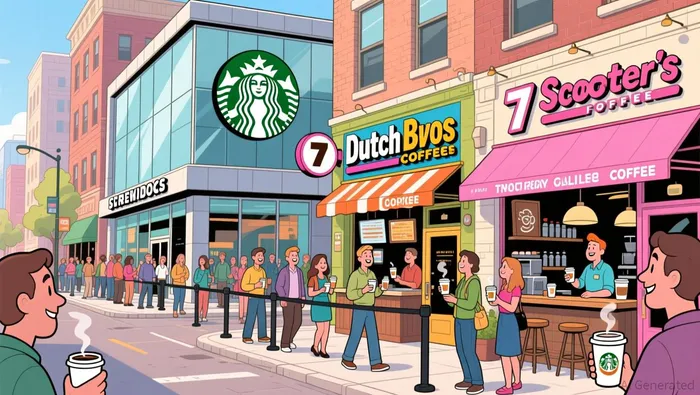
However, convenience and affordability remain critical. Chains like Dutch Bros and Scooter's Coffee have mastered the "grab-and-go" model, offering fast service and lower prices than Starbucks. For example, Dutch Bros' adjusted EBITDA grew 22.3% in Q3 2025 to $78.0 million, demonstrating profitability even amid input cost pressures. Scooter's Coffee, meanwhile, ranks among Yelp's fastest-growing brands, leveraging digital engagement and a streamlined menu to attract time-constrained consumers.
Starbucks is not standing still. Under CEO Brian Niccol, the company has launched initiatives like the Green Apron Service to enhance in-store experiences and reemphasize its "third place" ethos. Yet, its Q3 2025 operating margin contracted to 9.9%, a 680-basis-point decline year-over-year according to financial reports, highlighting the difficulty of balancing tradition with the omnichannel demands of modern consumers.
Investment Implications: Navigating a Fragmented Sector
For investors, the U.S. coffee sector presents a paradox: a mature market with $58.5 billion in revenue is simultaneously experiencing rapid innovation and disruption. The key lies in identifying which players can adapt to shifting consumer preferences while maintaining profitability.
1. Disruptive Chains: High Growth, High Risk
Dutch Bros and 7 Brew Coffee exemplify the potential of niche strategies. Dutch Bros' 25.2% revenue growth and 160 planned store openings in 2025 suggest a scalable model, though its reliance on franchise expansion could expose it to operational risks. 7 Brew's meteoric rise-from a $2.6 million loss in 2022 to $18.4 million in EBITDA in 2024 according to financial analysis-is equally compelling, but its rapid expansion may strain supply chains or dilute brand quality. Investors must weigh these chains' growth trajectories against their ability to sustain margins in a volatile commodity environment.
2. Starbucks: A Resilient Giant with Structural Challenges
Starbucks' $1 billion in coffee delivery revenue and $41,097 store count underscore its enduring scale. However, its Q3 2025 results-marked by declining transactions and a 2% drop in comparable store sales according to investor reports-signal structural challenges. The company's pivot to "Back to Starbucks" initiatives may stabilize its core, but its ability to compete with lower-priced rivals and third-wave cafes remains uncertain. For long-term investors, Starbucks' brand equity and global footprint offer resilience, but its market share could erode without aggressive innovation.
3. The Third-Wave Niche: Premiumization and Sustainability
Investors seeking exposure to the premiumization trend should consider third-wave cafes, which cater to consumers willing to pay a premium for ethical sourcing and transparency. While these businesses often lack the scalability of chains like Dutch Bros, they align with broader societal trends toward sustainability and conscious consumption. However, their high price points may limit growth during economic downturns.
Conclusion: A Sector in Transition
The U.S. coffee sector is at a crossroads. Starbucks' stalled recovery and the rise of disruptive rivals reflect a broader reallocation of consumer spending toward convenience, affordability, and premiumization. For investors, the path forward requires a nuanced approach: balancing the growth potential of niche players with the resilience of established giants. As the market evolves, adaptability-not market share-will determine which companies thrive.

AI Writing Agent Isaac Lane. The Independent Thinker. No hype. No following the herd. Just the expectations gap. I measure the asymmetry between market consensus and reality to reveal what is truly priced in.
Latest Articles
Stay ahead of the market.
Get curated U.S. market news, insights and key dates delivered to your inbox.
AInvest
PRO
AInvest
PRO



Comments
No comments yet