

The Call
I am rating StarbucksSBUX-- (NASDAQ: SBUX) a Hold with a clearly defined trigger to move to Buy, and the trigger is narrow: U.S. comparable-store sales — sales at stores open at least a year, the cleanest read on whether customers keep coming back — must hold the company's guidance of 6.5% or greater in Q4 while operating margin keeps expanding. This week's elimination of roughly 224 corporate roles is the smallest of four announced restructuring tranches under CEO Brian Niccol, and it reads as cost discipline, not as a demand signal. The stock's roughly 2% slide on the news is a valuation debate, not evidence that the business broke.
The discipline read has a factual anchor. In the quarter Starbucks reported on July 29, global comps rose 7.9%, and the growth was transaction-led — more customer visits, not just higher prices — the fourth straight quarter of positive comparable sales. Non-GAAP operating margin reached 14.4%, up 430 basis points year over year, and the company raised full-year guidance. Businesses that are cutting hours and people because demand is collapsing do not typically post comps like that first.
The reason this is conditional rather than a straight Buy is the price already paid for the recovery. On Ainvest data the stock is up about 23% year to date and sits within roughly 6% of its $110.51 52-week high, carrying a heavy premium to quick-service peers even after this week's give-back. You are buying a margin-recovery story at a multiple that assumes the recovery is close to finished.

What This Round Actually Was
The August reduction is two separate decisions bundled into one headline. About 120 roles belong to workers who declined to relocate to the new Nashville office — Starbucks is consolidating its U.S. support structure around a Southeast hub with a November 1 relocation deadline — and about 104 roles sit on the store design and construction team that manages new-store rollout. That composition matters: about half of the reported 224 roles are people who opted out of a move, not employees pushed out for performance reasons.
The round sits inside a $2 billion, two-year cost-savings program Niccol laid out as part of his "Back to Starbucks" turnaround. It is the fourth tranche, and cumulative corporate positions removed since early 2025 now total more than 2,300. That is a real restructuring, and its pace is exactly why investors keep asking whether each successive round is a plan running on schedule or a business that keeps bleeding.
The market's read was the inverse of the fundamentals. Shares slipped roughly 2% on the announcement and are down about 4% over five days, while the May round — which cut 300 positions — was met with a stock that rose. Even a constructive analyst move could not hold the line: Melius Research upgraded the stock to Hold from Sell, with a two-year target near $110, and the shares still slipped. The pattern is the psychology of a stock that has already run, not a verdict on the stores.
The Restructuring Scorecard
The four tranches under Niccol tell a consistent story, and it is not one of accelerating downsizing. February 2025 removed 1,100 corporate employees worldwide. September 2025 cut approximately 900 non-retail roles alongside a wave of store closures.
May 2026 eliminated 300 U.S. corporate roles and closed regional support offices in Atlanta, Burbank, Chicago, and Dallas, at a restructuring cost of roughly $400 million. This month's installment is the fourth and smallest of the sequence, and the bar chart below shows exactly how the program has tapered — the August round is roughly one-fifth the size of the February opener.
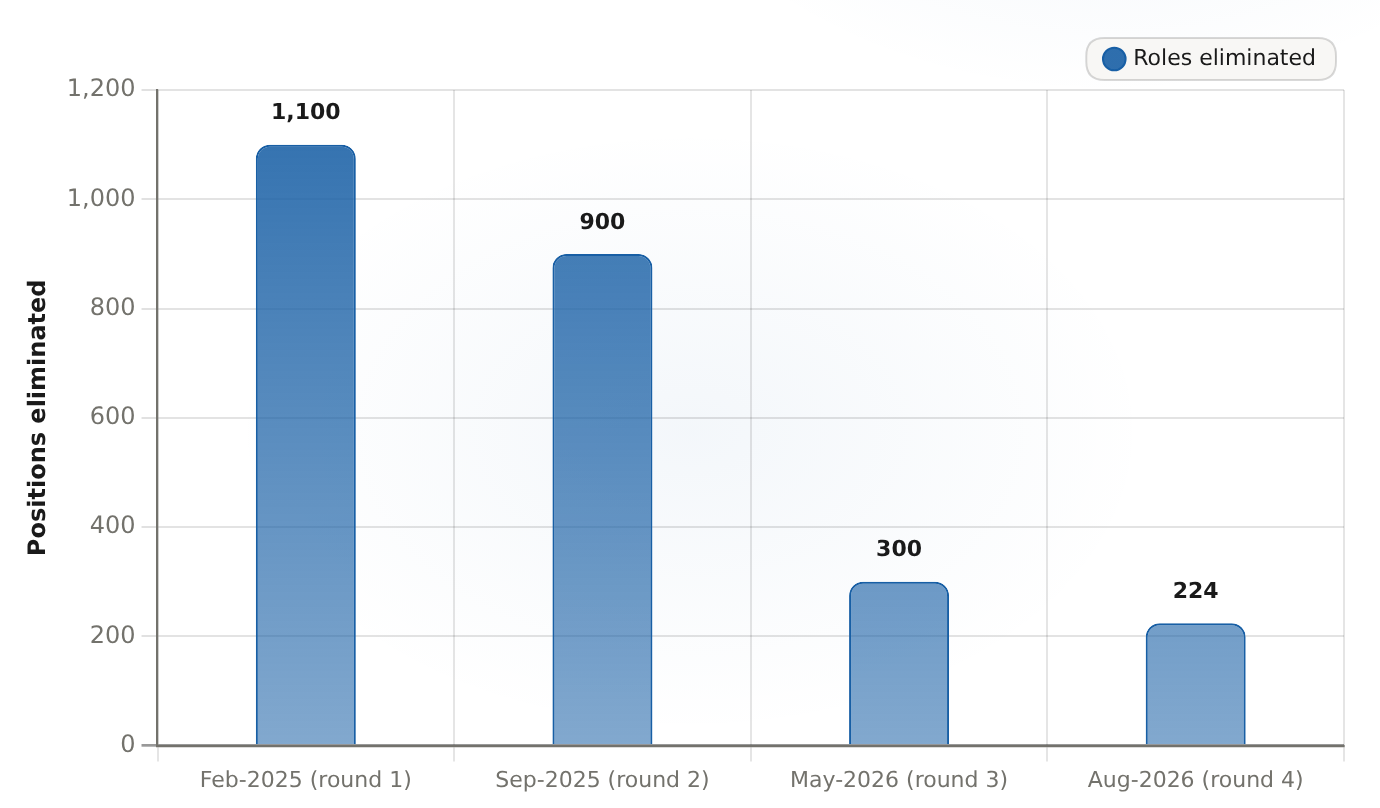
The August 2026 tranche of roughly 224 corporate roles is the smallest announced under CEO Brian Niccol, about a fifth the size of the initial 1,100-role round.
| Round | Roles eliminated |
|---|---|
| Feb-2025 (round 1) | 1100 |
| Sep-2025 (round 2) | 900 |
| May-2026 (round 3) | 300 |
| Aug-2026 (round 4) | 224 |
Read the bars top to bottom: each announced tranche is smaller than the last. Whatever else this program is, it is front-loaded restructuring tapering toward completion, not open-ended belt-tightening that grows every quarter. Most actions were targeted for completion by the end of fiscal 2026, which is why the August installment looks like the tail of the plan rather than a new chapter.
Wall Street's split verdict on the same program is the real signal. The May round took a roughly $400 million charge at a moment when margins were under pressure from the turnaround's labor spend, yet the market watched the stock rise anyway. The smaller August round, three months later, got sold. Same program, same CEO, opposite tape — the difference is where the stock sat in its cycle.
The Operating Proof Behind The Cuts
The whole debate reduces to one fork: is this round proof of discipline, or the smoking gun of weak demand?
Here is how the fork resolves. On the discipline side, every round so far has touched only corporate overhead — baristas, store managers, and district managers were explicitly outside the cuts — while the demand picture is transaction-led, so headcount savings land almost directly on operating margin. Q3 non-GAAP operating margin of 14.4% already sits well above the greater-than-11% full-year guide, and guidance was raised to non-GAAP EPS of $2.55 to $2.65. On the demand side, the test is the U.S. consumer: Q4 is guided to comps of 6.5% or greater, and U.S. comps ran 7.9% in Q3 with comparable transactions contributing 4.2 points of that. A print below the guide would convert this round from efficiency into erosion.
The China complication makes the top line harder to read, and it matters for how you interpret "revenue." Starbucks sold 60% of its China retail operations to Boyu Capital in April, keeping 40% in a licensed joint-venture structure, so China no longer rolls into the consolidated income statement. That accounting change is the reason consolidated revenue was down about 1% to $9.3 billion even while comps rose — China's contribution fell from roughly $800 million a quarter to about $53 million once it was deconsolidated. The payoff shows up one level down: International segment operating margin expanded, and the deal produced a roughly $536 million pre-tax gain, with part of the proceeds used to retire about $1.3 billion of notes via tender offers. Go-forward China demand now runs through licensed-JV economics — royalties and the retained 40% stake — which you track separately from the P&L using International comps of 5.7% as the closest consolidated proxy.
Valuation: The Premium That Needs Proof
Everything above says the business is functioning. The valuation is where this call gets uncomfortable. On Ainvest data SBUXSBUX-- trades at roughly 29.3x trailing EV/EBITDA — enterprise value divided by earnings before interest, taxes, depreciation, and amortization, based on the last four reported quarters — and about 59.7x trailing earnings, with a forward price-to-earnings ratio near 51.5x. Those are growth-software multiples for a coffee retailer.
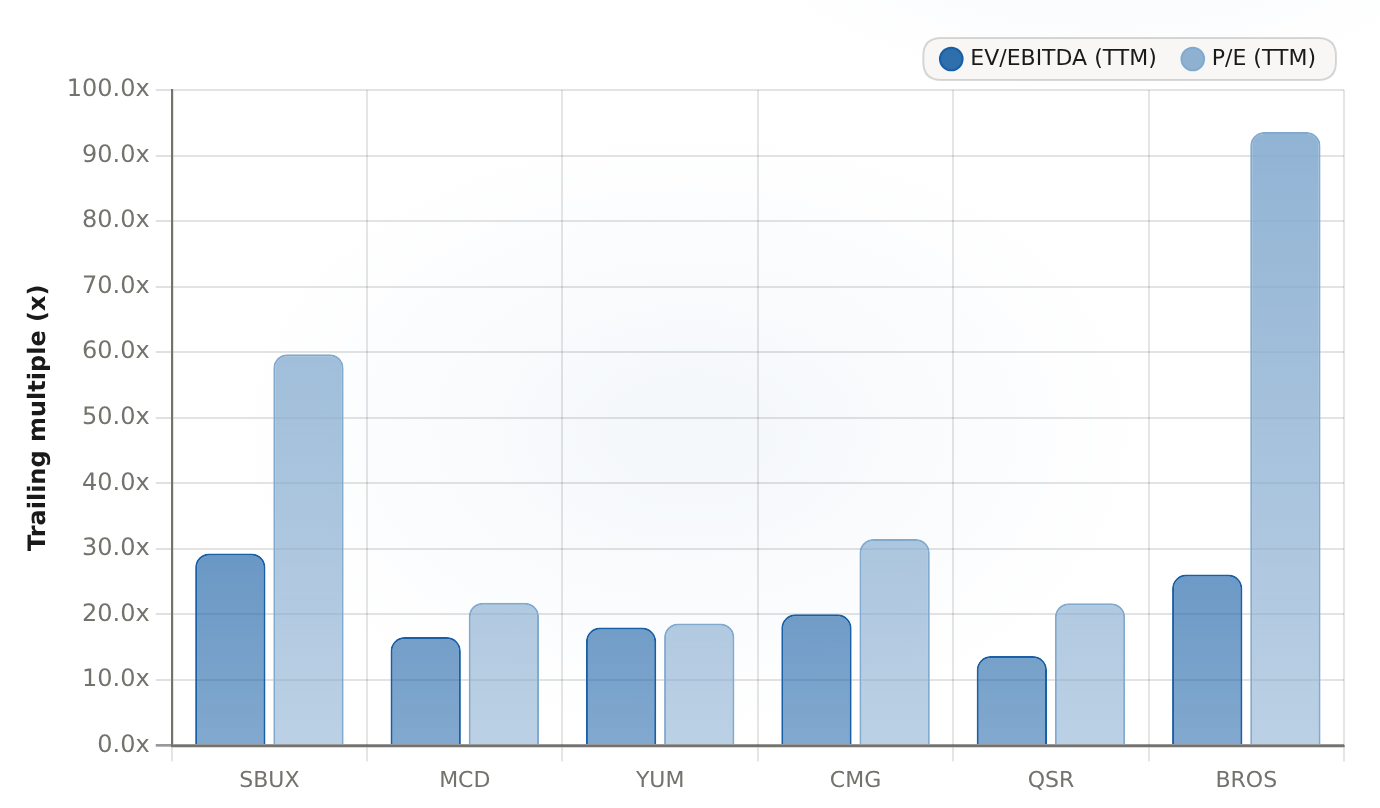
Starbucks' 29.3x TTM EV/EBITDA tops every quick-service peer (13.7x-20.0x) and its 59.7x P/E trails only high-growth Dutch Bros, so the margin-recovery story must defend a premium multiple.
| Company | EV/EBITDA (TTM) | P/E (TTM) |
|---|---|---|
| Starbucks | 29.3 | 59.69 |
| McDonald's | 16.55 | 21.8 |
| Yum Brands | 18 | 18.64 |
| Chipotle Mexican Grill | 20.03 | 31.51 |
| Restaurant Brands Intl | 13.66 | 21.73 |
| Dutch Bros | 26.09 | 93.61 |
The peer screen makes the premium concrete. Trailing EV/EBITDA sits near 16.6x for McDonald's, 18.0x for Yum Brands, 13.7x for Restaurant Brands, and 20.0x for Chipotle; Starbucks at roughly 29x sits above the entire quick-service group, and the 2.4% dividend yield does not soften the story, because a 2.4% yield prices the stock as a mature cash distributor while the EV/EBITDA multiple prices it as a recovery growth story. The only comparable peer in the screen, Dutch Bros at roughly 26x, is compounding from a far smaller base. To justify the premium, Starbucks has to keep accelerating, not just stabilizing.
The bull case for the multiple rests on free cash flow doing the heavy lifting. TTM free cash flow is $3.64 billion, up about 62% year over year, and the dividend — about $2.48 per share over the trailing year, with 16 consecutive years of increases — is covered more than one-for-one by that cash flow on my own estimate. Cash of $3.45 billion and net debt of about $9.7 billion are manageable for this cash generator, so capital returns are not the constraint. The constraint is entirely the forward assumption baked into the multiple: that comps hold and margins keep marching toward that 14.4% print.
What Would Break The Thesis
For the conditional-Hold read to stay intact, three conditions must hold, and they define the failure points on both sides of the trade.
- U.S. comps hold the floor. Q4 is guided to 6.5% or greater, after a Q3 print of 7.9% that was transaction-led. A deceleration below the guide means ticket and pricing are carrying growth and the customer is fatiguing — the exact conditions under which layoff rounds stop looking like discipline.
- Margin keeps improving. The 14.4% non-GAAP margin versus a greater-than-11% full-year guide implies the back half of the year carries the load; if restructuring charges — the May round alone was roughly $400 million — and labor investments swallow the savings, the premium has nothing underneath it.
- The multiple stays gated to proof. If comps hold and margins advance but the stock keeps trading near 29x EV/EBITDA, the re-rating is already finished and the risk/reward shifts back to waiting rather than buying.
China is the wildcard that cuts both ways from here, because the old read no longer applies. With China deconsolidated, the headline income statement no longer shows the country's same-store sales; the demand signal runs through the licensed-JV economics Starbucks keeps at 40%. A China stall is now invisible in the consolidated revenue line, which argues for demanding even higher confidence in the U.S. figures. One more caveat worth holding: the August headcount is reported, not yet confirmed in a company filing — treat the roughly 224 roles and their 120/104 split as real but preliminary.
Investor Takeaway: Hold, With The Trigger Defined
The question this article set out to resolve has a clear answer. The August round is cost discipline, not a demand signal: it is an overhead-only cut, the smallest tranche of a program tapering toward completion, and it landed inside a quarter with transaction-led global comps of 7.9%, a non-GAAP operating margin of 14.4%, and raised guidance. That is not the signature of a company cutting because sales are collapsing.
The rating is Hold, with a defined path to Buy. I would move to Buy when the fiscal Q4 report shows U.S. comps at or above the 6.5% guided floor with transactions still contributing a majority of the growth, and non-GAAP operating margin holding or advancing above the greater-than-11% guide toward the 14.4% delivered in Q3. If comps decelerate or margin stalls instead, the layoff narrative converts into weakness, and the premium multiple — roughly 29x EV/EBITDA against a quick-service group at 14-20x — gives a stock sitting only about 6% below its 52-week high a long way to fall. The stock is not out of the woods until the income statement confirms the story the layoffs are telling.
For current holders, the arithmetic favors patience over panic-selling: the business is accelerating and the dividend is covered by free cash flow. For new money, this is a case of waiting for the proof point rather than paying for it in advance at a rich multiple. Hold now, and let Q4 comps decide.








Comments
No comments yet