
StakeStone (STO) Surges 136% as Whale Withdrawals Trigger Price Explosion
 Aime Summary
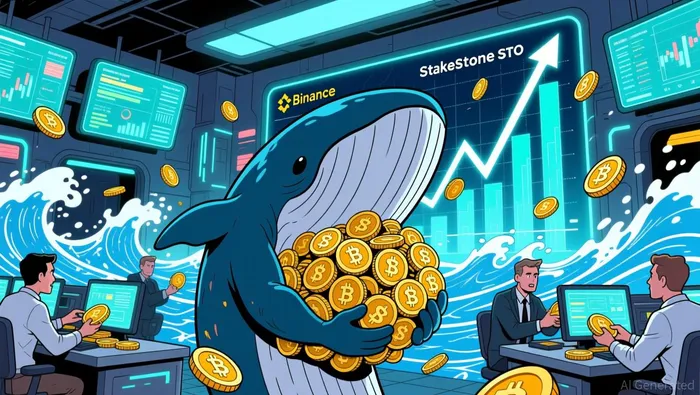
StakeStone (STO) experienced a 136% price surge in 24 hours, driven by a large whale accumulation of 25.5 million tokens. The withdrawal from Binance accounts for 11.32% of the token's circulating supply and triggered a demand shock. Analysts suggest this could reduce immediate selling pressure and indicate long-term holding strategies. This event is attracting attention in the trading community due to its size and impact on price dynamics.
The price of STOSTO-- surged from $0.11 to $0.26 within a single day, marking a significant increase. This surge is attributed to whale activity, as such large withdrawals are typically indicative of strategic accumulation. On-chain data shows that trading volumes have spiked, with the 24-hour volume exceeding the 7-day average by more than 200%. Traders are monitoring key levels such as $0.20 as resistance-turned-support and $0.30 as a potential next target if the buying pressure continues.
StakeStone's liquidity infrastructure model is also drawing attention. The protocol focuses on maximizing yield generation while solving liquidity distribution challenges. Its flagship offerings include LiquidityPad and yield-bearing wrapped versions of ETH and BTC. The surge in STO's price is attributed to interest in these innovative features and broader market trends around DeFi and real-world asset tokenization. This surge suggests that the market is responding to the potential of StakeStone's infrastructure.
Why is this Whale Activity Significant?
Whale activity is often seen as a precursor to future price movements. Large withdrawals from exchanges, especially from major platforms like Binance, can signal that large holders are reducing immediate selling pressure and building long-term positions. This behavior is often interpreted as a sign of confidence in the asset's future value. In the case of STO, the withdrawal of 25.5 million tokens represents a substantial portion of the circulating supply and could indicate a strategic accumulation strategy by a whale.
Such activity can have a significant impact on the price of a token, as it reduces the supply available on exchanges and can lead to increased demand from other market participants. The price surge following this withdrawal suggests that the market is reacting to this reduced supply and the potential for future price growth. Analysts are watching closely to see if this trend continues and what further implications it may have for the STO token.
What Does This Mean for StakeStone's Market Position?
StakeStone's recent surge in price and trading volume highlights its growing market position. The protocol's focus on liquidity infrastructure optimization differentiates it from traditional liquidity protocols that primarily facilitate token swaps. StakeStone's ability to maximize yield generation while addressing liquidity distribution challenges is a key factor in its appeal to investors and traders.
The surge in trading volume and price is also indicative of the broader trends in the DeFi space, particularly around real-world asset tokenization and institutional adoption. StakeStone's positioning in this space allows it to capture liquidity flows from the two largest crypto networks by market cap, representing approximately 65% of total crypto market capitalization. This strategic advantage could help StakeStoneSTO-- maintain its upward trajectory and solidify its position in the DeFi ecosystem.
What Are the Risks and Limitations of This Movement?
While the recent surge in STO's price is promising, it is important to consider the risks and limitations associated with this movement. The high volume-to-market-cap ratio of 4.5:1 indicates significant new capital entering the protocol or existing holders repositioning their stakes. This can be both an opportunity and a risk, as high volatility is often associated with such movements.
Additionally, the market for DeFi protocols is highly competitive, with established players having significant advantages in terms of liquidity, track records, and smart contract audits. StakeStone's current surge may reflect market anticipation of future utility rather than present-day fundamentals. This means that the token's performance could be subject to fluctuations based on market sentiment and broader economic factors.
Investors should also be cautious about the potential for a steep pullback following such a sharp price increase. Profit-taking deals could lead to a temporary decline in price as traders look to lock in gains. The consistency of gains across all trading pairs suggests broad-based demand, but it does not eliminate the risk of a sudden market correction.

Blending traditional trading wisdom with cutting-edge cryptocurrency insights.
Latest Articles
Stay ahead of the market.
Get curated U.S. market news, insights and key dates delivered to your inbox.


AInvest
PRO
AInvest
PRO



Comments
No comments yet