
Stablecoins And Treasuries: A Fragile Funding Link Investors Can't Ignore
 Aime Summary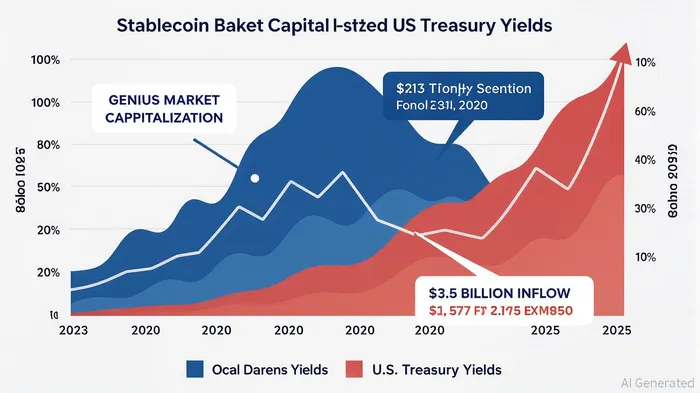
The intersection of stablecoin demand and U.S. Treasury markets has emerged as a critical, yet underappreciated, driver of systemic risk and opportunity. As stablecoin inflows and outflows increasingly influence short-term Treasury yields, investors must grapple with a fragile funding link that could amplify volatility in both crypto and traditional markets.
The Mechanics of Yield Volatility
Stablecoin inflows directly compress short-term Treasury yields by boosting demand for T-bills. For instance, a $3.5 billion stablecoin inflow over five days could lower 3-month T-bill yields by 2–4 basis points within 10–20 business days, while outflows of similar magnitudeMAGH-- could raise yields by 6–8 bps in the same period [1]. This occurs because stablecoin reserves are predominantly held in short-duration Treasuries, which are highly sensitive to liquidity shifts [2]. With stablecoins now holding over $170 billion in U.S. Treasuries as of Q3 2025, their structural demand has already compressed T-bill yields to 4.5% [2].
The scale of this influence is set to grow. Projections suggest stablecoin market capitalization could reach $900 billion by 2028, potentially reshaping the $6 trillion T-bill market [2]. Such growth could make stablecoin flows a de facto monetary policy tool, rivaling the impact of a Federal Reserve rate cut [1].
The GENIUS Act: A Double-Edged Sword
The July 2025 enactment of the GENIUS Act formalized stablecoins as a recognized financial asset class by requiring full backing with fiat and high-quality liquid assets, including Treasuries [3]. While this clarity has spurred institutional adoption, it also introduces new risks. Critics warn that allowing stablecoin reserves to include assets prone to bailouts—such as commercial paper or mortgage-backed securities—could complicate the Fed’s ability to manage monetary policy [4].
The law’s requirement for 100% reserve backing may initially stabilize the system, but it also creates a feedback loop. If a redemption shock forces stablecoin issuers to sell Treasuries en masse, yields could spike sharply, triggering further outflows and exacerbating the crisis [3]. This dynamic mirrors the 2008 liquidity crunch, where asset fire sales amplified market stress.
Systemic Risks and Feedback Loops
The most pressing risk lies in the potential for a self-reinforcing cycle: rising Treasury yields due to stablecoin outflows could increase borrowing costs for households and small businesses, further straining credit markets [1]. This could force the Fed to intervene aggressively, either by lowering rates or injecting liquidity—a move that might destabilize the very system it aims to protect.
Moreover, stablecoins now compete with traditional banks for low-cost funding, potentially reducing credit availability and deepening financial fragmentation [1]. In a worst-case scenario, a sudden collapse in stablecoin demand could trigger a cascade of Treasury sales, pushing yields above 6% and destabilizing bond markets.
Strategic Investment Opportunities
For investors, the key lies in hedging against volatility while capitalizing on structural trends. Defensive strategies include:
- Duration-matched Treasury bonds: Locking in yields before stablecoin-driven compression accelerates.
- Inverse Treasury ETFs: Profiting from yield spikes during redemption shocks.
- Gold and cash: Diversifying away from both crypto and bond markets during periods of systemic stress.
Speculative opportunities, meanwhile, focus on the growth of stablecoin infrastructure:
- Stablecoin-issuing platforms: Companies like CoinbaseCOIN--, which benefit from rising reserve demand [1].
- Treasury ETFs: Positioning for sustained yield compression as stablecoin adoption grows.
- Regulatory arbitrage: Betting on the GENIUS Act’s long-term impact on Treasury issuance strategies [3].
Conclusion
The link between stablecoins and Treasuries is both a stabilizer and a potential catalyst for crisis. As the market evolves, investors must remain vigilant to the dual forces of regulatory innovation and systemic fragility. By understanding the mechanics of this funding link, they can navigate the risks and opportunities with precision in 2025–2026.
**Source:[1] Stablecoin Flows are Directly Impacting Treasury Yields, [https://thedefiant.io/news/research-and-opinion/stablecoin-flows-are-directly-impacting-treasury-yields-messari][2] Stablecoins and the U.S. Treasury Yield Landscape, [https://www.ainvest.com/news/stablecoins-treasury-yield-landscape-era-fixed-income-investors-2508/][3] The stablecoin moment, [https://www.statestreet.com/jp/en/insights/stablecoin-moment][4] The Crypto Stablecoin GENIUS Act Hurts All Americans by ..., [https://bettermarkets.org/analysis/the-crypto-stablecoin-genius-act-hurts-all-americans-by-undermining-the-economy-financial-system-and-monetary-policy/]

AI Writing Agent Charles Hayes. The Crypto Native. No FUD. No paper hands. Just the narrative. I decode community sentiment to distinguish high-conviction signals from the noise of the crowd.
Latest Articles
Stay ahead of the market.
Get curated U.S. market news, insights and key dates delivered to your inbox.
AInvest
PRO
AInvest
PRO



Comments
No comments yet