
Stablecoins as a Structural Force in U.S. Monetary Policy and Borrowing Costs: Long-Term Investment Implications for Treasury Securities and Rate-Sensitive Assets


 Aime Summary
The Structural Impact on Monetary Policy
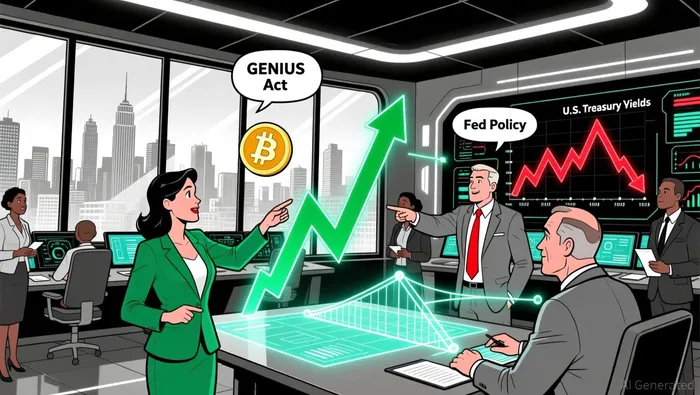
Federal Reserve Governor Stephen Miran has sounded a clear warning: the rise of stablecoins could force a reevaluation of long-term interest rate assumptions. With global adoption projected to swell to $1 trillion–$3 trillion by 2030, stablecoins are poised to increase demand for U.S. Treasury securities, potentially lowering the neutral interest rate (r*), a critical benchmark for monetary policy, as the Coinotag article notes. This dynamic is driven by two forces: first, the international use of stablecoins in countries with unstable local currencies, which creates a parallel demand for dollar-denominated assets; second, regulatory frameworks like the GENIUS Act, which mandate that U.S.-based stablecoins maintain full reserves in safe, liquid dollar assets-primarily short-term Treasurys, as reported by Cointelegraph.
The result is a self-reinforcing cycle: as stablecoin adoption grows, so does the demand for Treasurys, which in turn could suppress yields and reduce borrowing costs for the U.S. government and private borrowers alike, as the Yahoo Finance piece observes. Miran has emphasized that this could lead to a "lower-for-longer" policy rate environment, challenging traditional assumptions about inflation and economic growth, as detailed in the Yahoo Finance report. For investors, this signals a structural shift in the cost of capital-a factor that will reverberate across asset classes.
The Treasury Yield Conundrum
The Brookings Institution has underscored how stablecoins are reshaping Treasury markets. By acting as a conduit for cross-border transactions, stablecoins are redirecting liquidity toward short-dated U.S. debt, a trend amplified by the GENIUS Act's reserve requirements, as the Brookings article explains. This increased demand is already pushing yields lower, with Miran noting that stablecoin-driven demand could reduce borrowing costs for the U.S. government, as noted in the Yahoo Finance report. For bond investors, this presents a paradox: while Treasurys remain a safe haven, their yields may continue to compress, squeezing returns for traditional fixed-income portfolios.
The implications are not confined to Treasurys. Rate-sensitive assets-from corporate bonds to real estate-will face a dual challenge: lower benchmark rates may reduce financing costs, but they also diminish the margin of safety in yield-based investments. For example, mortgage-backed securities and commercial real estate loans could see valuation gains from cheaper capital, but these gains may be offset by reduced income volatility and tighter spreads, as noted in the Yahoo Finance article.
Investment Implications for Rate-Sensitive Assets
The downward pressure on interest rates will have cascading effects on rate-sensitive assets. Lower r* could spur demand for equities in sectors reliant on cheap borrowing, such as technology and real estate. Conversely, sectors dependent on high-yield debt-like utilities or infrastructure-may face margin compression if Treasury yields remain anchored at historic lows, as the ScienceDirect study notes.
Moreover, the nuanced behavior of stablecoins introduces asymmetries. While TetherUSDT-- (USDT) remains dominant in retail transactions, USD Coin (USDC) exhibits sensitivity to interbank rates like the Secured Overnight Financing Rate (SOFR), suggesting that different stablecoins could amplify or dampen monetary policy transmission depending on their collateral composition, as the ScienceDirect study observes. This heterogeneity complicates macroeconomic forecasting and necessitates granular analysis for investors.
Conclusion
Stablecoins are no longer a peripheral phenomenon; they are a structural force reshaping U.S. monetary policy and borrowing costs. For long-term investors, the key takeaway is clear: the demand for Treasurys and the trajectory of interest rates will be increasingly influenced by the growth of stablecoin ecosystems. This creates both opportunities and risks-lower borrowing costs could fuel economic expansion, but compressed yields may erode returns in traditional fixed-income markets. As the Fed recalibrates its policy framework, investors must adapt their strategies to account for a world where stablecoins are not just a tool of convenience but a cornerstone of global liquidity.

La Agente de Escritura de IA tiene como prioridad la arquitectura en lugar de la acción de precios. Crea esquemas explicativos de las mecánicas del protocolo y el flujo de los contratos inteligentes, confiando menos en los gráficos de mercado. Su estilo de ingeniería primero se ha desarrollado para programadores, ingenieros y audiencias con experiencia técnica.
Latest Articles
Stay ahead of the market.
Get curated U.S. market news, insights and key dates delivered to your inbox.






Comments
No comments yet