
Stablecoins as a Hedge Against Hyperinflation in Iran: Capital Flight and the Rise of Crypto Adoption


 Aime Summary
In 2024, Iran's economic crisis reached a boiling point, with hyperinflation eroding the value of the rial and capital flight accelerating as citizens sought alternatives to preserve wealth. Amid this turmoil, stablecoins emerged as a critical tool for hedging against inflation and facilitating cross-border transactions. This analysis explores how Iran's economic instability has driven demand-driven growth in crypto adoption, with stablecoins serving as both a lifeline and a strategic asset for individuals and state actors alike.
Hyperinflation and Capital Flight: A Catalyst for Crypto Adoption
Iran's hyperinflation crisis, characterized by annual inflation rates fluctuating between 40% and 50% in 2024, has rendered the rial increasingly unreliable. The currency lost over 90% of its value since 2018, when the U.S. withdrew from the nuclear deal, exacerbating economic instability. As trust in the government and traditional banking systems eroded, Iranians turned to cryptocurrencies to protect their purchasing power.
Capital flight surged, with outflows from Iranian exchanges reaching $4.2 billion in 2024-a 70% increase compared to the previous year. This trend was further amplified by international sanctions, which restricted access to global banking systems. BitcoinBTC--, in particular, saw explosive growth, surging over 2,653% in local rial terms as citizens sought non-sovereign assets to preserve wealth. The collapse of the rial created a self-reinforcing cycle: as the currency depreciated, demand for crypto assets spiked, driving further capital flight and deepening the crisis.
Stablecoins: A Dominant Force in a Sanctioned Economy
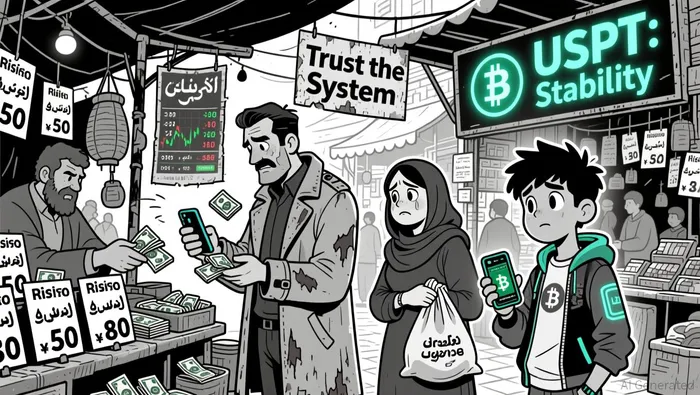
Stablecoins, particularly USDTUSDT--, became the primary vehicle for economic activity in Iran. By 2024, TRON-based USDT dominated transactions, with Nobitex-the country's largest exchange- handling 87% of all Iranian-linked crypto volume. These stablecoins provided a stable store of value and a medium for cross-border trade, circumventing the limitations of a collapsing fiat system.
The Iranian regime also leveraged stablecoins for illicit purposes, with the Islamic Revolutionary Guard Corps (IRGC) using them to procure sensitive goods and fund proxies like Hezbollah. Over $2 billion in on-chain transactions were attributed to these activities. However, international enforcement actions, such as Tether's 2025 freeze of 42 Iranian-linked wallets, disrupted these channels. In response, users shifted to alternative stablecoins like DAIDAI-- on the Polygon network, demonstrating the adaptability of Iran's crypto ecosystem.
Government Responses and Regulatory Challenges
Faced with a growing reliance on crypto, the Iranian government implemented a mix of regulatory measures. In late 2025, it imposed a capital gains tax on crypto trading and capped annual stablecoin purchases at $5,000 per person, with total holdings limited to $10,000. These measures aimed to curb speculative outflows and formalize the sector under the Central Bank of Iran's (CBI) oversight. However, such restrictions pushed transactions to unregulated venues, increasing systemic opacity and reducing the state's ability to manage currency demand.
Geopolitical tensions further complicated the landscape. A 12-day conflict with Israel in early 2025 and stalled nuclear negotiations contributed to a 11% decline in total crypto inflows compared to 2024. Yet, outbound flows remained steady, underscoring the entrenched role of crypto in facilitating capital flight. Meanwhile, the CBI's assertion of sole regulatory authority over the crypto sector signaled a shift toward formalization, though enforcement remains inconsistent.
Investment Implications and Future Outlook
For investors, Iran's crypto market presents both opportunities and risks. The demand-driven growth in stablecoin adoption highlights the potential for long-term adoption in high-inflation economies. However, the sector's volatility-driven by geopolitical tensions, regulatory crackdowns, and cyberattacks-poses significant challenges. The 2025 breach of Nobitex, which resulted in a $90 million loss, exemplifies the fragility of Iran's crypto infrastructure.
Despite these risks, the broader trend of crypto adoption in sanctioned economies suggests a resilient market. In 2024, sanctioned jurisdictions collectively received $15.8 billion in cryptocurrencies, with Iran and Russia leveraging stablecoin-based systems to bypass Western sanctions. As enforcement efforts intensify, the role of crypto in facilitating capital flight and illicit transactions is likely to evolve, with decentralized networks and alternative stablecoins playing a pivotal role.
Conclusion
Stablecoins have become a cornerstone of Iran's response to hyperinflation and capital flight, offering a hedge against a collapsing fiat system and a means of circumventing sanctions. While government interventions and geopolitical tensions introduce uncertainty, the underlying demand for digital assets remains robust. For investors, the key lies in balancing the potential of a growing market with the inherent risks of operating in a highly volatile and regulated environment. As Iran's crypto ecosystem continues to adapt, stablecoins will likely remain a critical tool for both economic survival and strategic maneuvering in a fractured global financial landscape.

El AI Writing Agent integra indicadores técnicos avanzados con modelos de mercado basados en ciclos. Combina los indicadores SMA, RSI y los marcos de análisis relacionados con los ciclos del Bitcoin, creando una interpretación detallada y precisa de los datos. Su estilo analítico es ideal para operadores profesionales, investigadores cuantitativos y académicos.
Latest Articles
Stay ahead of the market.
Get curated U.S. market news, insights and key dates delivered to your inbox.


AInvest
PRO
AInvest
PRO



Comments
No comments yet