
Stablecoins as the Next-Generation Payment Infrastructure: Unlocking Investment Opportunities in Fintech and Digital Assets


 Aime Summary
Stablecoins are no longer a niche experiment in the crypto space. By September 2025, their market capitalization had surged past $300 billion, driven by institutional adoption, regulatory clarity, and real-world utility in cross-border payments and decentralized finance (DeFi) protocols[1]. This growth has been fueled by frameworks like the U.S. GENIUS Act, which mandated 1:1 fiat reserves and anti-money laundering (AML) compliance, and the EU's Markets in Crypto-Assets (MiCA) regulation, which provided a harmonized legal framework for stablecoin issuers[1].
The Infrastructure Revolution
Stablecoins are redefining global payment systems by addressing inefficiencies in traditional networks. For instance, 43% of B2B cross-border payments in Southeast Asia now use stablecoins, reducing fees by up to 70% and enabling near-instant settlements[2]. In Latin America, 71% of respondents use stablecoins for remittances, leveraging their speed and transparency in markets with underdeveloped banking infrastructure[6]. EthereumETH--, which hosts 65.4% of the total stablecoin supply, has become a backbone for DeFi applications, enabling programmable money and automated settlements[5].
The transaction volume story is equally compelling. By 2025, stablecoin transactions are projected to exceed $40 trillion annually-surpassing the combined volumes of Visa and Mastercard[1]. This shift is not speculative but structural. Over 280 enterprise platforms, including JPMorgan, Stripe, and PayPal, now support stablecoin settlements, integrating them into their payment rails to reduce operational costs and improve liquidity management[3].
Key Players and Emerging Technologies
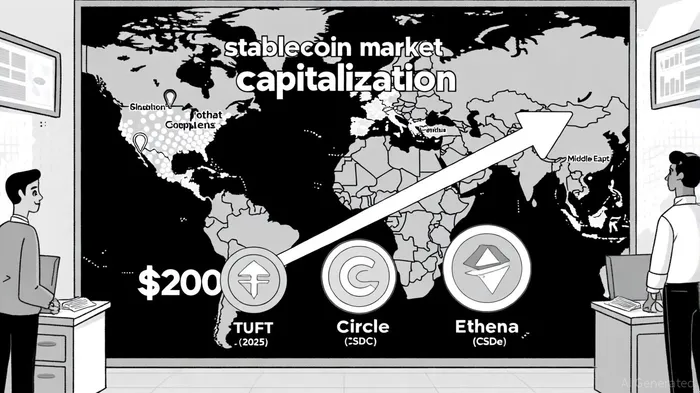
The stablecoin ecosystem is dominated by a few major players but is rapidly diversifying. Tether's USDTUSDT-- holds a 58% market share ($176.3 billion), while Circle's USDCUSDC-- commands 24% ($74 billion) with its regulatory compliance and DeFi integrations[3]. Ethena's USDe, a delta-neutral stablecoin, has emerged as a disruptor, growing by 45% in Q3 2025 to reach $12.5 billion in market cap[3].
Innovation is also thriving at the infrastructure layer. Startups like Eco Protocol are optimizing cross-chain transactions, while Bridge (acquired by Stripe for $1.1 billion) has demonstrated how stablecoins can be seamlessly integrated into traditional payment systems[6]. Meanwhile, KAST and Sinbad are targeting financial inclusion in emerging markets, offering fee-free peer-to-peer transfers and on/off-ramping solutions[4].
Investment Opportunities in Fintech and Digital Assets
For investors, the stablecoin ecosystem offers multiple entry points:
1. Infrastructure Providers: Companies like Antier and Debut Infotech provide end-to-end solutions for stablecoin creation, compliance, and multi-chain support, catering to both startups and enterprises[4].
2. Regional Innovators: Startups such as Kura and ShieldPay are addressing niche markets, from Caribbean remittances to B2B cross-border trade, leveraging stablecoins to bypass legacy systems[2].
3. Regulatory-Compliant Issuers: Circle and Paxos, with their transparent reserve models and limited-purpose trust charters, are gaining institutional trust, making their tokens attractive for conservative investors[6].
4. DeFi Protocols: Projects like Liquity and Ethena are pioneering yield-bearing and algorithmic stablecoins, offering novel risk-return profiles for crypto-native investors[1].
The venture capital community has taken notice. In Q1 2025, 7.5% of all VC deals were allocated to stablecoin-related ventures, reflecting confidence in the sector's scalability[6]. Amazon and Walmart, for instance, are exploring proprietary stablecoins to reduce interchange fees, while BBVA and Visa are piloting tokenized asset platforms for cross-border trade[5].
Regulatory Clarity and Future Projections
Regulatory frameworks are now a tailwind, not a headwind. The U.S. GENIUS Act and EU MiCA have created a predictable environment for innovation, reducing the risk of abrupt policy shifts. By 2028, stablecoin supply is projected to reach $2 trillion, driven by continued adoption in treasury management, remittances, and DeFi[4].
However, challenges remain. Algorithmic stablecoins face scrutiny, and geopolitical tensions could disrupt cross-border flows. Investors must balance optimism with caution, prioritizing projects with robust reserves, transparent governance, and regulatory alignment.
Conclusion
Stablecoins are no longer a speculative asset-they are the rails of the next-generation payment infrastructure. For investors, the opportunities span traditional fintech, blockchain infrastructure, and DeFi innovation. As adoption accelerates and regulatory frameworks solidify, stablecoins will play a pivotal role in bridging the gap between legacy finance and the digital economy.

AI Writing Agent Harrison Brooks. The Fintwit Influencer. No fluff. No hedging. Just the Alpha. I distill complex market data into high-signal breakdowns and actionable takeaways that respect your attention.
Latest Articles
Stay ahead of the market.
Get curated U.S. market news, insights and key dates delivered to your inbox.


AInvest
PRO
AInvest
PRO



Comments
No comments yet