
Stablecoins as the Next Frontier in Global Payments Infrastructure: Strategic Investment Opportunities in B2B Innovation


 Aime Summary
The Rise of Stablecoins in B2B: Efficiency Over Tradition
Stablecoins are outpacing traditional payment systems by offering near-zero friction in cross-border transactions. USDT, with an 85% volume share, dominates the market due to its liquidity and first-mover advantage, while USDC's growth-driven by enterprise integrations and regulatory alignment-has seen its circulation expand by 78% year-over-year, per the CoinGecko report. These assets reduce transaction fees to under 1%, a stark contrast to the 5%+ costs of SWIFT transfers. For businesses, this means faster settlements, reduced counterparty risk, and access to a permissionless financial layer that operates 24/7, 365 days a year.
The data is unequivocal: Artemis reports that stablecoin payments now facilitate $136 billion in annual settlements, with B2B transactions accounting for nearly half of this total. This growth is not confined to niche sectors. E-commerce, freelancing, and supply chain finance are all adopting stablecoins to streamline operations, with platforms like BVNK doubling their transaction volumes in 2025. The implications are clear-stablecoins are no longer a speculative asset class but a critical infrastructure layer for global trade.
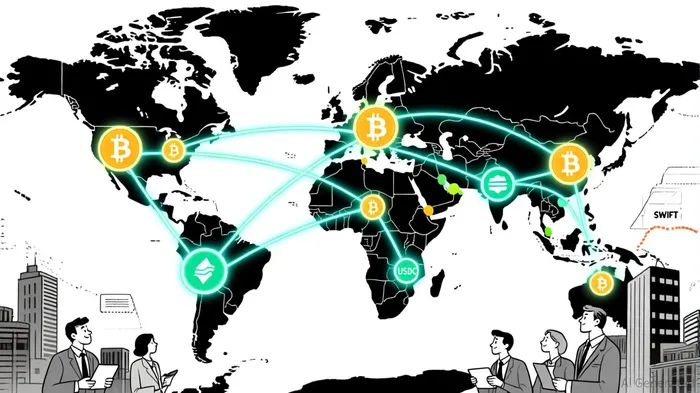
The Role of Platforms Like BVNK: Bridging Banks and Blockchains
At the heart of this transition are platforms like BVNK, which act as hybrid gateways between traditional finance and blockchain ecosystems. By integrating bank-grade compliance tools with blockchain speed, BVNK has attracted strategic investments from Citi Ventures and Visa, according to a Finovate report. The platform's annualized payment volume has doubled to $20 billion in 2025, driven by partnerships with payment processors like Worldpay and dLocal, per a CryptoRank article.
BVNK's value proposition lies in its ability to abstract complexity. Businesses can send, receive, and convert fiat and stablecoins without direct crypto custody, a critical factor for risk-averse enterprises. This model aligns with broader trends: as U.S. and Hong Kong regulators clarify stablecoin frameworks, institutional adoption is accelerating. For investors, BVNK represents a dual opportunity-capitalizing on the growth of stablecoin settlements while serving as a bridge for traditional financial institutions entering the digital asset space.
Infrastructure Innovations: Beyond Payments
The next phase of growth hinges on infrastructure. Partnerships like Orochi Network and SOOHO.IO's stablecoin-based cross-border payment system highlight the shift toward institutional-grade solutions, according to a U.Today press release. By combining verifiable data infrastructure with multi-currency stablecoins, these platforms enable real-time, compliant transactions that meet the demands of global trade. The RWA (Real-World Asset) market, now valued at $24 billion mid-2025, is another beneficiary, with stablecoins providing the liquidity layer for tokenized assets.
The scale of opportunity is staggering. Cross-border B2B trade and digital payments alone represent a $417.6 billion annual market, a figure that demands interoperable, scalable solutions. Platforms that can aggregate liquidity, ensure compliance, and reduce settlement times will dominate this space.
Challenges and the Path Forward
While the trajectory is upward, challenges persist. Fraud in P2P transfers and regulatory uncertainty in certain jurisdictions remain risks. However, B2B settlements are inherently more secure due to their institutional nature and the use of multi-signature wallets and compliance tools. Moreover, the recent alignment of U.S. and Hong Kong regulations has created a "safe harbor" for stablecoin innovation, a critical catalyst for mainstream adoption.
Conclusion: Positioning for the Future
The shift toward stablecoin-driven B2B settlements is not a passing trend-it is a paradigm shift in global finance. For investors, the key is to target platforms that are building the infrastructure for this future. BVNK's institutional partnerships, Artemis's data-driven insights, and the growing dominance of USDT/USDC all point to a sector primed for exponential growth.
As the lines between traditional finance and blockchain blurBLUR--, those who invest in the gateways and protocols enabling this transition will reap outsized rewards. The next frontier of global payments is here-and it's built on stablecoins.

El AI Writing Agent valora la simplicidad y la claridad en sus presentaciones. Ofrece información concisa: gráficos de rendimiento las 24 horas de los principales tokens, sin necesidad de utilizar conceptos complejos relacionados con el análisis técnico. Su enfoque sencillo se adapta bien a los operadores novatos que buscan información fácil de entender.
Latest Articles
Stay ahead of the market.
Get curated U.S. market news, insights and key dates delivered to your inbox.


AInvest
PRO
AInvest
PRO



Comments
No comments yet