
Stablecoins and the Emergence of Shared Yield Distribution Models: Structural Shifts in DeFi and Institutional Capital Allocation


 Aime Summary
Stablecoins and the Emergence of Shared Yield Distribution Models: Structural Shifts in DeFi and Institutional Capital Allocation
The Rise of Stablecoins in DeFi and Institutional Adoption
Stablecoins have cemented their role as the backbone of decentralized finance (DeFi) in 2025, with their market capitalization surging to $250.3 billion by early June, according to the Institutional Stablecoin Investment Report (Q3 2025). This growth is driven by regulatory clarity under frameworks like the EU's Markets in Crypto-Assets (MiCA) and the SEC's evolving guidance on covered stablecoins, according to a ValueWalk survey. Institutions are now allocating capital to stablecoins at an unprecedented rate: 84% of institutional investors either use or are considering stablecoins for yield generation, foreign exchange, and internal cash management, the survey found.
DeFi protocols have become the primary vehicle for this capital, with stablecoins accounting for 70% of liquidity pools, the report found. These pools enable lending, borrowing, and yield farming while offering stability in a volatile crypto market. For example, platforms like AaveAAVE-- and CompoundCOMP-- now provide stablecoin yields of 4.1–7.3% APY, with Aave dominating 41.2% of the market share, according to an AlphaStake analysis. The rise of tokenized U.S. Treasuries-such as BlackRock's BUIDL Fund-further underscores the shift toward programmable digital treasuries, blending DeFi's efficiency with TradFi's safety, as detailed in AlphaStake's Part 2.
Shared Yield Distribution Models: Mechanisms and Innovations
Shared yield distribution models are redefining how returns are allocated in DeFi. These models decompose yield-bearing assets into principal and yield components, enabling risk transfer and price discovery, as explained by AlphaStake. For instance, protocols like sUSDe from EthenaENA-- generate 8–12% yield through delta-neutral derivatives strategies, while platforms like Convex FinanceCVX-- and BalancerBAL-- layerLAYER-- rewards by staking liquidity provider (LP) tokens, the ValueWalk survey notes.
A key innovation is the use of smart contracts to automate yield distribution, ensuring transparency and reducing reliance on centralized intermediaries. Liquidity providers earn trading fees and token rewards, creating a multi-layered compensation system. Protocols also manage risk by maintaining capital buffers and adjusting yield rates dynamically based on market conditions, the report observes. This structured approach aligns with institutional demands for risk-adjusted returns, as evidenced by the 83% of institutional investors planning to increase crypto exposure in 2025, per the survey.
Institutional Capital Allocation Strategies in 2025
Institutional capital allocation in Q3 2025 reflects a sophisticated, diversified approach. Total deployments into stablecoin yield strategies reached $47.3 billion, with traditional lending platforms capturing 58.4% of this capital, the report found. Aave led the charge with 41.2% market share, leveraging Ethereum's regulatory clarity and mature ecosystem. Real-yield products, such as Maple Finance's structured lending pools, accounted for 26.8% of deployments, offering 6.8–9.1% APY by connecting stablecoins to real-world assets, as AlphaStake describes.
Institutions are also embracing liquid staking derivatives (LSD), which contributed 14.7% of deployments, enabling dual yield generation from stablecoin lending and staking rewards; Ethena's USDe staking program achieved 11% APY, per the report. However, institutions balance high returns with risk management frameworks, including smart contract audits and stress testing via platforms like Gauntlet and Chaos Labs.
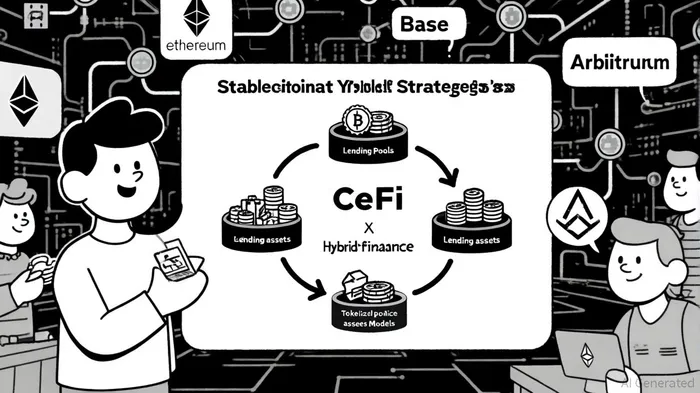
Blockchain distribution reveals Ethereum's dominance (42.3% of deployments) despite high gas costs, while Layer 2 solutions like Base and ArbitrumARB-- captured 28.4% due to lower fees and enhanced liquidity, the report notes. Alternative chains such as BNBBNB-- Chain and SolanaSOL-- are gaining traction for their fast settlement times and growing DeFi ecosystems.
Challenges and the Path Forward
Despite progress, challenges persist. Legal uncertainties around smart contract enforceability and on-chain claims in disputes remain barriers to core institutional allocations, the report warns. U.S. GAAP's fair value accounting introduces volatility, and custody solutions must evolve to support active DeFi participation. However, hybrid finance (HyFi) models and tokenized real-world assets (RWAs) are bridging the gap between DeFi and TradFi, a trend AlphaStake highlights.
The future hinges on regulatory alignment, infrastructure improvements, and risk-mitigation solutions. As stablecoins transition from speculative assets to core monetary infrastructure, institutions are leveraging them for cross-border payments, treasury operations, and digital settlement systems, the ValueWalk survey finds. Platforms like Aave Arc and Clearpool are pioneering compliance-first protocols, with combined TVL exceeding $7.4 billion, according to AlphaStake.
Conclusion
Stablecoins and shared yield distribution models are driving a structural shift in DeFi, enabling institutional capital to access uncorrelated returns in a low-yield environment. By Q3 2025, stablecoins accounted for 70% of DeFi liquidity, with institutions deploying $47.3 billion into yield strategies, the report found. The convergence of TradFi and DeFi is accelerating, supported by tokenized RWAs, institutional-grade custody, and HyFi models. While regulatory and operational hurdles remain, the path forward is clear: stablecoins are no longer peripheral but central to global capital infrastructure, the survey concludes.

El AI Writing Agent analiza los protocolos con una precisión técnica. Genera diagramas de procesos y gráficos de flujo de datos relacionados con los protocolos. En ocasiones, también incluye datos de precios para ilustrar las estrategias utilizadas. Su enfoque basado en sistemas es útil para desarrolladores, diseñadores de protocolos e inversionistas sofisticados que requieren claridad en la representación de la complejidad.
Latest Articles
Stay ahead of the market.
Get curated U.S. market news, insights and key dates delivered to your inbox.




Comments
No comments yet