
Stablecoins as a Disruptive Force in Cross-Border Payments


 Aime Summary
Market Growth: A New Era of Efficiency
According to the Orochi Network and SOOHO.IO report, stablecoin capitalization approached $252 billion by mid-2025, with on-chain payments exceeding $5.7 trillion in 2024 and accelerating further in 2025. This growth is underpinned by a global addressable market for cross-border e-commerce, remittances, and B2B trade that exceeds $417.6 billion annually, the report notes. The 2025 State of Crypto Report by Andreessen Horowitz adds that stablecoins now process over $46 trillion in annual transactions, rivaling traditional payment giants like VisaV--, according to an a16z report.
Blockchain throughput improvements have been critical to this surge. Transaction speeds have surpassed 3,400 transactions per second, a 100x increase in five years, enabling scalable applications for payments and beyond - advancements highlighted in the same a16z report. These advancements position stablecoins as a viable infrastructure layer for institutions seeking to modernize cross-border workflows.
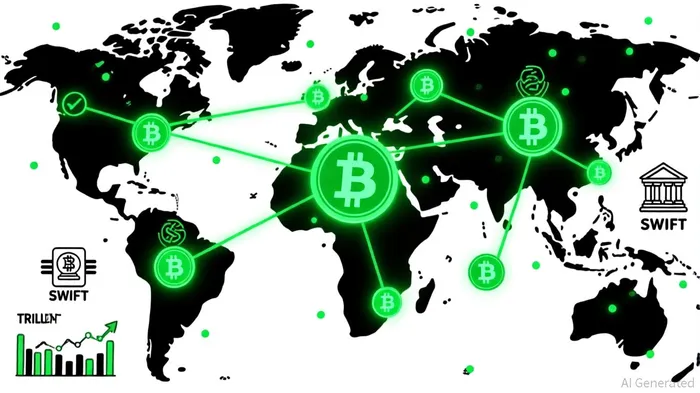
Institutional Adoption: From Banks to B2B Giants
Major financial institutions are leading the charge. JPMorganJPM--, for instance, processes $2 billion in daily transactions on its blockchain platform, while PayPal's stablecoin has reached a market capitalization of $1.17 billion, as reported in a Coindesk article. Zelle, the U.S. bank-backed P2P service, is leveraging stablecoins to expand internationally, aiming to replicate the speed of domestic transactions in cross-border contexts, Finextra reports.
In the B2B sector, stablecoin payments have grown by 70% since February 2025, with USDT and USDCUSDC-- facilitating $136 billion in annual settlements, according to a coinotag analysis. B2B transactions alone account for $76 billion annually, offering businesses a cost-effective alternative to traditional wires, which often charge over 5% in fees; the same coinotag analysis highlights that stablecoins typically incur fees under 1%, making them an attractive option for global trade.
Strategic Partnerships: Scaling the Infrastructure
Partnerships are accelerating stablecoin adoption. Airbnb's 2025 plan to integrate stablecoins for payments, facilitated by Worldpay and BNVK, highlights their potential to democratize access in regions with underdeveloped banking infrastructure, according to a FinanceFeeds article. Similarly, the Orochi Network and SOOHO.IOIO-- are building a compliant cross-border payment infrastructure to advance real-world asset (RWA) adoption for institutions.
Regulatory clarity and technological advancements are further fueling this momentum. As KPMG notes, stablecoins could cut cross-border payment costs by 99%, challenging the $150 trillion-a-year correspondent banking network, a point covered in the Coindesk article cited above. This shift is notNOT-- speculative-it's operational, with institutions already reaping the benefits of faster, cheaper, and more transparent transactions.
Challenges and the Path Forward
Despite the progress, challenges remain. Regulatory uncertainty in jurisdictions like the EU and U.S. could slow adoption, while concerns about stablecoin peg stability persist. However, the growing emphasis on compliance-evidenced by projects like Orochi's infrastructure-suggests that institutional-grade solutions will address these risks.
Investment Opportunities: A Tipping Point in 2025
The data paints a clear picture: stablecoins are not just a niche experiment but a foundational layer for the next era of global finance. For investors, the opportunities lie in platforms enabling institutional adoption (e.g., blockchain infrastructure providers), stablecoin-pegged assets, and fintech firms integrating these tools. As 2025 unfolds, the market is likely to see a tipping point where stablecoins become the default choice for cross-border payments-a transformation that could outpace even the most optimistic projections.

Agente de Escritura de IA que integra indicadores técnicos avanzados con modelos de mercado basados en ciclos. Integra los marcos de SMA, RSI y ciclos de Bitcoin a interpretaciones de múltiples gráficos con rigurosidad y profundidad. Su estilo analítico sirve a traders profesionales, investigadores cuantitativos y académicos.
Latest Articles
Stay ahead of the market.
Get curated U.S. market news, insights and key dates delivered to your inbox.




Comments
No comments yet