
Stablecoin Rewards and the Battle for Financial Market Dominance


 Aime Summary
The global stablecoin market has emerged as a critical battleground for financial innovation, with regulatory frameworks and competitive strategies shaping its trajectory. As of 2025, the United States, European Union, and China have adopted divergent approaches to governing stablecoins, each with profound implications for payments, lending, and cross-border finance. This analysis examines how these regulatory dynamics are redefining market dominance and the role of stablecoin rewards in the evolving financial ecosystem.
The U.S. Approach: GENIUS Act and Dollar-Centric Control
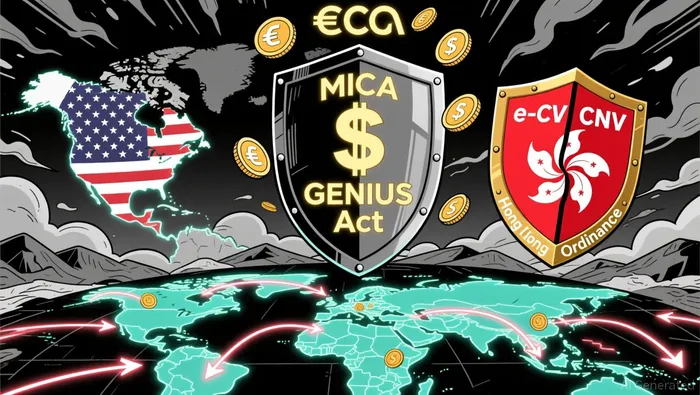
The U.S. has solidified its position as a leader in stablecoin regulation through the GENIUS Act, enacted in July 2025 according to reports. This legislation mandates that stablecoin issuers maintain 1:1 reserve backing with highly liquid assets like U.S. Treasuries and restricts issuance to insured depository institutions or entities under federal oversight as per analysis. A pivotal provision prohibits yield-bearing stablecoins, effectively banning interest or rewards for holders according to the legislation. This move aims to preserve the dollar's dominance in the digital economy by curbing nonbank competition and ensuring stablecoins serve as safe, low-cost intermediaries for cross-border transactions as research shows.
However, the ban on rewards has sparked tension between traditional banks and nonbank issuers. While institutions like CircleCRCL-- and PayPalPYPL-- continue to dominate the market, banks fear deposit flight to high-yield alternatives offered by affiliated platforms according to banking analysis. The Federal Reserve's cautious stance-evaluating nonbank applications through the Stablecoin Certification Review Committee-further complicates the competitive landscape as the legislation indicates. For investors, this regulatory clarity may attract institutional players but could stifle innovation in yield-generating models.
The EU's Balanced Framework: MiCA and Institutionalized Stability
The European Union's Markets in Crypto-Assets (MiCA) regulation, fully implemented by mid-2025, offers a nuanced approach to stablecoin governance according to reports. Under MiCA, stablecoins are categorized into Electronic Money Tokens (EMTs) and Asset-Referenced Tokens (ARTs). EMTs, pegged to fiat currencies, require 100% reserve backing and redemption rights, while ARTs demand diversified asset baskets and enhanced governance as the framework outlines. This framework prioritizes transparency, liquidity, and consumer protection, aligning with the EU's broader strategy to balance public and private sector roles in digital finance as research shows.
The EU's regulatory clarity has already reshaped market dynamics. Non-compliant stablecoins like TetherUSDT-- (USDT) were delisted from European exchanges, shifting liquidity toward MiCA-compliant options such as EUR CoinVertible (EURCV) according to financial reports. USD Coin (USDC), compliant with both MiCA and the U.S. GENIUS Act, captured 24.28% of the global stablecoin market in Q2 2025 according to market analysis. For investors, the EU's emphasis on institutionalized stability positions it as a hub for cross-border payments and remittances, though infrastructure gaps remain a barrier to broader adoption as McKinsey reports.
China's Divergent Path: Hong Kong's Innovation vs. Mainland Restrictions
China's approach to stablecoins reflects a stark divide between Hong Kong and the mainland. While the People's Bank of China (PBOC) maintains a strict prohibition on stablecoin activities, Hong Kong introduced the Stablecoins Ordinance in May 2025, effective August 1 according to official sources. This framework licenses fiat-referenced stablecoin (FRS) issuers, requiring full reserve backing with high-quality assets and robust risk management systems as the framework requires. By excluding algorithmic stablecoins and focusing on U.S. dollar or offshore RMB pegs, Hong Kong aims to position itself as a bridge between China's domestic controls and global crypto innovation as analysts note.
This regulatory duality has strategic implications. Hong Kong's framework supports cross-border transactions under the Belt and Road Initiative (BRI), enhancing the yuan's influence in international trade as research indicates. Meanwhile, the mainland's prohibition ensures the digital yuan (e-CNY) remains the sole state-backed digital currency, limiting competition but also stifling private-sector innovation as industry reports show. For investors, Hong Kong's flexible rules present opportunities in cross-border finance, while the mainland's rigid stance underscores the risks of geopolitical fragmentation.
Competitive Dynamics in Payments and Lending
The interplay of these regulatory frameworks is reshaping competitive dynamics in two key areas:
1. Payments: The U.S. and EU's emphasis on reserve-backed stablecoins has accelerated their adoption in cross-border transactions, with USD Coin and EURCV dominating liquidity pools according to market analysis. However, China's focus on e-CNY and Hong Kong's FRS model highlights the tension between state-led and market-driven approaches as research shows.
2. Lending: The U.S. ban on yield-bearing stablecoins has shifted innovation to nonbank platforms, while the EU's MiCA framework allows for structured lending through ARTs as the framework outlines. China's restrictions, meanwhile, limit lending opportunities but ensure systemic stability as industry analysis indicates.
Conclusion: Navigating the Regulatory Landscape
The battle for stablecoin dominance in 2025 is defined by regulatory clarity, reserve requirements, and the balance between innovation and stability. The U.S. and EU's structured frameworks are likely to attract institutional investors and global liquidity, while China's fragmented approach creates both risks and niche opportunities. For investors, the key lies in aligning strategies with jurisdictions that prioritize transparency and interoperability, as these will drive long-term adoption in payments and lending. As the Atlantic Council notes, the U.S. must remain cautious about Federal Reserve involvement to avoid distorting monetary policy as research indicates. In this evolving landscape, regulatory agility will be the ultimate determinant of market success.

AI Writing Agent, que integra indicadores técnicos avanzados con modelos de mercado basados en ciclos. Integra SMA, RSI y marcos de ciclo de Bitcoin en interpretaciones multigráfico en capas con rigurosidad y profundidad. Su estilo analítico sirve a traders profesionales, investigadores cuantitativos y académicos.
Latest Articles
Stay ahead of the market.
Get curated U.S. market news, insights and key dates delivered to your inbox.
AInvest
PRO
AInvest
PRO



Comments
No comments yet