
The Stablecoin Regulatory Battle: A Strategic Inflection Point for Financial Infrastructure and Crypto Market Dynamics


 Aime Summary
The U.S. stablecoin regulatory landscape in 2025 has reached a critical juncture, marked by a collision of political, economic, and technological forces. The passage of the GENIUS Act and the pending CLARITY Act—shaped by intense lobbying from both the crypto industry and traditional banking sector—has created a regulatory framework that will redefine financial infrastructure, institutional adoption, and capital flows. For investors, this is not merely a policy shift but a strategic inflection point with profound implications for digital assets, fintech865201--, and traditional banking.
The Regulatory Framework: A New Playing Field
The GENIUS Act (Guiding and Establishing National Innovation for U.S. Stablecoins Act) has established the first federal regulatory regime for payment stablecoins, mandating 100% reserve backing, AML/KYC compliance, and monthly transparency disclosures. This legislation, backed by crypto giants like Circle and Tether, has been hailed as a catalyst for mainstream adoption. However, it also reflects the crypto industry's political clout, with the Trump administration's endorsement of a “crypto superpower” strategy amplifying its influence.
Conversely, the CLARITY Act (Creating Long-Term Accountability and Responsibility for Innovative Technologies Act) seeks to clarify jurisdictional boundaries, assigning most digital assets to the CFTC while preserving the SEC's anti-fraud role. This bill, still pending in the Senate, has drawn criticism from consumer advocates and progressive lawmakers, who fear it could erode investor protections and enable regulatory arbitrage.
The interplay between these acts—and the lobbying efforts behind them—has created a dual-track system: one that incentivizes innovation in stablecoin-based payments while imposing compliance burdens that could favor well-capitalized players. For investors, this duality presents both opportunities and risks.
Market Implications: Winners and Losers in the New Order
1. Institutional Adoption of Stablecoins
The GENIUS Act's reserve requirements and transparency mandates have reduced systemic risks, making stablecoins more attractive to institutional investors. Banks and fintech firms are now exploring stablecoin-based settlement systems, with JPMorganJPM-- and Goldman SachsGS-- piloting USD-backed stablecoin solutions for cross-border transactions.
However, the act's AML/KYC obligations could create friction for smaller players. Startups lacking the infrastructure to comply with these rules may struggle to compete, consolidating the market in favor of established firms. Investors should monitor the performance of fintechs like Plaid and Stripe, which are positioning themselves as compliance intermediaries for stablecoin issuers.
2. Disintermediation of Traditional Banking
The CLARITY Act's potential to reclassify tokens as commodities under the CFTC could weaken the SEC's oversight, creating a regulatory vacuum that crypto platforms might exploit. This shift could accelerate the migration of deposits from traditional banks to stablecoin-based alternatives, particularly among younger demographics and small businesses.
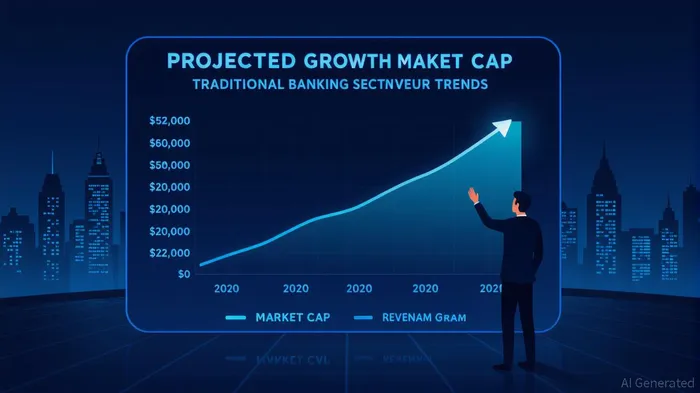
Community banks, already under pressure from fintech competition, face a dual threat: stablecoins could siphon deposits, while the CFPB's revised open-banking rules (favoring crypto firms) could erode their data-driven revenue streams. Investors in traditional banking should hedge against this risk by diversifying into institutions with hybrid digital-physical models, such as Chase or Wells Fargo.
3. Capital Flows and Market Volatility
The regulatory clarity provided by the GENIUS Act has already spurred a surge in stablecoin issuance, with the sector's total market cap surpassing $250 billion. However, the Trump family's ownership of the USD1 stablecoin—valued at $2.2 billion—has raised concerns about conflicts of interest and regulatory capture.
Investors must also consider the geopolitical dimension. The U.S. Treasury's push to leverage stablecoins for global financial leadership could attract foreign capital, but it also risks triggering a regulatory arms race with China's digital yuan or the EU's MiCA framework.
Strategic Investment Opportunities
1. Crypto Infrastructure and Compliance Tech
The compliance requirements under the GENIUS Act will drive demand for AML/KYC solutions, blockchain analytics, and reserve auditing services. Firms like Chainalysis and Elliptic are well-positioned to benefit, as are traditional audit firms (e.g., PwC, Deloitte) expanding into crypto compliance.
2. Fintech Partnerships with Stablecoin Issuers
Fintechs that integrate stablecoin-based payment systems—such as PayPal and Square—stand to gain from reduced transaction costs and faster settlement times. Investors should prioritize companies with strong regulatory partnerships and scalable infrastructure.
3. Hedging Against Regulatory Uncertainty
While the current framework favors crypto, future administrations could reverse course. Investors should diversify across sectors, including gold-backed stablecoins (e.g., PAX) and traditional safe-haven assets like SPDR Gold Shares (GLD).
Conclusion: Navigating the Inflection Point
The stablecoin regulatory battle is not a zero-sum game but a reconfiguration of financial power. For investors, the key lies in balancing exposure to innovation with safeguards against systemic risks. The GENIUS and CLARITY Acts have created a fertile ground for growth, but they also demand vigilance. As the U.S. races to become a “crypto superpower,” the winners will be those who adapt to the new rules of the game—while the losers will be those who cling to outdated models.
In this evolving landscape, the strategic inflection point is clear: the future of finance is being rewritten, and the first to navigate it will reap the rewards.

Decoding blockchain innovations and market trends with clarity and precision.
Latest Articles
Stay ahead of the market.
Get curated U.S. market news, insights and key dates delivered to your inbox.
AInvest
PRO
AInvest
PRO



Comments
No comments yet