
Stablecoin Regulation: Implications for DeFi and Institutional Investment
 Aime Summary
For DeFi, the Act's emphasis on transparency-such as monthly audits and reserve disclosures-has bolstered trust in stablecoins, which are foundational to decentralized lending and trading protocols. Projects like DeFi Development Corp have pioneered the "Active Treasury" model, deploying stablecoin reserves into institutional-grade liquidity pools to generate yield. Similarly, Bitmine ImmersionBMNR-- Technologies ($BMNR) transitioned to an Ethereum-first treasury, leveraging the Act's framework to stake ETH for returns while maintaining compliance. These adaptations highlight how DeFi is evolving to meet institutional-grade standards. 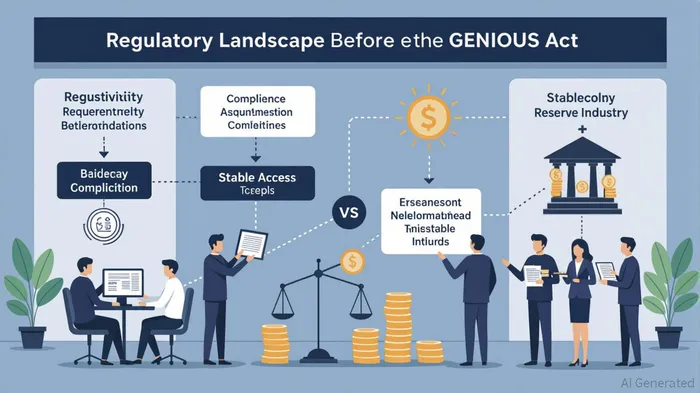
Institutional infrastructure providers have also emerged as key beneficiaries. BitGo, for instance, secured a national bank charter from the Office of the Comptroller of the Currency (OCC), positioning itself to service the growing demand for secure stablecoin custody and compliance solutions. This institutionalization mirrors the trajectory of early crypto investment vehicles like Grayscale's Bitcoin Trust, where regulatory clarity was a prerequisite for large-scale capital inflows.
Risks: Structural Vulnerabilities in a New Era
Despite the Act's progress, critical risks persist. DeFi lending platforms, while structurally similar to traditional banks, lack safeguards such as deposit insurance and liquidity buffers. As noted in a 2026 BPInsights analysis, these platforms remain vulnerable to cascading leverage crises if counterparties fail or market conditions deteriorate. The GENIUS Act does not fully address indirect interest payments by exchanges or affiliates, which could mislead consumers into treating stablecoins as investment tools rather than payment instruments, amplifying exposure to volatility.
Compliance costs also pose a challenge. Smaller stablecoin issuers and DeFi protocols may struggle with the Act's stringent audit and AML requirements, potentially stifling innovation and consolidating market power among larger players according to legal analysis. While the Act allows state-level regulation for nonbank issuers with less than $10 billion in circulation, the "substantially similar" federal framework creates a complex compliance landscape according to the report.
The Path Forward: Balancing Innovation and Stability
The GENIUS Act has set a global benchmark for stablecoin regulation, but its long-term success hinges on how regulators and market participants navigate its implementation. Financial regulators now have 18 months to draft detailed rules on capital and liquidity standards, a process that will shape the ecosystem's resilience according to Brookings research. For DeFi, aligning with traditional financial safeguards-such as stress-testing lending models and adopting transparent governance-will be critical to mitigating systemic risks.
Institutional investors, meanwhile, must weigh the Act's benefits against its complexities. While stablecoin-backed products offer efficiency and scalability, due diligence on counterparty risks and compliance frameworks will remain paramount. As McKinsey notes, stablecoins are poised to become a cornerstone of modern payments infrastructure, but their potential will only be fully realized if innovation is paired with robust oversight.
Conclusion
The GENIUS Act represents a pivotal moment in the evolution of stablecoins, offering a blueprint for harmonizing innovation with stability. For DeFi and institutional investors, the Act's regulatory clarity has opened doors to new opportunities, from institutional-grade yield generation to cross-border payment solutions. Yet, the path forward is not without pitfalls. Structural vulnerabilities in DeFi lending, compliance burdens, and the risk of regulatory arbitrage must be addressed to ensure the ecosystem's long-term viability. As the market matures, the interplay between regulatory rigor and technological agility will define the next chapter of stablecoin-driven finance.

Blending traditional trading wisdom with cutting-edge cryptocurrency insights.
Latest Articles
Stay ahead of the market.
Get curated U.S. market news, insights and key dates delivered to your inbox.




Comments
No comments yet