
Stablecoin Regulation Expands As BlackRock Launches Tokenized Fund Amid Fed Rate Uncertainty
 Aime Summary
- Circle has added a New York trust charter to the USDCUSDC-- regulatory framework, placing operations under direct state supervision to enhance compliance credibility.
- BlackRock launched a tokenized money market fund on SolanaSOL-- and EthereumETH-- to help institutions manage stablecoin reserves under the GENIUS Act.
- Stablecoin issuers now hold approximately $213 billion in short-term U.S. debt, making them a structural bid on Treasuries.
- Three Fed dissents signal potential rate hikes that could compress stablecoin yields and trigger capital flight.
- Abbott Cooper PLLC is investigating potential fiduciary duty breaches by the board of Stablecoin Development Corp, highlighting governance risks for stablecoin related entities.
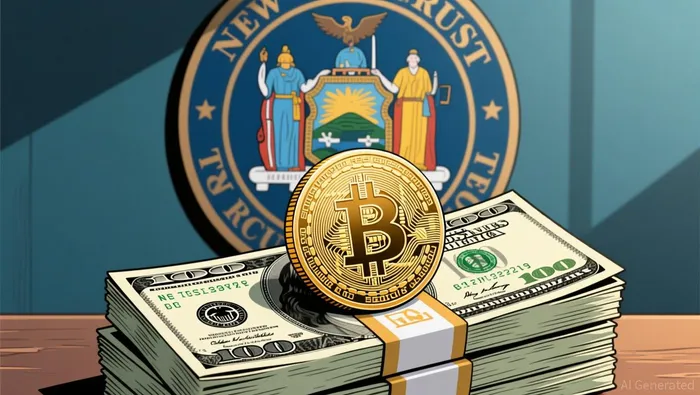
Circle has added a New York trust charter to the regulatory framework behind USDC, placing part of its stablecoin operation under the direct supervision of the New York Department of Financial Services (DFS). A trust charter is a state banking authorization that allows a company to hold and administer assets on behalf of others under financial regulator oversight. This adds a supervised state-level layerLAYER-- to USDC’s existing regulatory structure, tying it more directly to a recognized U.S. framework known for its high compliance standards via the BitLicense regime.
The significance of this move lies in stablecoin credibility. Trust in stablecoins depends heavily on compliance and oversight because holders expect each token to be redeemable at par. A regulatory addition like a trust charter speaks directly to that expectation, which matters more for stablecoins than for volatile crypto assets that make no peg promise. For exchanges, institutions, and users, a state trust charter strengthens confidence that the issuer operates under supervised standards. CircleCRCL-- has positioned USDC’s regulatory framework as a competitive differentiator, and this charter reinforces that positioning.
This company-level step reflects Circle’s own compliance decisions under an existing state regime rather than new nationwide stablecoin law. However, it contributes to the broader debate over how these assets should be supervised. The charter marks another building block in Circle’s strategy of anchoring USDC to formal regulatory structures, addressing the central U.S. policy issue where tokens sit at the intersection of payments, banking, and crypto.
How Is BlackRockBLK-- Entering The Regulated Stablecoin Space?
BlackRock has launched the BlackRock Daily Reinvestment Stablecoin Reserve Vehicle (BRSRV), a new tokenized fund aimed at companies managing stablecoin reserves. The fund records ownership on Solana, Ethereum, and Tempo, marking BlackRock’s first use of Solana for such a product. Ownership is held through wallets approved by transfer agent Securitize, with a permissioned system requiring verified and whitelisted investors. The transfer agent retains the ability to restrict, freeze, or revoke shares.
Despite using blockchain technology, the fund does not invest in digital assets. It invests only in cash, short-term U.S. Treasury securities, and overnight repurchase agreements backed by Treasuries. With a minimum initial investment of three million dollars, the product is targeted at institutions rather than individual investors. BlackRock stated the fund is structured to qualify as an eligible reserve asset under the GENIUS Act, which sets rules for how payment stablecoins must be backed in the United States.
The launch builds on BlackRock’s earlier tokenization work, such as its BUIDL fund, which manages over $2.6 billion. Other large firms like Morgan Stanley and Fidelity have introduced similar products since the GENIUS Act passed. While the filing notes risks such as future regulatory changes or blockchain outages, the move demonstrates how major asset managers are building infrastructure around stablecoin regulation to meet specific U.S. legal requirements.
What Is The Impact Of Fed Rates On Stablecoin Yields?
On July 29, 2026, the Federal Reserve held its benchmark rate at 3.50-3.75% in a 9-3 vote. Three regional Fed presidents dissented in favor of a 25 basis point hike, signaling that the monetary floor under stablecoin economics is less stable than it appears. Stablecoin issuers have become significant buyers of U.S. short-dated debt. TetherUSDT-- holds approximately $141 billion in Treasury securities, while Circle’s USDC allocates roughly 80% of its reserves to BlackRock’s USDXX government money market fund.
Together with the broader stablecoin market totaling approximately $308.5 billion, these issuers represent a structural bid on short-dated Treasuries that did not exist three years ago. The mechanism is straightforward: issuer revenue is generated by the yield on Treasury bills and money market instruments, currently sustained by the 3.50-3.75% federal funds rate. A rate cut compresses this yield, while a rate hike expands it but risks capital flight from stablecoins into higher-yielding alternatives.
The IMF estimates that a 1% shock to stablecoin market capitalization impacts Treasury bill yields, suggesting the channel is large enough to be a monetary policy transmission mechanism. Regulatory signals also compound the structural picture. The American Bankers Association warned of deposit-flight risk from community banks if stablecoin issuers can pay interest. Meanwhile, New York’s Department of Financial Services proposed a state stablecoin framework, and the OCC began implementing the GENIUS Act.
ProShares’ IQMM fund, a de facto GENIUS Act reserve vehicle, has grown to $20.5 billion in assets, suggesting institutional capital is positioning for a regulated future where the yield environment matters more than technology. The FOMC’s hold buys time, but the structural question remains whether the stablecoin-T-bill channel now constrains the Fed’s policy flexibility. If the committee moves toward a hike, the compression of stablecoin yields could trigger a repricing across the $308.5 billion market.
Are There Governance Risks For Stablecoin Related Entities?
Abbott Cooper PLLC has announced an investigation into potential legal claims on behalf of stockholders of Stablecoin Development Corporation (NYSE American: SDEV), formerly NovaBay Pharmaceuticals, Inc. The investigation focuses on whether the members of the SDEV board of directors breached their fiduciary duties to shareholders. The legal firm is seeking to identify stockholders who have continuously held SDEV shares since prior to August 19, 2025. Investors in this group are encouraged to contact the firm to discuss their legal rights and potential recovery options.
The case is being handled on a contingency fee basis, meaning there is no upfront cost to stockholders unless a financial recovery is obtained. This development signals heightened scrutiny regarding corporate governance at SDEV. For investors, the primary risk factor is the potential for shareholder litigation, which could result in significant legal costs, management distraction, or settlement payouts. The specific nature of the alleged breach is not detailed in the announcement, but the focus on the pre-August 2025 holding period suggests events or decisions during that window are under review.
Investors are advised to monitor the progression of primary signals of production as technical engagements and pre-feasibility studies. Eagle Nuclear Energy Corp. is systematically advancing its Aurora uranium project toward a production decision, marking a critical transition from a holding phase to active development. While the company has not yet completed a Pre-Feasibility Study or made a final production decision, it is actively engaging in key technical evaluations necessary to bridge the gap between a discovered deposit and a producing mine.
The company’s strategic advantage lies in its strong financial position and resource base. Eagle Nuclear Energy holds a sizeable domestic uranium resource, identified as the largest conventional measured and indicated deposit in the USA. Unlike many peers, the company maintains cash on hand with no interest-bearing debt, providing a buffer against capital market volatility during the development stage. Additionally, a permit application has been filed for a planned drill program, signaling regulatory progress.
These operational steps are supported by a broader policy environment that is increasingly favorable to domestic uranium production. This combination of a high-quality asset, a debt-free balance sheet, and supportive regulatory trends creates a unique value proposition. Investors are advised to monitor the progression of the pre-feasibility study and technical engagements as primary signals of the company's ability to close the distance to production.

Blending traditional trading wisdom with cutting-edge cryptocurrency insights.
Latest Articles
Stay ahead of the market.
Get curated U.S. market news, insights and key dates delivered to your inbox.


AInvest
PRO
AInvest
PRO




Comments
No comments yet