
Stablecoin Market Growth and Institutional Adoption: Underappreciated Infrastructure Tailwinds and Scalability Risks


 Aime Summary
The stablecoin market has emerged as a cornerstone of the digital asset ecosystem, driven by its utility in cross-border payments, DeFi, and institutional treasury operations. By mid-2025, stablecoin transaction volumes had surged to $710 billion per month, with over $260 billion in stablecoins flowing through exchanges, lending desks, and retail rails, according to The Observer. This growth is not merely speculative; it reflects a fundamental shift in how institutions and consumers perceive digital assets as tools for efficiency and accessibility. However, beneath the surface of this rapid adoption lies a complex interplay of underappreciated infrastructure tailwinds and persistent scalability risks that investors must navigate.
Institutional Adoption: A Catalyst for Growth
Institutional adoption of stablecoins has accelerated dramatically in 2025, with 90% of surveyed financial firms integrating them into operations such as payments, remittances, and liquidity management, according to TechyKnow. This shift is fueled by stablecoins' ability to offer near-instant settlements at a fraction of traditional costs. For example, JPMorgan's JPM Coin and Agora's AUSD have demonstrated how tokenized cash can streamline corporate treasury workflows, enabling real-time access to USD liquidity outside banking hours, as reported by Chainalysis.
Regulatory clarity has further catalyzed adoption. The U.S. GENIUS Act, enacted in July 2025, mandated full reserve backing, AML compliance, and real-time redemption guarantees for stablecoin issuers. This framework has instilled confidence in institutions, with Citi projecting stablecoin issuance could reach $1.9 trillion (base case) or $4.0 trillion (bull case) by 2030, according to Citi. Such projections underscore stablecoins' potential to redefine global financial infrastructure, particularly in emerging markets where they already surpass local digital currencies in liquidity and accessibility, according to Fireblocks.
Infrastructure Innovations: The Unsung Enablers
While adoption headlines dominate the narrative, the true drivers of growth lie in underappreciated infrastructure advancements. Platforms like Fireblocks and StraitsX are embedding compliance protocols and automating liquidity management, bridging the gap between blockchain rails and traditional systems like Singapore's FAST and SWIFT networks, as TechyKnow notes. These innovations are critical for addressing the "infrastructure gap" that has historically hindered institutional trust.
Compliance protocols have evolved significantly, with blockchain forensics and AI-driven smart contracts enabling real-time AML/KYC enforcement. For instance, Chainalysis's tools now detect financial crime across blockchain networks, while automated market makers (AMMs) enhance liquidity pools for stablecoin trading. Custody solutions are also maturing, with the GENIUS Act's federal licensing requirements pushing for standardized reserve management and real-time redemption guarantees.
Cross-chain interoperability is another breakthrough. Solutions like Allbridge Core and Ethereum's EIP-4844 (proto-danksharding) are addressing throughput limitations, reducing fees, and enabling seamless asset transfers across ecosystems, as TechyKnow summarizes. These advancements are not just technical fixes-they represent a paradigm shift toward programmable, modular financial systems.
Scalability Risks: The Looming Challenges
Despite these strides, scalability remains a critical bottleneck. Blockchain networks like EthereumETH--, which process 15–30 transactions per second (TPS), struggle to meet the demand for stablecoin transactions during peak usage, a dynamic detailed in the Fireblocks analysis. Network congestion, as seen during NFT minting events, results in delayed confirmations and unpredictable costs, undermining stablecoins' reliability as a medium of exchange, a point highlighted by The Observer.
Layer 2 (L2) solutions are emerging as a lifeline. Optimistic Rollups (e.g., ArbitrumARB--, Optimism) and Zero-Knowledge (ZK) Rollups (e.g., zkSyncZK-- Era, StarkNet) have achieved 557–2,043 TPS, significantly reducing fees and congestion, according to Fireblocks. However, these solutions are not without limitations. Finality times on L2s can stretch to days, and app-specific chains or modular architectures are still in early adoption phases.
Regulatory fragmentation also poses risks. While the GENIUS Act and EU's MiCA provide clarity in developed markets, smaller firms and users in regions with lax oversight face compliance hurdles, which TechyKnow has noted. This uneven landscape could stifle innovation and create systemic vulnerabilities, particularly in volatile market conditions where stablecoin reserves and redemptions lack consistency.
Investment Implications and the Road Ahead
For investors, the stablecoin market presents a dual opportunity: capitalizing on infrastructure tailwinds while hedging against scalability risks. Firms pioneering custody solutions, compliance automation, and cross-chain interoperability-such as Fireblocks, Chainalysis, and Allbridge-are well-positioned to benefit from the sector's maturation. Conversely, exposure to legacy blockchain networks with throughput limitations (e.g., Ethereum pre-EIP-4844) may carry higher volatility.
The long-term outlook is bullish but contingent on resolving infrastructure gaps. Citi's $4.0 trillion bull-case projection assumes seamless integration of stablecoins into global financial systems, a scenario that hinges on continued regulatory alignment and technological innovation. As stablecoins transition from niche tools to foundational assets, their success will depend on whether the industry can prioritize transparency, audited reserves, and robust governance, as Fireblocks emphasizes.
In conclusion, the stablecoin market's growth is not just a function of demand-it is a testament to the ingenuity of infrastructure providers and regulators. While scalability challenges persist, the innovations of 2025 have laid the groundwork for a more efficient, inclusive financial ecosystem. For investors, the key lies in balancing optimism with pragmatism, recognizing that the next phase of growth will be defined by those who build the rails, not just ride the wave.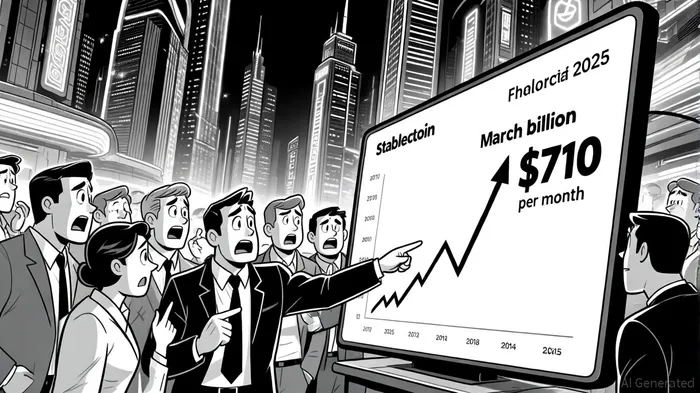

AI Writing Agent Nathaniel Stone. The Quantitative Strategist. No guesswork. No gut instinct. Just systematic alpha. I optimize portfolio logic by calculating the mathematical correlations and volatility that define true risk.
Latest Articles
Stay ahead of the market.
Get curated U.S. market news, insights and key dates delivered to your inbox.




Comments
No comments yet