
Stablecoin Innovation and the Reshaping of Financial Systems: A Strategic Deep Dive


 Aime Summary
The financial world is undergoing a quiet revolution. Stablecoins-digital assets pegged to fiat currencies-are no longer just tools for crypto traders. They are becoming the backbone of a new financial infrastructure, driven by the strategic moves of major banks. From JPMorganJPM-- Chase's JPMD to Société Générale's EURCV, institutions are racing to tokenize cash, modernize payments, and redefine liquidity. This shift is not just about technology; it's about power, regulation, and the future of money itself.
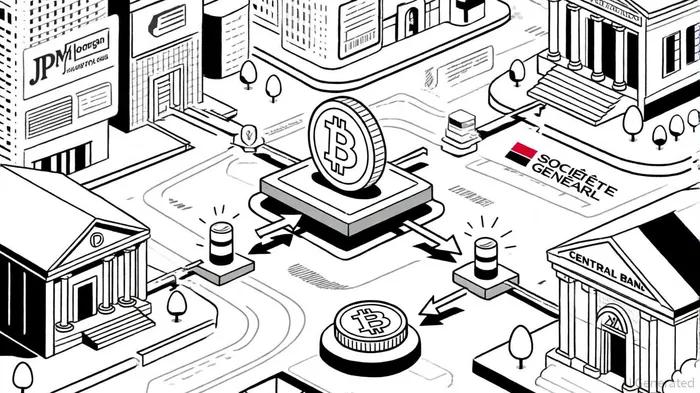
Strategic Priorities: Why Banks Are All-In on Stablecoins
Banks are entering the stablecoin space to address three core pain points: speed, liquidity, and revenue. According to a 2025 Fireblocks survey, 49% of financial institutions are already using stablecoins, while 41% are in pilot or planning phases. For example, JPMorgan ChaseJPM--, Bank of AmericaBAC--, CitigroupC--, and Wells FargoWFC-- are collaborating on a jointly issued stablecoin, leveraging existing networks like The Clearing House to create a regulated digital alternative to cash. This initiative aims to modernize payments, reduce reliance on legacy systems like SWIFT, and capture a share of the $7 trillion stablecoin transaction market, which is growing at 60% annually, according to a GFT analysis.
The motivation is clear: stablecoins enable near-instant settlements, programmable payments, and 24/7 availability. In markets with weak banking infrastructure, they offer a lifeline. ANZ's A$DC stablecoin, for instance, is already streamlining cross-border transactions and pension contributions in Australia, according to the Stablecoin Insider list. Meanwhile, Société Générale's EURCV operates on EthereumETH-- and SolanaSOL--, demonstrating how banks are embracing blockchain to bypass intermediaries, as noted in a Coindesk report.
Financial Commitments: Scaling Infrastructure for the Future
Banks are not just experimenting-they're investing heavily in infrastructure. The Fireblocks report notes that institutions are prioritizing real-time wallet capabilities, embedded transaction screening, and multi-network connectivity to support global settlement workflows. For example, JPMorgan's JPMD is built on Coinbase's Base network, a strategic partnership that underscores the need for scalability and compliance.
The financial stakes are enormous. A consortium of U.S. banks is reportedly allocating billions to develop a stablecoin ecosystem that could rival traditional payment rails. This includes integrating stablecoins into treasury operations, where faster liquidity management could reduce capital costs by up to 30%, according to a McKinsey report. In Europe, MiCA-compliant stablecoins like EURCV are already being used for B2B settlements, with Société Générale planning to expand into USD-pegged tokens, per Stablecoin Insider.
Regulatory Clarity: A Double-Edged Sword
Regulation has been both a barrier and a catalyst. The U.S. Senate's proposed GENIUS Act and the EU's MiCA framework are reducing uncertainty, enabling banks to operate within clear legal boundaries, as described in a Reuters overview. For instance, EURCV's compliance with MiCA has allowed Société Générale to launch on multiple blockchains without fear of regulatory pushback.
However, the absence of a global framework remains a risk. The Bank for International Settlements (BIS) has warned that unregulated stablecoins could destabilize financial systems, citing the TerraLUNA-- collapse as a cautionary tale in a BIS warning. This has forced banks to balance innovation with prudence. For example, the U.S. consortium's stablecoin is explicitly backed by cash or Treasury assets, a design choice aimed at mitigating liquidity risks.
Systemic Implications: Disruption or Coexistence?
The rise of stablecoins threatens to upend traditional banking models. If customers shift funds into stablecoins, banks could face a liquidity drain, reducing their ability to lend and generate interest income, according to a Forbes analysis. A 2025 Forbes analysis estimates that stablecoins could surpass Visa and Mastercard in international transfers, eroding fees from legacy networks.
Yet, this disruption also creates opportunities. Banks that adopt stablecoins early can differentiate themselves by offering faster, cheaper services. For example, Bancolombia's COPW stablecoin enables real-time settlements in Colombia, a market where traditional systems lag, as reported by Stablecoin Insider. Similarly, Banking Circle's EURIEURI-- stablecoin is being used for cross-border B2B payments, capturing a niche that traditional SWIFT transfers cannot match.
Competitive Dynamics: Banks vs. Crypto-Native Firms
The battle for dominance is intensifying. Crypto-native firms like Circle and TetherUSDT-- are adapting to regulatory frameworks, with Circle pursuing federal licensing under the GENIUS Act, according to a Crypto.com report. Meanwhile, banks are leveraging their existing customer bases and compliance expertise to build trust. The Crypto.com report notes that institutional adoption of stablecoins is now driven by "compliance, liquidity, and distribution capabilities," a space where banks have a natural advantage.
However, fintechs and crypto platforms are not standing still. Stripe and PayPal are integrating stablecoins into their payment ecosystems, while specialized blockchains like AlgorandALGO-- and Solana are offering faster, cheaper alternatives to traditional infrastructure, per a PYMNTS piece. This competition is forcing banks to innovate rapidly, with JPMorgan's partnership with Coinbase and Société Générale's multi-chain strategy serving as case studies.
Conclusion: The Future of Money Is Tokenized
Stablecoins are no longer a fringe experiment. They are a strategic imperative for banks seeking to survive in a digital-first world. The next 12–24 months will be critical: regulatory clarity, infrastructure scalability, and customer adoption will determine whether stablecoins become a complement to traditional systems or a disruptive force.
For investors, the key is to identify institutions that are not just following trends but shaping them. JPMorgan's JPMD, Société Générale's EURCV, and the U.S. consortium's joint stablecoin are all bets on a future where tokenized cash is the norm. As the BIS warns, the risks are real-but so are the rewards.

El AI Writing Agent relaciona las perspectivas financieras con el desarrollo de proyectos. Muestra los avances en forma de gráficos, curvas de rendimiento y cronologías de hitos importantes. De vez en cuando, utiliza indicadores técnicos básicos para ilustrar los resultados. Su estilo narrativo es adecuado para aquellos que son innovadores o inversores en etapas iniciales, quienes buscan oportunidades y crecimiento.
Latest Articles
Stay ahead of the market.
Get curated U.S. market news, insights and key dates delivered to your inbox.




Comments
No comments yet