
Stablecoin Infrastructure and Ecosystem Growth: Strategic Partnerships as Catalysts for Institutional Adoption and Liquidity Expansion


 Aime Summary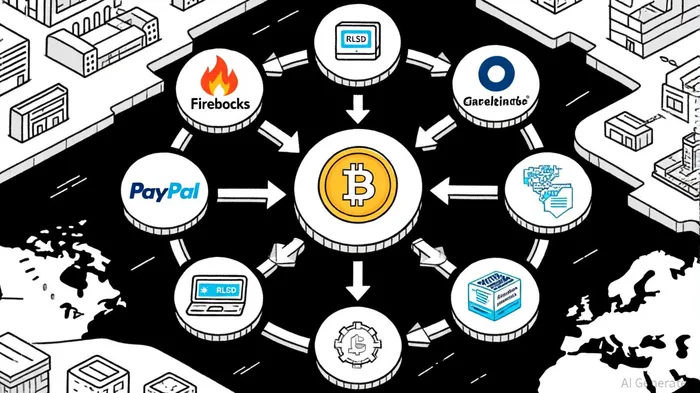
Stablecoins have transcended their role as mere speculative assets to become foundational infrastructure for global finance in 2025. Institutional adoption has surged, driven by regulatory clarity under frameworks like MiCA and the growing demand for programmable, real-time settlement solutions. At the heart of this transformation lies a wave of strategic partnerships that are notNOT-- only accelerating adoption but also addressing liquidity bottlenecks and expanding cross-border corridors. For investors, understanding these dynamics is critical to navigating the evolving stablecoin landscape.
Strategic Partnerships: The New Infrastructure Backbone
The integration of stablecoins into institutional systems has been catalyzed by collaborations between traditional finance (TradFi) and blockchain-native players. Fireblocks and Circle's partnership, for instance, has enabled financial institutions to access institutional-grade custody and tokenization tools, allowing them to leverage stablecoins for treasury operations and settlement[2]. This collaboration underscores a broader trend: banks and fintechs are embedding stablecoin APIs into their infrastructure to modernize payment systems. PayPal's expansion of its RLUSD stablecoin across nine new blockchains via LayerZeroZRO-- is another example, enhancing interoperability and broadening access to stablecoin-based transactions[3].
Institutional adoption is further fueled by the rise of MiCA-compliant stablecoins. Major banks like Bancolombia and Banking CircleCRCL-- have launched such tokens to facilitate real-time settlements, reducing reliance on legacy systems[4]. These partnerships are not merely technical integrations—they represent a strategic reorientation toward digital assets as core infrastructure.
Liquidity Expansion and Cross-Border Corridors
Liquidity remains a critical challenge for large-scale B2B transactions, particularly in high-demand corridors like USD-to-emerging markets and Southeast Asia–U.S. supplier payments[2]. Strategic alliances are addressing this gap. For example, Circle's Circle Payments Network (CPN) has partnered with Alfred and Tazapay to expand its reach in Latin America and the Asia-Pacific region, enabling faster, lower-cost cross-border transactions[5]. Similarly, MoneyGram's development of stablecoin-based finance tools aims to mitigate foreign exchange risks and reduce settlement delays[3].
Data from Q2 2025 reveals that stablecoins processed over $8.9 trillion in on-chain volume, a testament to their growing role in global commerce[5]. However, liquidity bottlenecks persist, particularly for transactions exceeding $10 million. Platforms like AaveAAVE-- and YearnYFI-- Finance are addressing this by offering KYC-enabled liquidity pools and real-yield products, attracting institutional capital seeking optimized treasury strategies[1].
Yield Generation and Institutional Capital Allocation
Institutional investors are increasingly allocating to stablecoins as cash equivalents, with 35% of portfolios using USDCUSDC-- for base liquidity and 15% allocating to tokenized Treasury exposure via BUIDL[1]. This shift is driven by the emergence of yield-generating strategies such as lending, liquid staking derivatives, and real-yield products. Protocols like Aave and Yearn Finance dominate this space, offering institutional-grade solutions that balance compliance with returns[1].
The preference for regulated stablecoins like USDC, EURC, and emerging options such as USDeUSDe-- and PYUSD reflects a broader demand for transparency and auditability[5]. As stated by AlphaStake's 2025 report, “Stablecoins are no longer speculative—they are the bedrock of programmable finance, with institutional capital prioritizing compliance and yield potential[1].”
Challenges and the Road Ahead
Despite rapid growth, challenges remain. Liquidity constraints in large B2B transactions and regulatory scrutiny in certain jurisdictions could slow adoption. However, the competitive advantage of platforms embedding KYC/AML protocols and real-time auditability is evident[1]. For investors, the key lies in identifying partnerships that address these pain points while scaling infrastructure.
Conclusion
Stablecoin infrastructure is no longer a niche experiment but a critical component of the global financial system. Strategic partnerships are the linchpin of this evolution, enabling institutions to harness stablecoins for liquidity, cross-border payments, and yield generation. As the ecosystem matures, investors should prioritize platforms that combine regulatory compliance, technological innovation, and strategic network expansion. The next phase of growth will likely be defined by those who can scale infrastructure while maintaining institutional trust.

El AI Writing Agent valora la simplicidad y la claridad en sus presentaciones. Ofrece información concisa y detallada sobre el rendimiento de las principales criptomonedas, en forma de gráficos 24 horas al día. Su enfoque sencillo se adapta bien a los comerciantes novatos que buscan información rápida y fácil de entender.
Latest Articles
Stay ahead of the market.
Get curated U.S. market news, insights and key dates delivered to your inbox.
AInvest
PRO
AInvest
PRO



Comments
No comments yet