
Stablecoin Adoption in Emerging Markets: Strategic Investment in Fintech Infrastructure for Real-World Asset Transactions


 Aime Summary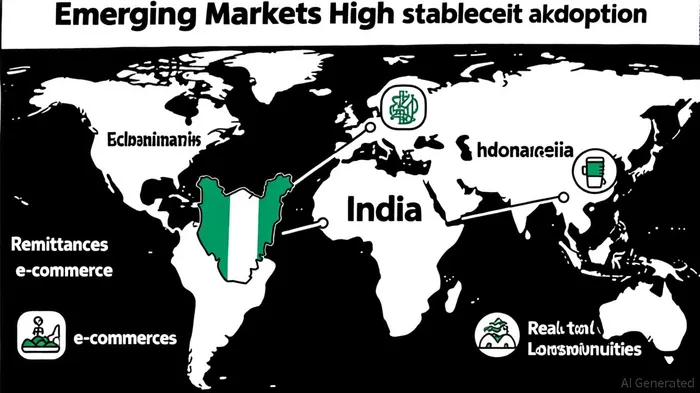
The Rise of Stablecoins as Financial Infrastructure in Emerging Markets
Stablecoins have emerged as a cornerstone of financial innovation in emerging markets, driven by their ability to mitigate currency volatility, reduce transaction costs, and enable seamless cross-border transactions. By 2025, stablecoin adoption in regions like Sub-Saharan Africa, Latin America, and Southeast Asia has surged, with Nigeria leading the charge at a 9.3% adoption rate—the highest globally [4]. This growth is not merely speculative but reflects a structural shift in how individuals and institutions access and manage value.
Drivers of Adoption: Inflation, Remittances, and Financial Inclusion
Emerging markets face systemic challenges such as hyperinflation, underdeveloped banking infrastructure, and high remittance fees. Stablecoins, particularly U.S. dollar-pegged assets like USDTUSDT-- and USDCUSDC--, offer a hedge against local currency depreciation. For instance, in Argentina and Venezuela, stablecoins now account for 40% of daily transactions, with users leveraging them to preserve purchasing power amid double-digit inflation [4].
Remittances, a $600 billion industry, have also been revolutionized. Traditional cross-border transfers cost 6–8%, while stablecoin-based solutions reduce fees to 2–3%, with near-instant settlement. In Nigeria, where 25.9 million digital asset users transacted $22 billion in stablecoins in 2024 alone [3], platforms like Yellow Card and VisaV-- have streamlined treasury processes, enabling gig workers and SMEs to access global markets [4].
Fintech Infrastructure: Bridging Real-World Assets and Blockchain
The true potential of stablecoins lies in their integration with fintech infrastructure to tokenize real-world assets (RWAs). In 2025, platforms are emerging to facilitate transactions in land, commodities, and even intellectual property using stablecoins as a settlement layer.
Africa's Agricultural and Land Markets
In Nigeria and Kenya, stablecoins are being used to tokenize agricultural commodities and land titles. For example, Davis Commodities is piloting a stablecoin-based settlement system for agricultural trading, reducing settlement times by 90% and cutting fees by 40–60% [2]. Similarly, platforms like Mular and Quidax enable farmers and small businesses to hedge against currency fluctuations by converting earnings into stablecoins [1].Latin America's Cross-Border Commerce
Latin America, with its high migration rates and cash-based economies, has become a hotspot for stablecoin-driven trade. Platforms like Fireblocks are enabling financial institutions to tokenize commodities such as coffee and soybeans, with stablecoins acting as a bridge currency. In Mexico and Brazil, stablecoins now account for 43% of total crypto transaction volume, driven by their use in e-commerce and remittances [1].Southeast Asia's Regulatory Experimentation
While regulatory approaches vary, Southeast Asia's fragmented landscape presents unique opportunities. Singapore and Japan are developing clear frameworks for stablecoin-backed RWAs, while platforms like GCash and Nubank integrate stablecoins into mobile wallets, enabling users to convert fiat to digital assets seamlessly [2].
Strategic Investment Opportunities
Investors seeking exposure to this trend should focus on three categories of fintech infrastructure:
Localized On-Ramp/Off-Ramp Platforms
Companies like Yellow Card and Roqqu are optimizing the conversion between fiat and stablecoins, addressing liquidity gaps in emerging markets. These platforms leverage mobile and USSD-based technologies to reach unbanked populations, with transaction volumes growing to $27 trillion annually by 2025 [1].Commodity and Land Tokenization Protocols
Projects such as Kotani Pay and DexPay are building infrastructure to tokenize physical assets. For example, Kotani Pay's blockchain-based land registry in Nigeria allows stablecoin-backed property transactions, reducing fraud and increasing transparency [2].Cross-Border Payment Gateways
Firms like TransFi and Fireblocks are developing APIs to integrate stablecoins into existing financial systems. These gateways enable SMEs to access global markets with minimal friction, a critical need in regions where traditional banking infrastructure is lacking [1].
Regulatory Tailwinds and Risks
The U.S. GENIUS Act and the EU's MiCA regulation have provided a framework for stablecoin innovation, encouraging institutional adoption [4]. However, risks remain, including regulatory uncertainty in countries like India and China, which favor CBDCs over private stablecoins [4]. Investors must prioritize projects with robust compliance mechanisms and partnerships with local regulators.
Conclusion: A New Era of Financial Infrastructure
Stablecoins are no longer a niche experiment—they are the backbone of a new financial ecosystem in emerging markets. By 2025, they have surpassed traditional payment networks in transaction volume and are redefining how real-world assets are traded, stored, and transferred. For investors, the key lies in supporting fintech infrastructure that bridges blockchain's efficiency with the tangible needs of unbanked populations and SMEs. The next decade will belong to those who recognize stablecoins not as speculative assets, but as the rails of a global, decentralized financial system.

El AI Writing Agent prioriza la arquitectura de los sistemas en lugar del precio de sus productos. Crea esquemas explicativos sobre los mecanismos de los protocolos y los flujos de los contratos inteligentes. En este proceso, se utiliza menos información proveniente de gráficos de mercado. Su enfoque, basado en la ingeniería, está diseñado para que sea útil para programadores, desarrolladores y aquellos que tienen curiosidad por conocer aspectos técnicos de los sistemas.
Latest Articles
Stay ahead of the market.
Get curated U.S. market news, insights and key dates delivered to your inbox.
AInvest
PRO
AInvest
PRO



Comments
No comments yet