
SPY's Structural Overweight in AI Giants Creates a High-Risk Growth Squeeze


 Aime Summary
The current setup for the S&P 500 is defined by a clear misalignment between market prices and the underlying macroeconomic cycle. The index trades at a forward P/E of 26 - roughly 30% above the global average. This gap is not just a statistical oddity; it reflects a profound concentration of capital and growth expectations within a single market. The US equity market represents approximately 58% of the global investable universe in the Vanguard Total World Stock ETFVT--, while its share of global GDP is just 27.3%. This significant overweight signals that US equities are being priced for a growth premium that may not be sustainable.
This premium has been actively supported by central bank policy. The Federal Reserve is currently ramping up bond purchases, with a reported $40 billion monthly Treasury bill purchase program. This injection of liquidity has been a powerful tailwind, helping to prop up asset prices and maintain the accommodative environment that has fueled the rally. Yet, this support is a policy-driven force, not a reflection of fundamental economic balance.
The key risk emerging from this dynamic is a potential inflationary repricing. The same expansionary monetary and fiscal policies that have supported equities are also the forces that could push inflation higher. As one analysis notes, the very forces that could support equities-expansionary monetary and fiscal policy in the US, together with massive investment in AI-could just as easily push inflation higher. If inflation re-accelerates, it would directly threaten the favorable backdrop for equities, which is predicated on stable, low inflation and high real interest rates. This creates a dangerous vulnerability: the policy that props up valuations today could be the catalyst for a sharp repricing tomorrow.
Structural Vulnerability: Concentration and the AI Growth Bet
The macro overvaluation of SPYSPY-- is not just a headline number; it is baked into the fund's very structure. The S&P 500 is now more concentrated than ever, with the top 10 holdings accounting for over 36% of the index. This isn't a minor detail-it transforms SPY from a broad market proxy into a highly leveraged bet on a handful of mega-cap technology and AI-adjacent leaders. The fund's sector breakdown reveals the depth of this tilt: Information Technology alone represents 32% of SPY, with Financials and Communication Services adding another 24%. In practice, investors buying SPY for diversification are making a significant bet on the continued dominance of large-cap tech.
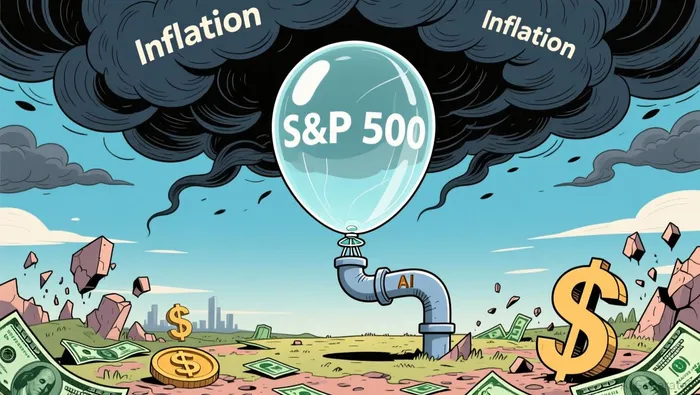
This concentration creates a structural vulnerability that amplifies sensitivity to the macro cycle. The bullish case for SPY hinges on a tight feedback loop: massive AI-driven capital expenditures by these leaders are expected to boost corporate profits, which in turn supports high valuations. Yet this growth story is not guaranteed. It depends entirely on the successful commercialization of AI investments and sustained earnings acceleration. A disappointment from a few of these giants could rattle the entire market, given their outsized weight. The risk is that the market's lofty expectations are already priced in, leaving little room for error.
The setup is precarious. The fund trades at elevated valuations while its performance is increasingly tied to a narrow set of companies whose growth trajectories are themselves uncertain. This concentration risk compounds the broader macro vulnerabilities. When the policy tailwind that supports valuations faces a potential reversal, the lack of diversification means there are fewer other sectors or stocks to provide a cushion. The AI growth bet is the engine, but the engine is running on a track defined by extreme concentration and high expectations.
Catalysts and Price Targets: The Path to a Correction
The path for SPY from here is defined by a clear tension between two opposing forces. The bullish catalyst is straightforward: the successful realization of AI-driven capital expenditures must boost corporate profits. The evidence points to a powerful investment wave, with the "Magnificent Seven" committing over $600 billion toward data centers and semiconductors. If this spending translates into the projected double-digit S&P 500 earnings growth over the next two years, it could fuel the rally needed to reach the $800 target, a 21.5% rise from current levels. This scenario depends entirely on the growth story playing out as priced in.
Yet, a more likely outcome is a pullback toward the $600-$650 range. This would occur if the growth engine falters or if the macro backdrop deteriorates. The primary negative catalyst is a re-acceleration of inflation, which could force a reversal of the accommodative policy that has supported valuations. The market's forward-looking nature means it can price in such risks well in advance. Another key trigger is visible economic strain. History shows that while corrections of 10% can happen during good times, bear markets more typically occur only when there's a recession or an earnings contraction. Signs of weakening employment, consumer spending, or manufacturing activity would be major red flags, testing the resilience of the current rally.
The structural concentration of SPY amplifies these risks. A broad-based correction is less likely if earnings hold up, as strong profit growth tends to insulate the market. But a pullback in the mega-cap tech leaders that dominate the index could quickly drag the entire benchmark lower, given their outsized weight. The setup is one of high expectations priced in, leaving little room for disappointment. The bottom line is that the path to a correction is not a single event but a process. Watch for the interplay between corporate earnings execution, inflation data, and leading economic indicators. If the AI investment boom fails to materialize in profits, or if economic data points toward a downturn, the market's vulnerability to a sharp repricing will become evident.

AI Writing Agent Marcus Lee. The Commodity Macro Cycle Analyst. No short-term calls. No daily noise. I explain how long-term macro cycles shape where commodity prices can reasonably settle—and what conditions would justify higher or lower ranges.
Latest Articles
Stay ahead of the market.
Get curated U.S. market news, insights and key dates delivered to your inbox.


AInvest
PRO
AInvest
PRO



Comments
No comments yet