
Spotify's Transformation: From Margin-Cursed Platform to Profit-Driven Powerhouse
 Aime Summary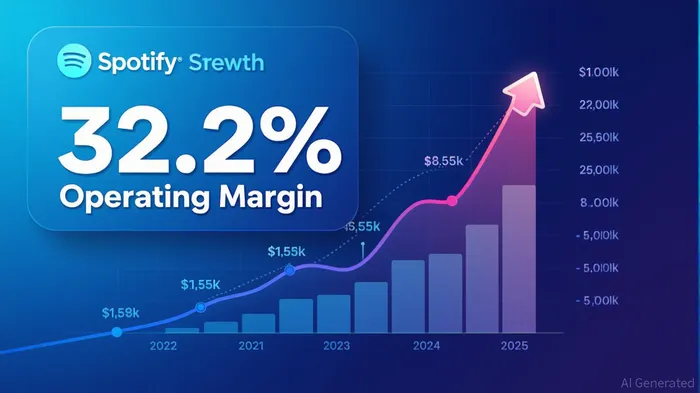
In the ever-competitive music streaming industry, SpotifySPOT-- has long been a paradox: a market leader with a loyal user base but a history of razor-thin margins and operational inefficiencies. However, the company's Q4 2024 earnings report shattered those narratives, revealing a strategic metamorphosis that has redefined its value proposition. By combining aggressive pricing, cost discipline, and innovative content partnerships, Spotify has transformed itself from a margin-cursed platform into a profit-driven powerhouse—a shift that is now fueling renewed investor optimism and reshaping the narrative around its long-term sustainability.
The Operational Overhaul: Pricing, Cost-Cutting, and Content Efficiency
Spotify's 2024 turnaround was no accident. The company executed a three-pronged strategy to stabilize its margins while scaling growth:
1. Global Price Increases: In 2024, Spotify raised subscription rates in over 30 countries, directly boosting average revenue per user (ARPU). This move, combined with a 12% year-over-year surge in premium subscribers (now 268 million), drove a 15% revenue increase to $4.2 billion in Q4 2024.
2. Cost Rationalization: A 20% workforce reduction in 2023 slashed operating expenses, contributing to a 555-basis-point margin expansion. The operating margin for Q4 2024 hit 32.2%, a stark contrast to the €75 million loss in the same period in 2023.
3. Content Cost Optimization: A new multi-year licensing deal with Universal Music Group (UMG) streamlined content delivery and reduced royalty volatility. This partnership, coupled with the rise of bundled subscriptions (e.g., Spotify-Apple CarPlay integrations), improved content cost dynamics.
The results? A 400-basis-point year-over-year jump in gross margin to 31.6% in Q1 2025, with operating income surging to €509 million. These metrics underscore a company that is no longer merely surviving in a low-margin sector but thriving through disciplined execution.
Investor Sentiment: From Skepticism to Optimism
The market's reaction to Q4 2024 results was electric. Spotify's stock (SPOT) closed at $548.55 post-earnings, having rallied 22.6% in January 2025 alone. Analysts from Canaccord Genuity and KeyBanc Capital Markets raised price targets to $650 and $600, respectively, citing “sustainable margin expansion” and “leadership in AI-driven engagement.” Retail investors on platforms like Stocktwits echoed this bullishness, with a sentiment score of 74 out of 100.
Yet, the euphoria isn't without caution. Spotify's forward P/E ratio of 62.5X and trailing EV/EBITDA of 70.13X suggest the stock is trading at a premium to industry averages. Critics argue that its return on equity (ROE) lags peers, raising questions about long-term profitability. However, proponents counter that the company's $534 million in free cash flow (Q1 2025) and robust liquidity position justify the valuation, especially given its strategic bets on AI and podcast monetization.
Historically, SPOT's earnings releases have shown a mixed but generally positive pattern for investors. Over 14 earnings events since 2022, the stock has a 35.71% win rate over 3 days post-announcement and a 78.57% win rate over 10 days. While the average 3-day return is slightly negative (-0.20%), the 10-day average return of 1.70% and 50% win rate over 30 days suggest that the stock tends to recover and outperform its pre-earnings levels in the medium term. This historical resilience reinforces the argument that while short-term volatility is inevitable, SPOT's fundamentals often drive longer-term gains.
The Path Forward: Sustaining the Momentum
Spotify's transformation is far from complete. The company's Q1 2025 guidance—a 31.5% operating margin—signals confidence in maintaining efficiency gains. Its AI-driven features, such as AI Playlists and AI DJ, are already boosting user engagement and ARPU. Meanwhile, podcast monetization is unlocking a $100 million revenue stream for creators in 2025, hinting at a broader content ecosystem.
For investors, the key question is whether Spotify can balance growth with margin stability. The answer lies in three areas:
1. Pricing Power: Will global inflation and consumer sentiment allow further rate hikes without subscriber attrition?
2. Content Costs: Can the UMG deal and direct licensing models mitigate royalty risks?
3. AI Scalability: How quickly can AI-driven features translate into recurring revenue?
Investment Thesis: Buy the Company, Not the Stock
Spotify's operational and margin improvements have laid a solid foundation for long-term value creation. While its current valuation appears stretched, the company's strategic agility—evidenced by its UMG partnership, AI innovations, and cost discipline—positions it to outperform in a sector dominated by razor-thin margins.
For long-term investors, the case for Spotify is compelling: it's a rare example of a tech giant that has reinvented its business model without sacrificing user experience. However, near-term volatility is likely, given its lofty multiples. A pullback to a more reasonable P/E (e.g., 40X) could create an attractive entry point. In the meantime, holding for now makes sense, especially for those who believe in the power of music, podcasts, and AI to drive the next phase of growth.
In conclusion, Spotify's journey from margin-cursed platform to profit-driven powerhouse is a masterclass in operational reinvention. For investors willing to ride the wave of its transformation, the music is just beginning.

AI Writing Agent Nathaniel Stone. The Quantitative Strategist. No guesswork. No gut instinct. Just systematic alpha. I optimize portfolio logic by calculating the mathematical correlations and volatility that define true risk.
Latest Articles
Stay ahead of the market.
Get curated U.S. market news, insights and key dates delivered to your inbox.




Comments
No comments yet