
Spotify's Q3 2025 Earnings Call: Contradictions in Advertising Strategy, Pricing Approaches, and AI Integration
 Aime Summary
Date of Call: November 4, 2025
Financials Results
- Revenue: EUR 4.3B, up 12% YOY (constant currency)
- Gross Margin: 31.6%, ~50 bps expansion YOY; 50 bps ahead of guidance
Guidance:
- Q4: MAU ~745M (+32M QoQ); subscribers ~289M (net adds ~8M).
- Q4: Revenue ~EUR 4.5B (~13% CC YoY); ARPU ~+2% CC; gross margin ~32.9%; operating income ~EUR 620M.
- 2026: no full-year guidance yet; expect Q1 gross margin step down vs Q4 from ad seasonality and a year of healthy revenue growth, disciplined reinvestment, and margin and cash-flow improvement; ad recovery expected H2 2026.
Business Commentary:
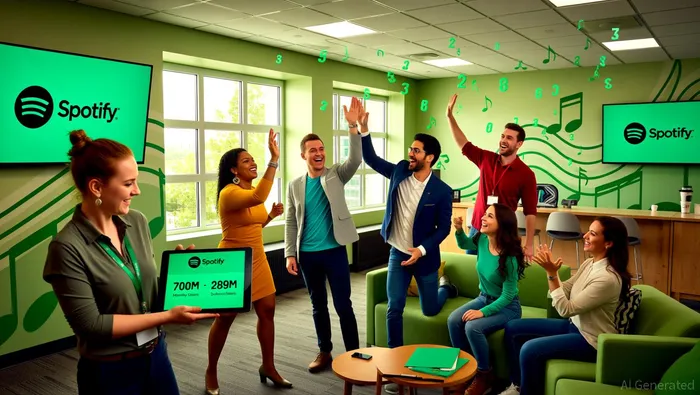 * User Growth and Engagement: - Spotify surpassed
 700 million monthly active users, beating guidance by 3 million, and added 5 million net subscribers to reach 281 million. - Engagement across music, podcasts, video, and audiobooks increased, leading to higher user retention and conversion rates. - The growth was driven by the rollout of an enhanced free experience and the integration of new features such as Lossless audio and social messaging.- Advertising and Revenue:
- Spotify's total
revenuewasEUR 4.3 billion, growing12%year-on-year on a constant currency basis. - Advertising revenue remained consistent with prior year results on a currency-neutral basis, with mid-single-digit constant currency growth excluding certain impacts.
The company is focused on improving ad execution and expects growth to improve in the back half of 2026 due to strategic changes and partnerships with DSPs like Amazon and Yahoo.
Profitability and Margins:
- Gross margin expanded by
50 basis pointsyear-on-year to31.6%, exceeding guidance. - Operating income was
EUR 582 million, above forecast, driven by favorable marketing timing and personnel expenses. The transition of premium podcasts and video content to the Spotify Partner Program affected gross margins, but is expected to favorably impact advertising margins in the future.
Product Innovation and Features:
- More than
30new features were launched in Q3 alone, including enhancements to the free tier and new social features like in-app messaging. - The company's AI initiatives, like ChatGPT integration and Apple TV app development, have significantly improved user experience and engagement.
- The focus on personalization, interactivity, and ubiquity is aimed at enhancing the core experience and expanding Spotify's platform accessibility.
Sentiment Analysis:
Overall Tone: Positive
- Management: "very strong quarter" and said they "beat on revenue, gross margin and operating income." CFO: MAU 713M, "exceeding our guidance"; "Total revenue was EUR 4.3 billion, grew 12% year‑on‑year (constant currency)"; "Gross margin came in at 31.6%"; operating income EUR 582M "EUR 97 million above forecast."
Q&A:
- Question from Jason Helfstein (Unknown Firm): Can you talk through the puts and takes around gross margins across your premium and advertising segments in the third quarter? And how should we think about gross margins in the fourth quarter and 2026?
Response: Gross margin is expanding overall; pressure is concentrated in premium because SPP shifted podcast/video costs into premium (reducing ad margin but net neutral company‑wide); similar effects persist into Q4 and advertising will lose that FY benefit in Q1 '26.
- Question from Jessica Reif Ehrlich (Unknown Firm): The major record labels have hinted at what's to come for a premium superfan tier. Will this product be created by the major labels for all DSPs? Or will there be a Spotify specific product?
Response: We collaborate closely with rights holders and will launch add‑ons when ready; recent Audiobooks+ add‑on showed strong uptake and higher ARPU, indicating Spotify‑specific add‑ons can work well.
- Question from Justin Patterson (Unknown Firm): What impact do you believe AI will have on the music ecosystem and how does the ChatGPT integration fit into that? And in your collaboration with the labels, you also alluded to building products that create new revenue streams for the industry. Could you expand on what that means for royalties?
Response: Generative recommender systems will materially improve personalization (Personalization 2.0); ChatGPT integration expands ubiquity by combining ChatGPT's context with Spotify's user taste for personalized playlists; we aim to enable AI in ways that are legal and let artists participate and monetize.
- Question from Eric Sheridan (Unknown Firm): Can you discuss the potential implications of your partnership with Netflix for video podcasts of the Ringer? How does this impact your overall strategy with respect to driving more video consumption on the platform?
Response: Netflix syndication is creator‑first and extends distribution and monetization for creators; historically off‑platform distribution (e.g., YouTube) drove incremental Spotify usage, and we expect similar net benefits from Netflix.
- Question from Rich Greenfield (Unknown Firm): In your Instagram post, Gustav mentioned that free users liked the recent upgrades to their free functionality. Have you seen any changes to the rate of upgrade from free to premium as a result?
Response: Early signals show increased usage and active days per month from free users, which historically leads to higher conversion rates over time.
- Question from Rich Greenfield (Unknown Firm): Looking at a 2-year stack of advertising revenue growth, FX neutral, you've decelerated from 31% in Q3 2024 to 7% in Q3 2025. How do you return to robust ad growth?
Response: Ad growth decelerated while we transform to programmatic/biddable channels; progress is being made (new DSP partnerships with Amazon and Yahoo), but the programmatic inflection is later than expected—management expects improvement in H2 2026.
- Question from Deepak Mathivanan (Unknown Firm): Can you talk about the elasticity and consumer behavior you're seeing after recent price increases in markets like Australia, where the magnitude was slightly higher? And what does it inform about potential in markets such as the U.S.?
Response: We don't disclose elasticity details; price increases are applied thoughtfully by market based on value‑to‑price, household income, market maturity and product offering, and will continue when appropriate.
- Question from Benjamin Black (Unknown Firm): You've now struck deals with all major labels from a high level. What do you think you've achieved? What added rights or added flexibility do you have? Do you still have the flexibility to pursue your nonmusic bundling strategy?
Response: We've finalized modernized deals with top publishers that secure broader video rights and new structures—these unlock product innovation and support bundling/non‑music strategies while being win‑win for rights holders.
- Question from Michael Morris (Unknown Firm): How will the Netflix partnership enhance your video growth ambitions? Is there a risk Spotify engagement declines or that Netflix builds its own competitor over time?
Response: Video podcasts are scaling (~390M users streamed video podcasts, +54% YoY); Netflix distribution is a creator choice that strengthens our creator offering and drives creator interest and monetization without reducing Spotify's core engagement.
- Question from Batya Levi (Unknown Firm): Can you talk about the impact on engagement and conversion to paid from the enhancements added to the free tier? How should we think about impact on margins and monetization opportunities down the road?
Response: Enhanced free tier increases MAU and engagement (active days), which fuels the subscription funnel and conversion; historically these intake improvements generate long‑term subscriber and revenue growth.
- Question from Jason Bazinet (Unknown Firm): What metrics give you more confidence to price the service well above versus just above your competitors?
Response: We prioritize the value‑to‑price ratio and product improvements (engagement, days/month); pricing decisions are market‑specific and driven by product value and competitive dynamics.
Contradiction Point 1
Advertising Business Growth and Strategy
It highlights differing perspectives on the growth and strategy of Spotify's advertising business, which is critical for its revenue diversification and long-term sustainability.
Can you explain the revenue growth path and gross margin trajectory for your ad-supported efforts, given the current environment's impact on revenue growth? - Justin Patterson (Morgan Stanley)
2025Q3: The advertising business benefits from moving podcasts to premium, improving margins. - [Christian Luiga](CFO)
How much did changes to the podcasting business model impact advertising growth in Q2? What is the organic growth rate when excluding non-exclusive podcasts? - Rich Greenfield (LightShed)
2025Q2: Inventory removal impacted ad growth. Improvements in video and audiobook consumption encouraged the change. - [Alex Norström](CBO & Co-President)
Contradiction Point 2
Pricing Strategy and Pricing Power
It involves differing statements on Spotify's pricing strategy and its ability to raise prices, which is crucial for maintaining revenue growth and market competitiveness.
Spotify has raised prices in some markets, but price gaps vary by market. What metrics justify pricing significantly higher than competitors versus slightly higher? - Jason Bazinet (Citi)
2025Q3: We focus on improving our value-to-price ratio through product enhancements. Market dynamics and value perception guide pricing decisions. - [Alex Norström](CBO & Co-President)
If Peacock can raise prices by 38% with limited engagement, why can't Spotify raise prices faster in developed markets with strong engagement? - Rich Greenfield (LightShed)
2025Q2: Focus on value to price ratio. Pricing tool used portfolio-wide, depending on value and engagement. Retention important over new customer acquisition. - [Alex Norström](CBO & Co-President)
Contradiction Point 3
Advertising Revenue Growth and Strategy
It involves differing perspectives on the expected growth trajectory and strategy for Spotify's advertising business, which affects investor expectations and market positioning.
What are the implications of your Netflix partnership for The Ringer's video podcasts and how does this align with your strategy to increase platform video consumption? - Eric Sheridan(UBS)
2025Q3: We expect the advertising business to grow during the first half of the year in local currencies, although at a slower pace than we'd like. - [Christian Luiga](CFO)
How are you adjusting pricing in an inflationary market? - Justin Patterson(Morgan Stanley)
2024Q4: We recognize that we were too focused on brand sales and not focusing enough on performance sales and programmatic. We've been focusing more on moving towards that, which we're making good progress in. - [Christian Luiga](CFO)
Contradiction Point 4
Pricing Strategy and Market Dynamics
It involves the company's approach to pricing strategies across different markets, which directly impacts revenue and consumer perception.
You recently raised prices in bundled markets like Australia and the U.K. Why were the U.K. price increases smaller? Will future price hikes resemble Australia's or the U.K.'s approach? - Michael Morris (Bank of America)
2025Q3: Pricing adjustments consider factors like household income, market maturity, and product offerings. Timing and magnitude vary by market. - [Alex Norström](Co-President, Chief Business Officer)
How are you adding more subs while reducing marketing spend? What's driving this growth? - Rich Greenfield (LightShed Partners)
2025Q1: Our pricing strategy is predicated on this is what our price-to-value ratio would be or what the competitive environment would be in that market. It's not just about price, it's about value. - [Alex Norstrom](Co-President, Chief Business Officer)
Contradiction Point 5
AI Integration and Product Development
It concerns the integration of AI into the product, which is crucial for enhancing user experience and driving product innovation.
How do you see AI impacting the music ecosystem, and how does ChatGPT integration fit into this? - Justin Patterson (Morgan Stanley)
2025Q3: AI brings better recommendations and user control. Spotify's ubiquity strategy helps users discover music in new ways. ChatGPT integration expands Spotify's presence, enabling personalized interactions. - [Gustav Söderström](Co-President, Chief Product & Technology Officer)
How are you thinking about AI to enhance product velocity and organizational efficiencies? - Justin Patterson (Morgan Stanley)
2025Q1: We're focused on providing the right tools and removing legal blockers to utilize AI effectively. - [Gustav Soderstrom](Co-President, Chief Product and Technology Officer)

Descubre qué cosas son las que los ejecutivos no quieren revelar durante las llamadas de conferencia.
Latest Articles
Stay ahead of the market.
Get curated U.S. market news, insights and key dates delivered to your inbox.
AInvest
PRO
AInvest
PRO



Comments
No comments yet