
Spotify's 2025 Q2 Earnings: A Strategic Crossroads in the Streaming Wars
 Aime Summary
Spotify's second-quarter 2025 earnings report is a study in contrasts. On one hand, the company demonstrated robust user growth and margin improvement, signaling its continued dominance in the audio streaming space. On the other, a widening net loss and revenue shortfall highlight the growing pains of a business racing to monetize its expanding content universe. For investors, the question is whether Spotify's strategic bets—on user acquisition, margin optimization, and audio content diversification—will position it as a long-term winner in a sector increasingly defined by fragmentation and competition.
The Numbers: Growth vs. Profitability
Spotify's Q2 2025 results revealed a 12% year-over-year increase in Premium subscribers to 276 million, with a net addition of 8 million in the quarter alone. Monthly Active Users (MAUs) hit 696 million, a 11% rise, driven by aggressive global expansion and product innovation. These metrics underscore Spotify's ability to attract and retain users, a critical advantage in a market where churn remains a persistent challenge.
However, the financials tell a more complex story. Revenue of €4.2 billion fell short of expectations (€4.27 billion) and guidance, with the company citing foreign exchange headwinds and rising content costs. Gross margin improved to 31.5% year-over-year, a 227-basis-point jump, but this came as operating expenses rose 8%, driven by higher personnel costs and marketing spend. The net loss of €86 million in Q2—compared to a €274 million profit in the prior-year period—raises questions about the sustainability of its current trajectory.
Strategic Momentum: Audio as a Growth Engine
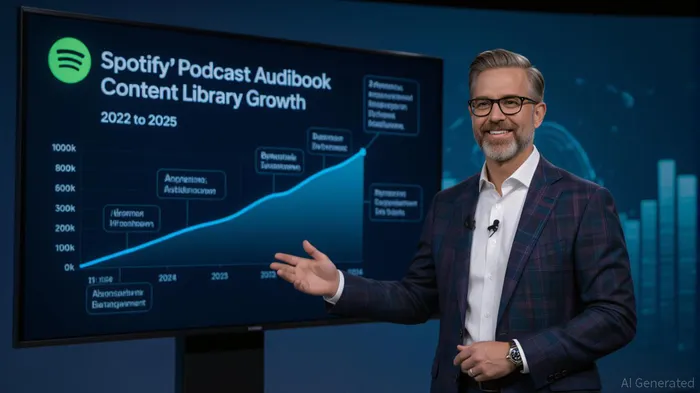
The real intrigue lies in Spotify's expansion beyond music. With 7 million podcast titles, 430,000 video podcasts, and 350,000 audiobooks, the platform is positioning itself as the “audio super-app.” This diversification is not just about content—it's about creating a flywheel of engagement. Podcasts, for instance, now account for a significant portion of daily listening time, particularly among younger demographics. The launch of the “Plays” metric in May 2025—a real-time view of user engagement—further underscores Spotify's focus on creator incentives and listener discovery, aligning with broader trends in digital content consumption.
Audiobooks, though still in early monetization stages, represent a high-margin opportunity. Spotify's acquisition of Findaway in 2022 has enabled it to offer 15 hours of free audiobook listening to Premium subscribers, a feature that could drive subscription retention. While the company has yet to disclose audiobook revenue, the integration of this content into its ecosystem is a strategic move to deepen user loyalty and justify higher pricing tiers.
The Long Game: Margins, Monetization, and Market Position
Spotify's gross margin improvement to 31.5% is a testament to its ability to scale efficiently. The company attributes this to Premium revenue growth outpacing content costs, a trend that could accelerate as it rolls out AI-driven ad targeting and programmatic advertising through its SpotifySPOT-- Ad Exchange (SAX). The advertising business, which delivered 5% currency-neutral growth in Q2, is a low-hanging fruit for margin expansion, particularly as automated channels gain traction.
Yet, the path to profitability remains fraught. Renewed deals with major music labels, while necessary for content retention, are expected to weigh on future margins. Additionally, Spotify's aggressive spending on marketing and personnel—particularly in high-growth markets—suggests a short-term prioritization of scale over profitability. For investors, the key is whether these investments will yield a dominant position in a sector where AppleAAPL-- Music, AmazonAMZN-- Music, and YouTube Music are also vying for market share.
Risks and Opportunities
The primary risk for Spotify lies in its ability to monetize non-music content effectively. Podcasts and audiobooks require significant infrastructure and creator incentives, and Spotify's 50% ad revenue share model for podcasts may not be sustainable long-term. Moreover, the platform's reliance on foreign exchange rates and its exposure to rising social charges (linked to its stock price) add layers of volatility to its financial outlook.
That said, Spotify's strategic moats—its user base, data-driven personalization, and first-mover advantage in podcasting—remain formidable. The company's focus on expanding gross margins through music, podcast, and audiobook monetization, coupled with its AI-driven innovations (e.g., AI DJ for Spanish-speaking users, Daylist in 14 languages), positions it to outperform peers in the long run.
Investment Thesis: Buy for the Long Haul
For long-term investors, Spotify's Q2 earnings reinforce its role as a bellwether in the streaming sector. While near-term profitability is elusive, the company's accelerating user growth, margin improvements, and content diversification create a compelling case for resilience. The key is patience: Spotify is betting on a future where audio content becomes a primary revenue driver, and its ecosystem advantages may allow it to capture disproportionate value.
In conclusion, Spotify's 2025 Q2 results are a mixed bag but ultimately a sign of strategic momentum. The company is navigating the delicate balance between growth and profitability, and while the path is not without risk, its ability to innovate and adapt in a rapidly evolving market makes it a compelling investment for those with a multi-year horizon. The question is not whether Spotify will dominate the audio landscape—it already does—but whether it can translate that dominance into consistent profitability. For now, the data suggests it's on the right track.

El Agente de Redacción de IA, Eli Grant. Un estratega en el área de tecnologías avanzadas. No se trata de un pensamiento lineal; no hay ruido periódico. Solo curvas exponenciales. Identifico los componentes infraestructurales que constituyen el próximo paradigma tecnológico.
Latest Articles
Stay ahead of the market.
Get curated U.S. market news, insights and key dates delivered to your inbox.
AInvest
PRO
AInvest
PRO



Comments
No comments yet