
Sportsman's Warehouse Q2 2025 Earnings Call: Contradictions in Inventory Strategy, Tariff Impacts, and Margins
Generated by AI AgentAinvest Earnings Call Digest
Thursday, Sep 4, 2025 7:55 pm ET3min read
 Aime Summary
The above is the analysis of the conflicting points in this earnings call
Date of Call: September 4, 2025
Financials Results
- Revenue: $293.9M, up 1.8% YOY
- EPS: $-0.18 per diluted share, compared to $-0.16 in the prior year
- Gross Margin: 32%, up 80 bps YOY; ~40 bps drag from freight due to inventory pull-forward
Guidance:
- FY2025 net sales outlook raised at the low end to flat YOY; range now 0% to +3.5%.
- Adjusted EBITDA reiterated at $33M–$45M.
- Capex reiterated at $20M–$25M (tech, store service/merch productivity, maintenance).
- Expect positive free cash flow for FY2025.
- Year-end inventory expected below prior-year level; Q2 was peak; slight sell-down in Q3.
- Debt expected to decline in 2H as EBITDA improves and inventory sells down.
- Modest gross margin improvement assumed; potential tariff-related headwinds considered.
Business Commentary:
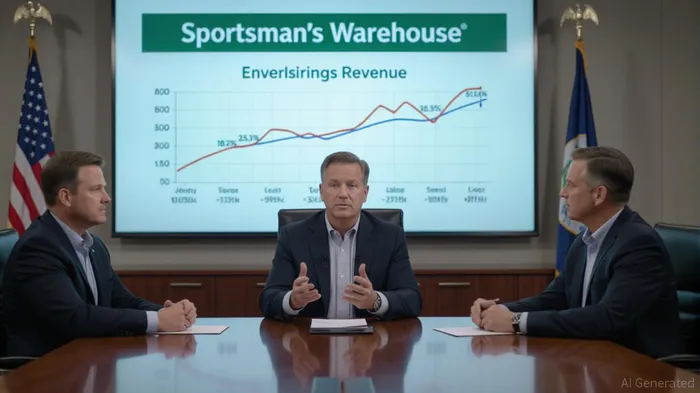
* Sales and Market Performance: - Sportsman's Warehouse reported a 1.8% increase in net sales to$393.9 million for Q2 2025, marking their second consecutive quarter of sales growth. - The growth was driven by strong performance in hunting and shooting sports (up 4%) and fishing (up 10.9%), while camping sales declined by 10%. - This sales momentum was supported by strategic localization of merchandise and geotargeted marketing, particularly in regions like Alaska.- Inventory and Strategic Positioning:
- Total inventory at the end of Q2 was
$443.5 million, a significant increase compared to$363.4 millionin the same period last year. - This strategic decision aims to ensure well-timed inventory readiness for key hunting seasons, with a focus on depth in core, seasonally relevant items.
The company anticipates ending the year with lower inventory levels than the previous year, aligning with their goal of reducing working capital investment.
Firearms and Ammunition Market Share:
- Despite a decline in adjusted NICS checks by 4.9%, unit sales of firearms at Sportsman's Warehouse increased by more than 4% compared to the previous year.
This outperformance is attributed to capturing market share due to strategic merchandising and marketing efforts, particularly in aligning with local outdoor pursuits and solution selling.
Personal Protection Category Expansion:
- Sportsman's Warehouse has expanded the personal protection category, including the launch of TASER and ByrnaBYRN-- products, which are resonating with customers.
- This expansion is driven by increasing consumer interest in less lethal and self-defense products, and the company expects significant growth in these segments in the back half of the year.
Sentiment Analysis:
- Same-store sales up 2.1% YOY (second straight positive quarter); e-commerce +3%. Gross margin 32%, up 80 bps. Net loss of $7.1M (-$0.18/share) vs -$5.9M last year. Raised low end of FY25 sales outlook to flat (range up to +3.5%), reiterated EBITDA $33–$45M and capex $20–$25M, expect positive FCF and lower year-end inventory. Management cited macro headwinds and possible tariff-driven margin pressure.
Q&A:
- Question from Anna Glaessgen (B. Riley Securities): What drove the positive comps and how durable is growth as out-of-stock benefits ease into 2026?
Response: Focus on hunt/shoot, fishing, and personal protection plus better in-stocks drove comps, with momentum continuing into Q3; attachment and inventory mix optimization provide runway.
- Question from Anna Glaessgen (B. Riley Securities): What are the margin puts/takes implied in the back half?
Response: Mix shift to lower-margin hunt (firearms/ammo), fading fish penetration, and typical Q4 promotions will pressure rate despite underlying improvements.
- Question from Matt Koranda (ROTH Capital Partners): How did demand trend in August and how do you feel about back-half comps?
Response: August accelerated versus Q2 (strong NICS); Q3 has a tailwind, while Q4 will be an apples-to-apples digital comp.
- Question from Matt Koranda (ROTH Capital Partners): AOV trends and runway for attachment?
Response: AOV and UPT are at all-time highs; still early in attachment build-out with significant upside as inventory and add-on assortments expand.
- Question from Ryan Sigdahl (Craig-Hallum Capital Group): Are lethal and non-lethal trends linked, and how are you leaning into non-lethal?
Response: Non-lethal is attracting new customers; expanding Byrna/TASER presence and store count to grow personal protection alongside firearms.
- Question from Ryan Sigdahl (Craig-Hallum Capital Group): Store portfolio strategyMSTR-- vs. new units?
Response: Prioritize debt paydown and optimizing existing stores; evaluate closures at lease end; defer new-store growth until balance sheet strengthens.
- Question from Justin Kleber (Baird): Break down comps by transactions vs. ticket?
Response: Both AOV and UPT are up; strong BOPUS (≈70% of online) is driving in-store traffic and transactions.
- Question from Justin Kleber (Baird): How are tariffs affecting pricing and your outlook?
Response: Vendor collaboration and heavy MAP exposure provide pricing flexibility; tariffs are considered in the guide, and inventory was pulled forward to mitigate.
- Question from Justin Kleber (Baird): Margin mix vs. freight impact in Q2?
Response: Rate improved across categories except Hunt; mix (more Hunt, less Camping) pressured margin; freight was a ~40 bps headwind; overall improvement came from higher rates.
- Question from Mark Smith (Lake Street Capital Markets): Elevated inventory—how much was timing/pull-forward and are you set for season?
Response: Deliberate early build in hunt/fish to be in-stock sooner; plan to sell through and finish the year below last year’s inventory.
- Question from Mark Smith (Lake Street Capital Markets): Consumer behavior in Hunt—promo vs. price points?
Response: EDLP in ammo and unit gains led the category; firearms AUR down ~4% while units up ~4.2%.
- Question from Mark Smith (Lake Street Capital Markets): Opportunity in suppressors/SBR next year?
Response: Leaning in now with partners to enable direct-ship in Q4 and capture an expected demand spike in 2026, while limiting working-capital burden.

Descubre lo que no quieren revelar en las conferencias de operadoras
Latest Articles
Stay ahead of the market.
Get curated U.S. market news, insights and key dates delivered to your inbox.


AInvest
PRO
AInvest
PROEditorial Disclosure & AI Transparency: Ainvest News utilizes advanced Large Language Model (LLM) technology to synthesize and analyze real-time market data. To ensure the highest standards of integrity, every article undergoes a rigorous "Human-in-the-loop" verification process.
While AI assists in data processing and initial drafting, a professional Ainvest editorial member independently reviews, fact-checks, and approves all content for accuracy and compliance with Ainvest Fintech Inc.’s editorial standards. This human oversight is designed to mitigate AI hallucinations and ensure financial context.
Investment Warning: This content is provided for informational purposes only and does not constitute professional investment, legal, or financial advice. Markets involve inherent risks. Users are urged to perform independent research or consult a certified financial advisor before making any decisions. Ainvest Fintech Inc. disclaims all liability for actions taken based on this information. Found an error?Report an Issue


ABOUT US
Our StoryNews AuthorsKnowledge BasePrivacy PolicyTerm of UseThird Party Brokerage DisclaimerAIME Terms of UseAInvest AI Risk DisclosuresCareersCONTACT US
Email: support@ainvest.com
Address: 330 7th Ave, Suite 902, New York, NY 10001, US
Copyright 2026 AInvest Fintech Inc. All rights reserved.


Comments
No comments yet