
Sportradar Group (SRAD) Plunges 4.19% as Bearish Signals Intensify Amid Five-Day 12.87% Slide
Generated by AI AgentAinvest Technical RadarReviewed byShunan Liu
Wednesday, Jan 7, 2026 9:44 pm ET2min read
SRAD-- Aime Summary
 The 50-day moving average (approximately $23.50) and 200-day moving average (around $24.00) are both above the current price of $21.06, confirming a bearish trend. The 100-day moving average (~$23.30) further reinforces this divergence. A crossover of the 50-day MA below the 200-day MA (death cross) would amplify the bearish bias, while a sustained close above the 200-day MA could indicate a shift in sentiment. Short-term traders may monitor the 50-day MA as a dynamic support level, with a break below triggering deeper bearish momentum.
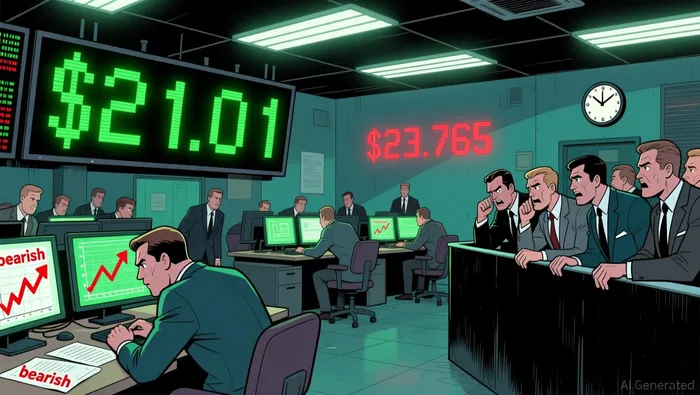
Aime SummarySportradar Group (SRAD) has experienced a sharp decline of 4.19% in the most recent session, marking its fifth consecutive down day with a cumulative 12.87% drop over five days. The price action reflects heightened bearish momentum, with key support levels forming around the $21.01 intraday low and resistance near $23.765. The candlestick patterns, including a bearish engulfing formation and a dark cloud cover, suggest continued selling pressure, while a potential bullish reversal may emerge if the price stabilizes above $21.06.
Candlestick Theory
The recent price action exhibits a series of bearish candlestick formations, including long lower shadows and narrow-range bodies, indicating capitulation from short-term traders. A key support level is established at $21.01, where a potential bullish reversal could materialize if the price closes above this level. Conversely, resistance is evident near $23.765, with multiple failed attempts to breach this threshold. A breakdown below $21.01 would likely extend the downtrend toward the next support at $20.00, while a rebound above $23.05 could signal a short-term consolidation phase.Moving Average Theory
The 50-day moving average (approximately $23.50) and 200-day moving average (around $24.00) are both above the current price of $21.06, confirming a bearish trend. The 100-day moving average (~$23.30) further reinforces this divergence. A crossover of the 50-day MA below the 200-day MA (death cross) would amplify the bearish bias, while a sustained close above the 200-day MA could indicate a shift in sentiment. Short-term traders may monitor the 50-day MA as a dynamic support level, with a break below triggering deeper bearish momentum. MACD & KDJ Indicators
The MACD line has crossed below the signal line, forming a bearish crossover, with the histogram showing declining bullish momentum. The KDJ (Stochastic) oscillator is in oversold territory (K=25, D=30), suggesting potential exhaustion of the downtrend. However, the absence of a bullish divergence between price and the KDJ (e.g., lower lows in price but higher lows in the oscillator) weakens the case for a reversal. A sustained close above $21.50 could trigger a KDJ crossover, signaling a short-term rally.Bollinger Bands
The price is currently near the lower Bollinger Band ($21.01), indicating low volatility and a high probability of continued selling pressure. The 20-day standard deviation is contracting, suggesting an impending breakout or breakdown. A break below the lower band would validate bearish expectations, while a rebound above the middle band ($22.00) could initiate a consolidation phase. The upper band ($24.50) remains a distant resistance, requiring a significant reversal to test.Volume-Price Relationship
Trading volume has remained elevated during the recent decline, confirming the validity of the downtrend. A sharp increase in volume on a bearish candle would reinforce the continuation pattern, while a decline in volume could indicate waning selling pressure. Conversely, a surge in volume on a bullish candle near support levels would suggest a potential reversal, though current volume patterns do not yet support this scenario.Relative Strength Index (RSI)
The 14-day RSI is in oversold territory (~28), aligning with the KDJ oscillator’s signal. While this suggests the price may be overextended to the downside, the RSI has not yet formed a bullish divergence with price action, limiting the probability of an immediate reversal. A close above $21.50 would push the RSI above 30, signaling a potential short-covering rally, though a sustained move above $22.50 would be required to confirm a broader trend reversal.Fibonacci Retracement
Key Fibonacci levels from the recent high of $26.90 to the low of $21.01 include 38.2% at $24.20 and 61.8% at $22.10. The price has tested the 61.8% level multiple times, with a break below $22.10 likely to target the 78.6% retracement at $20.70. A sustained close above $22.10 could trigger a retest of the 50% level at $23.95, offering a potential entry point for countertrend traders.Confluence and Divergences
A confluence of bearish signals is evident at current price levels, with the RSI in oversold territory, MACD bearish, and Bollinger Bands compressed. However, a divergence between the KDJ oscillator and price action (e.g., higher lows in the oscillator despite lower lows in price) could hint at a near-term bottom. The absence of a bullish reversal pattern in candlestick theory and a failure to close above the 200-day MA would maintain the bearish bias.
If I have seen further, it is by standing on the shoulders of giants.
Latest Articles
Stay ahead of the market.
Get curated U.S. market news, insights and key dates delivered to your inbox.
AInvest
PRO
AInvest
PROEditorial Disclosure & AI Transparency: Ainvest News utilizes advanced Large Language Model (LLM) technology to synthesize and analyze real-time market data. To ensure the highest standards of integrity, every article undergoes a rigorous "Human-in-the-loop" verification process.
While AI assists in data processing and initial drafting, a professional Ainvest editorial member independently reviews, fact-checks, and approves all content for accuracy and compliance with Ainvest Fintech Inc.’s editorial standards. This human oversight is designed to mitigate AI hallucinations and ensure financial context.
Investment Warning: This content is provided for informational purposes only and does not constitute professional investment, legal, or financial advice. Markets involve inherent risks. Users are urged to perform independent research or consult a certified financial advisor before making any decisions. Ainvest Fintech Inc. disclaims all liability for actions taken based on this information. Found an error?Report an Issue


ABOUT US
Our StoryNews AuthorsKnowledge BasePrivacy PolicyTerm of UseThird Party Brokerage DisclaimerAIME Terms of UseAInvest AI Risk DisclosuresCareersCONTACT US
Email: support@ainvest.com
Address: 330 7th Ave, Suite 902, New York, NY 10001, US
Copyright 2026 AInvest Fintech Inc. All rights reserved.


Comments
No comments yet