

The cornerstone investor is supposed to be the stampede. In a Hong Kong IPO, the cornerstone is the first buyer committed before the general book even really opens — a big name that signs up at the top of the offer range, in exchange for a guaranteed allocation at whatever price the deal eventually prints, and in return for not selling for at least six months. Its whole function is to be the visible evidence that sober institutional money looked at this deal, did the work, and wanted in badly enough to accept a lockup. Every subsequent buyer reads the cornerstones first.
So here is the strange thing about the cornerstones reportedly being assembled for Shein's Hong Kong listing. Shein is reportedly setting aside at least $400 million of the deal for cornerstone investors — roughly a fifth of the reported $2 billion raise — and by one report, most of those positions would go to the company's own existing shareholders, doubling down, while the banks arranging the transaction are considering putting their own funds into cornerstone slots. That is not a stampede of fresh demand. That is a deal, painted into a corner, standing up its own date.
A cornerstone allocation is the one thing a banker can offer a big investor without actually offering anything: the investor commits before pricing, and in exchange for the certainty of a big allocation it gives up the right to sell for six months after listing. Hong Kong's guidance letter GL51-13 forbids the listing company from slipping cornerstones anything extra — no put options from the controlling shareholders, no sharing of underwriting commissions, no commitments to recycle proceeds back into the investor's funds — on the theory that side-letter sweetness would mislead the public about how real the demand is. The guaranteed allocation at the official price is the entire legitimate bargain. And because cornerstones book first, at the top of the range, the bookrunner can point at a wall of committed orders to defend the price band against everyone who shows up later.
That design is exactly what makes the reported shape of Shein's anchor so informative. Pre-selling roughly 20% of a $2 billion deal is mechanically useful: it is committed demand, it is locked up, it makes the pricing line hold. But a cornerstone roster that is mostly the company's own shareholders, with the banks potentially backstopping the rest, is not evidence that the market wants the stock. It is evidence that the deal's incumbent owners have the strongest incentive to build the floor. Investor: "I thought the cornerstones proved the market was here." Company: "Sure, but contractually they prove the deal can price." One of those is a signal about demand; the other is a description of who is holding the book together. This looks like the second one — a sponsored floor under a soft book, and only partly a market test.
The two gates she cleared, and the one she hasn't
Put the mechanistic cynicism aside for a second, though, because the case that this IPO actually happens in September is real, and it rests on the regulatory gates. China's securities regulator completed approval of the Hong Kong filing on July 10, 2026, and the Hong Kong exchange's listing committee approved the offering in mid-to-late July. Those are precisely the two gates that killed Shein's earlier attempts: the confidential US filing stalled under tariffs, an FTC investigation and scrutiny over labor practices, and Beijing blocked the London prospectus over risk disclosures tied to the company's China supply chain. A mainland-rooted company effectively cannot schedule a Hong Kong listing until Beijing signs off, and Beijing signed off.
But the live gate is no longer regulatory; it is the order book. The company is targeting a bookbuild starting around August 24 and a listing around September 1 — which is itself already a slip, from late August, on a reported "slight delay in taking investor orders." September 1 is a target, not a contract. The scheduling variable now is whether the book fills, and holds together, inside the price band. That is the entire game.
The price of the exit
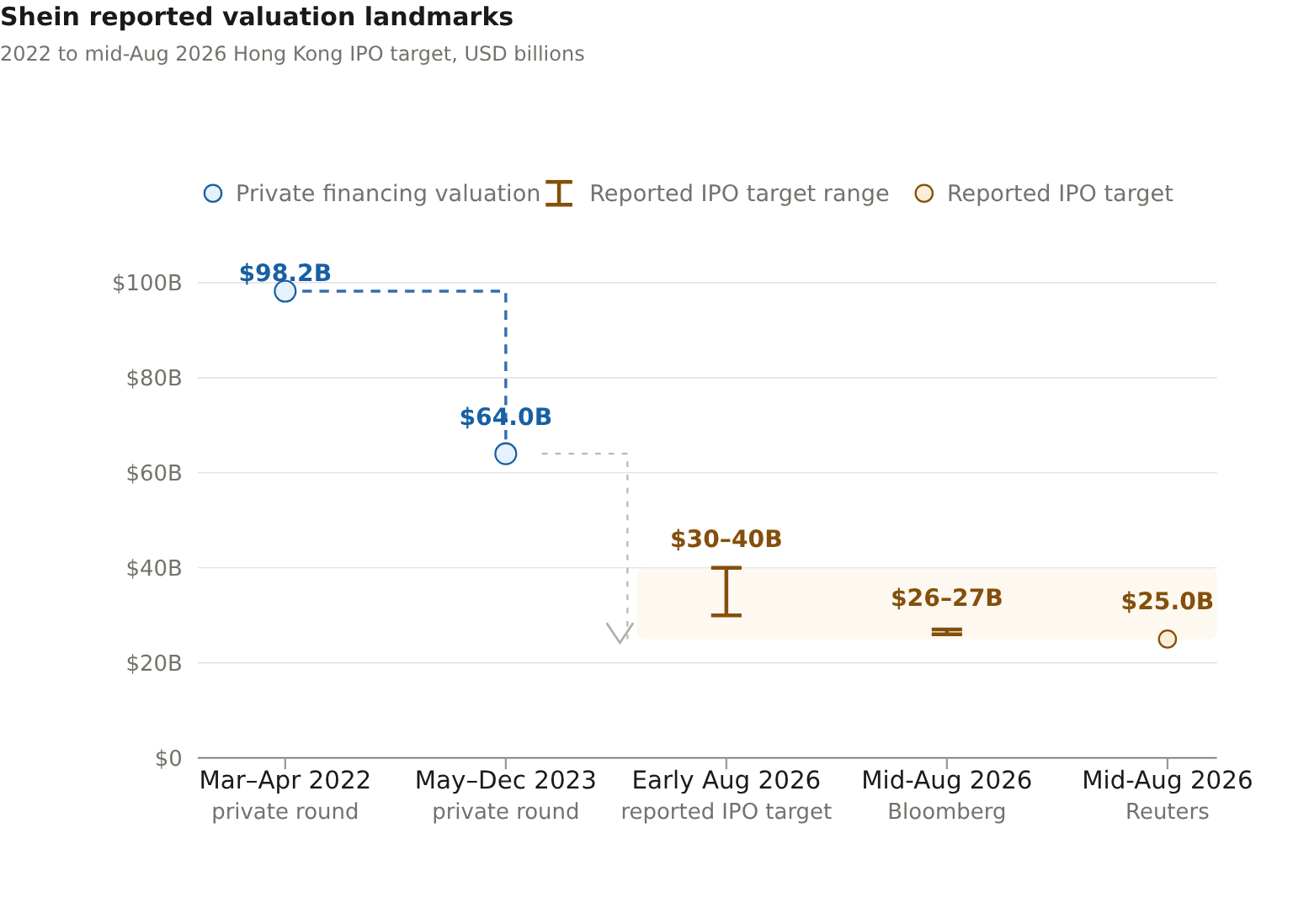
Which brings you to the price. Shein raised about $1.8 billion in early 2022 at a private valuation of roughly $98.2 billion, then about $1.7 billion in 2023 at around $64 billion. The reported Hong Kong targets since then have been a one-way ride: $30 billion to $40 billion in early August, pulled back to $26 billion to $27 billion per Bloomberg in mid-August, and roughly $25 billion per Reuters days later, with one source describing a $25 billion to $28 billion window tied to the actual price range. The operative reported band is about $25 billion to $27 billion, and it should be treated as a negotiation, not a number. At around $25 billion, floating up to 8% of the company implies gross proceeds of something like $2 billion.
Shein reported valuation landmarks
2022 to mid-Aug 2026 Hong Kong IPO target, USD billions
| Period | Valuation (USD billions) | Nature |
|---|---|---|
| Mar–Apr 2022 private round (~$1.8B raised) | 98.2 | Private financing valuation |
| May–Dec 2023 private round (~$1.7B raised) | 64.0 | Private financing valuation |
| Early Aug 2026 reported IPO target | 30–40 | Reported IPO target range |
| Mid-Aug 2026 reported IPO target (Bloomberg) | 26–27 | Reported IPO target range |
| Mid-Aug 2026 reported IPO target (Reuters) | 25.0 | Reported IPO target |
The point of lining up those landmarks is not the tidy downward staircase, though that staircase is where the whole story lives. A business priced as high-growth internet at ~$100 billion has to be re-priced as a mature, tariff-threatened apparel retailer at ~$25 billion — that gap, roughly a $70 billion de-rating in a little over four years, is the reason this deal can no longer sell itself and has to be held together by hand. The cornerstone floor is a symptom of the de-rating, not a cure for it.
The growth story, in reverse
The financials explain the staircase. Revenue growth decelerated from 41.1% in fiscal 2023 to 20.7% in fiscal 2024, to 8% in fiscal 2025 (on revenue of about $41.8 billion), and then to just 1.1% year over year in the first quarter of 2026. The first quarter also swung to a net loss of about $99 million from a profit of $395 million a year earlier — a swing that partly reflects one-time accounting charges and convertible-share losses rather than pure operating carnage, but the direction is unmistakable.
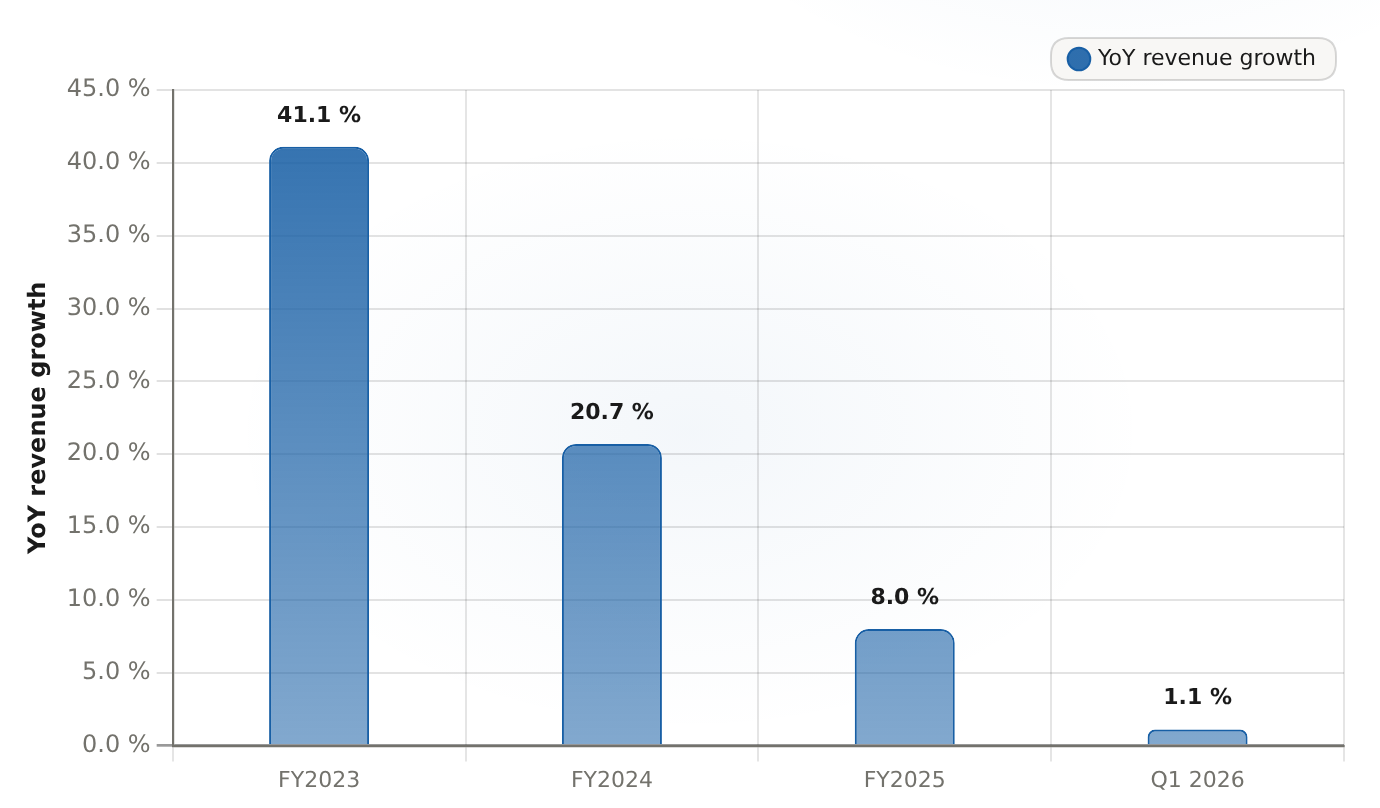
Shein's YoY revenue growth fell from ~41% (FY2023) to ~1% (Q1 2026), collapsing the high-growth narrative that once justified a ~$100B valuation.
| Period | YoY revenue growth (%) |
|---|---|
| FY2023 | 41.1 |
| FY2024 | 20.7 |
| FY2025 | 8 |
| Q1 2026 | 1.1 |
Why the growth stopped matters more than the top line itself. The US removal of the de minimis duty exemption on low-value parcels, plus new US tariffs from May 2025, forced Shein to raise prices, and US revenue fell more than 3% in 2025 and then 14% year over year in the first quarter of 2026. On the other side of the world, new European charges on low-value imports and an EU Digital Services Act probe added another layer of cost and regulatory friction. A company growing 1.1% a year, losing money in its most recent quarter, fighting tariffs on both continents and under an FTC investigation is exactly the sort of business that prices at a quarter of what it was once worth — and exactly the sort of business that needs its friends to stand near the book when it comes to market.
Whether the floor holds
Keep the epistemic honesty in view, because almost every number in this story is a rumor with good posture. The $400 million cornerstone reserve, the UBS Asset Management and Boyu Capital talks, the $2 billion raise, the September 1 date, and the valuation targets all come from unnamed people familiar with the matter. Shein has not confirmed the list; UBS declined to comment; Boyu, Tencent and the rest of the reportedly approached names mostly did not respond, and the lineup is not finalized. When everyone is describing a deal through intermediaries, the deal is not done.
So the watchlist is operational. The live metric is the order book: whether cornerstone commitments actually firm up, and whether pricing holds inside the reported $25 billion to $27 billion band. The failure conditions are a second slip, a repricing below the band, a cornerstone shortfall, or one of the regulators reopening a gate — an escalation of the FTC probe, disclosed in Shein's filing and with potentially significant fines, or new EU duty or tariff measures. Any one of those reopens the question of whether September 1 happens at all.
The compressed judgment is simple. Shein has cleared the gates that once killed the deal, so the September target is credible; and the $400 million cornerstone reserve genuinely de-risks the mechanics of pricing — it is locked-up, committed demand that helps the bookrunner hold the line. But the anchor is assembled the way it is because the market is not supplying the demand on its own, and when the cornerstones are your own shareholders and your own bankers, the floor is real but it is your floor. The stampede part is the part you have to imagine.








Comments
No comments yet