
Spirit Airlines' Bankruptcy: A Catalyst for Regional Airline Realignment and Investment Opportunities


 Aime Summary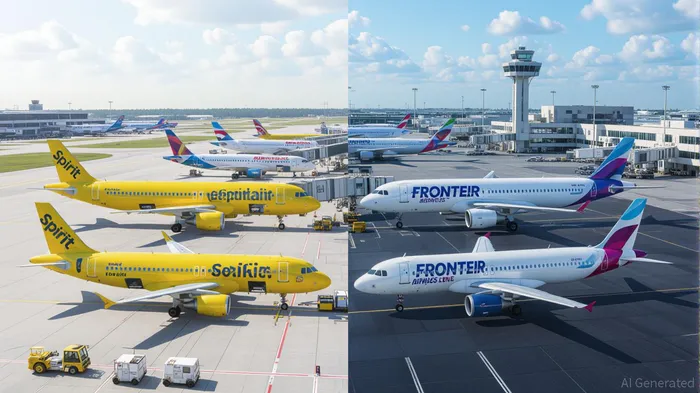
The U.S. regional airline sector is undergoing a seismic shift as Spirit Airlines' second Chapter 11 filing in August 2025 accelerates market share reallocation. Once a dominant force in the ultra-low-cost carrier (ULCC) space, Spirit's financial collapse—driven by $2.4 billion in debt, a $257 million loss since March 2025, and a fragmented network—has created a vacuum that competitors like FrontierFYBR-- Airlines and Allegiant Air are swiftly exploiting. For investors, this crisis underscores a critical inflection point in the industry, where strategic positioning and operational agility will determine long-term winners.
The Fracturing of Spirit's Model
Spirit's business model, built on bare-bones fares and razor-thin margins, has proven unsustainable in a post-pandemic landscape marked by volatile demand and rising costs. Its recent restructuring includes furloughing 270 pilots, downgrading 140 captains, and reducing fleet size by 30%. These measures, while necessary for survival, have left Spirit with a weakened capacity in key leisure markets like Orlando and Las Vegas. The airline's reliance on domestic leisure travel (85% of its capacity) further exposes it to economic headwinds, as budget-conscious travelers increasingly opt for pricier options with added amenities.
Spirit's struggles are compounded by its failed merger attempts with JetBlueJBLU-- and Frontier, as well as a $3 million-per-day liquidity crunch from its credit card processor. Its delisting from the NYSE and projected cancellation of common stock signal a lack of investor confidence, with shares trading at a fraction of their 2023 peak.
Frontier's Aggressive Expansion: A Case Study in Strategic Adaptation
Frontier Airlines has emerged as the primary beneficiary of Spirit's decline. Since Spirit's bankruptcy filing, Frontier's stock surged 15–20% in mid-September 2025, driven by Deutsche Bank's upgrade to “Overweight.” The airline's strategy is a masterclass in market capture: it has launched 20 new routes in 2025, directly overlapping with Spirit's core hubs in Detroit, Houston, and Fort Lauderdale. These routes offer fares as low as $29, undercutting Spirit's pricing while leveraging Frontier's $1 billion+ free cash flow to sustain operations.
Frontier's hybrid model—combining low fares with premium offerings like First Class and tiered pricing—has allowed it to differentiate from Spirit's purely cost-driven approach. Its recent fleet modernization (32 new Airbus A320neos in 2026 vs. Spirit's three) and loyalty program enhancements (e.g., companion travel certificates) further solidify its competitive edge. Analysts project Frontier's network overlap with Spirit will rise from 35% to 40% by winter 2025, positioning it to absorb displaced demand.
Allegiant Air's Niche Play: Underserved Markets as a Growth Engine
While Frontier targets overlapping routes, Allegiant Air is expanding into underserved markets with high-density seating configurations. Its 10% year-on-year capacity growth in July 2025, driven by BoeingBA-- 737 MAX 8-200 aircraft, highlights its focus on secondary airports and leisure destinations. Allegiant's strategy of maximizing capacity on low-demand routes—such as connecting smaller cities to major hubs—has allowed it to maintain profitability despite the broader industry's struggles.
Allegiant's fleet of efficient Airbus A320s and its ability to operate in non-competitive markets provide a buffer against the price wars that have eroded Spirit's margins. However, its smaller scale and reliance on niche routes make it less positioned to capitalize on Spirit's immediate collapse compared to Frontier.
Market Share Reallocation: A Duopoly in the Making?
The U.S. regional airline market is highly concentrated, with the top 10 carriers accounting for 91% of domestic seats. Legacy carriers like American and DeltaDAL-- dominate 74% of capacity, but the ULCC segment is seeing a power shift. Frontier and Allegiant now hold 3% of the market share, with Frontier's aggressive expansion threatening to push Spirit out of the top 10 entirely.
Spirit's repeated restructuring efforts raise existential questions about its long-term viability. If it fails to reemerge from Chapter 11, Frontier could consolidate its position as the leading ULCC, while Allegiant's niche strategy may allow it to maintain a stable but smaller footprint.
Investment Implications: Navigating the New Landscape
For investors, the key takeaway is clear: Frontier Airlines is the most compelling play in the post-Spirit landscape. Its disciplined debt management, fleet modernization, and strategic route expansion position it to dominate the ULCC sector. However, risks remain, including potential regulatory scrutiny over reduced competition and the possibility of a broader economic downturn.
Spirit, meanwhile, is a high-risk bet. While its restructuring could yield a leaner, more efficient airline, the likelihood of liquidation or further consolidation is significant. Investors should monitor its ability to secure court approvals and stakeholder support.
Allegiant Air offers a more defensive play, with its focus on underserved markets and high-density operations. However, its smaller scale and limited exposure to Spirit's core routes make it a secondary consideration.
Conclusion: The New Era of Regional Airline Competition
Spirit Airlines' bankruptcy is not just a corporate crisis—it's a catalyst for industry realignment. As Frontier and Allegiant capitalize on the vacuum, the U.S. regional airline sector is shifting toward a model that balances low fares with value-added services. For investors, the path forward lies in supporting airlines that combine operational agility with strategic foresight. Frontier's bold expansion and Allegiant's niche expertise make them the most attractive options in a market poised for consolidation.
The question is no longer whether Spirit can survive, but how quickly its competitors will redefine the rules of the game.

Stay ahead of the market.
Get curated U.S. market news, insights and key dates delivered to your inbox.
AInvest
PRO
AInvest
PRO



Comments
No comments yet