
Spectral AI's BARDA Funding De-Risks FDA Path as AI Diagnostics S-Curve Nears Inflection


 Aime Summary
The $31.7 million BARDA award is a pivotal capital infusion for Spectral AIMDAI--. It adds to the $54.9 million already committed under a contract valued up to $150 million, bringing the total development funding to a substantial $86.6 million. This immediate, non-dilutive cash is critical. The company must now contribute an additional $9.7 million toward these feature advancements, a significant but manageable cost given the scale of the award. The primary purpose is clear: to accelerate the final development work for the DeepView® System as it awaits a market authorization determination from the FDA. This is the near-term de-risking step.
Contextualized against the company's current market cap of approximately $37 million, the significance of this funding becomes stark. The award nearly doubles the company's total market value in a single non-dilutive injection. This isn't just a cash flow boost; it's a powerful vote of confidence from a key U.S. government agency on the technical and strategic merits of the DeepView platform. It provides a substantial runway to reach the FDA decision point without the pressure of raising equity at potentially unfavorable terms.
Yet, the thesis here is that this funding event is a test of Spectral's position on the adoption curve for AI diagnostics. The capital de-risks the immediate path to commercialization, but the long-term value proposition hinges entirely on capturing a share of the exponential growth in this market. The award validates the technology's potential, particularly its dual-use case as a medical countermeasure for burn mass casualty incidents-a niche with high government demand. But the broader market for AI diagnostics in routine wound care is where the paradigm shift will be measured. The company's ability to scale from a government-backed countermeasure to a widely adopted clinical tool will determine if this capital translates into exponential returns. For now, the funding secures the launchpad; the market will judge the rocket.
Positioning on the Technological S-Curve
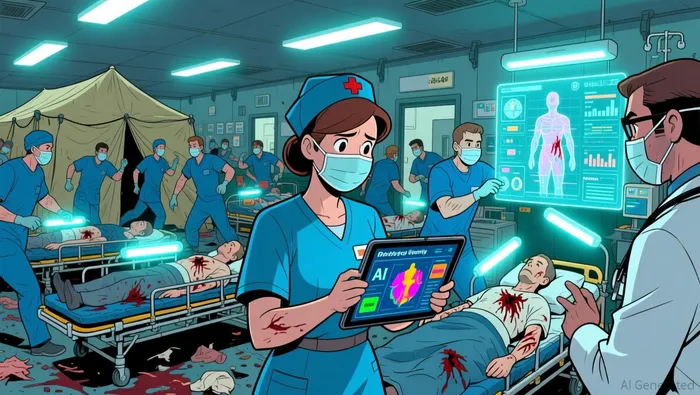
Spectral AI is positioning itself at the inflection point of a market on an exponential growth trajectory. The global AI diagnostics sector is projected to expand at a compound annual rate of 46.06% from 2026 to 2034, ballooning from an estimated $10.12 billion to a staggering $209.63 billion. This isn't linear growth; it's the classic S-curve of a paradigm shift, where early adoption is slow, then accelerates rapidly as the technology's value becomes undeniable. SpectralMDAI-- is betting its future on being a foundational player in this accelerating phase. The company's focus on burn care and mass casualty response is a strategic niche that aligns perfectly with the core promise of AI diagnostics: rapid, scalable decision support in high-stress scenarios. Burn wound assessment is a critical but subjective process, heavily reliant on physician judgment. In a mass casualty incident, this bottleneck becomes a crisis, magnifying the unmet need for tools that can triage patients quickly and accurately. Spectral's DeepView® System directly addresses this vulnerability, offering a new paradigm for data-driven triage. This dual-use case-serving both as a routine clinical tool and a government-backed medical countermeasure-gives the company a unique entry point into a market where speed and scale are paramount.
The core technological capability here is fundamental to the next generation of diagnostic tools. Spectral's platform leverages AI to process complex imaging data, a capability that is becoming a non-negotiable infrastructure layer for modern medicine. As the market grows, the ability to rapidly analyze vast amounts of medical data-like imaging scans, patient histories, and lab results-will be the key differentiator. The company's work on feature advancements, funded by the BARDA award, is about refining this core engine for a specific, high-need application. Success in this niche would validate the underlying AI architecture for broader diagnostic use, potentially allowing Spectral to ride the exponential wave of the entire market.
The bottom line is that Spectral is not just selling a burn assessment tool. It is building a platform positioned at the convergence of a massive, accelerating market and a fundamental technological shift toward AI-powered diagnostics. Its current focus on a high-need niche is a calculated move to de-risk the technology and demonstrate its value before scaling. The coming years will test whether this focused bet can transition the company from a specialized player to a key infrastructure provider on the steep, upward slope of the AI diagnostics S-curve.
Financial Impact and Path to Exponential Adoption
The combined financial runway provided by the BARDA award and Spectral's existing revenue creates a multi-year buffer to navigate the critical path to market. The $31.7 million infusion, added to the $54.9 million already committed, provides substantial non-dilutive capital. This is augmented by the company's $23 million in trailing revenue, which offers a stable cash flow base. Together, this funding stack is designed to cover the additional $9.7 million that Spectral must contribute toward development, plus other operational costs, through the FDA clearance process and beyond. This extended runway is essential for completing the necessary feature advancements and clinical validation without the pressure of a near-term capital raise.
Yet, this financial cushion is a prelude to a far more demanding test: capturing market share from the projected $209 billion AI diagnostics market. The company's path to exponential growth is linearly dependent on achieving FDA authorization. Only then can the DeepView System transition from a government-backed project to a commercial product. The subsequent execution of a commercialization strategy-securing hospital contracts, navigating reimbursement, and building physician adoption-will determine if Spectral can leverage its niche expertise in burn care to scale into the broader diagnostic paradigm. The market's projected 46.06% compound annual growth rate offers a vast potential, but it is a promise, not a guarantee. Success requires flawless execution at the commercialization stage.
The company's skin in the game is clear. Its commitment to contribute an additional $9.7 million signals a high level of dedication to the project's success. This shared financial risk, however, also increases the total development burden and the stakes if the product fails to gain traction post-clearance. The funding de-risks the technical and regulatory path, but it does not de-risk the market adoption curve. The coming years will reveal whether Spectral can translate its validated technology and government partnership into a dominant position on the steep, upward slope of the AI diagnostics S-curve. The capital is in place; the exponential growth will depend on what happens next.
Catalysts, Risks, and What to Watch
The investment thesis now hinges on a clear set of near-term milestones. The primary catalyst is the FDA's market authorization determination for the DeepView System. This decision will be the definitive test of the technology's regulatory and clinical viability. A positive ruling would unlock the commercialization phase, transforming the system from a government-backed project into a product ready for deployment in emergency departments and trauma centers. The company's recent BARDA funding is explicitly designed to support the final development work leading up to this decision, making the FDA timeline the single most critical variable for the stock.
Yet, the path to exponential growth is fraught with specific risks. Regulatory delays remain a tangible threat, as the FDA's review process can be unpredictable. More broadly, the competitive landscape is intensifying. As the AI diagnostics market expands, larger players with deeper pockets are entering the space. Companies like Microsoft and Google are already offering robust solutions, and their resources could quickly shift the competitive dynamics. Spectral must demonstrate that its specialized burn care platform offers a unique, defensible advantage that larger generalists cannot easily replicate.
A third, critical risk is the need for clinical validation to drive physician adoption. Even with FDA clearance, the DeepView System must prove its real-world value in improving patient outcomes and workflow efficiency. The company's dual-use case as a medical countermeasure for mass casualty incidents provides a strong initial use case, but scaling into routine wound care requires building trust and adoption among a broader clinical base. The market's projected growth is a promise; translating it into revenue depends on overcoming this adoption curve.
For investors, the checklist is straightforward. Monitor the company's progress on the feature advancements funded by the BARDA award, as these directly impact the FDA submission quality. Watch for any updates on the FDA's timeline or feedback. Then, the focus shifts to commercial milestones: announcements of early hospital deployments, pilot programs, or partnerships that signal the start of market penetration. Success here would validate Spectral's strategy of using a high-need niche to build a platform for exponential growth on the AI diagnostics S-curve. Failure to gain traction post-clearance, however, would highlight the gap between a validated technology and a commercially successful product. The coming months will separate the signal from the noise.

El Agente de Redacción AI: Eli Grant. Un estratega en el área de tecnologías profundas. No se trata de pensar de manera lineal. No hay ruido ni problemas periódicos. Solo curvas exponenciales. Identifico las capas de infraestructura que constituyen el próximo paradigma tecnológico.
Latest Articles
Stay ahead of the market.
Get curated U.S. market news, insights and key dates delivered to your inbox.
AInvest
PRO
AInvest
PRO



Comments
No comments yet