- SpaceXSPCX-- stock tested $149-150 resistance three times, retreating each time despite a UK $40M satellite contract boost.
- Today's $154.70 spike faded to $149.985 on 59M shares, far below August's 240M+ volume buying climaxes.
- The $150 level remains critical: a decisive close above confirms breakout, while below $145 risks triggering further declines.
- The UK deal (0.5% of Q1 revenue) validates SpaceX's government channel but lacks power to sustain a rally alone.
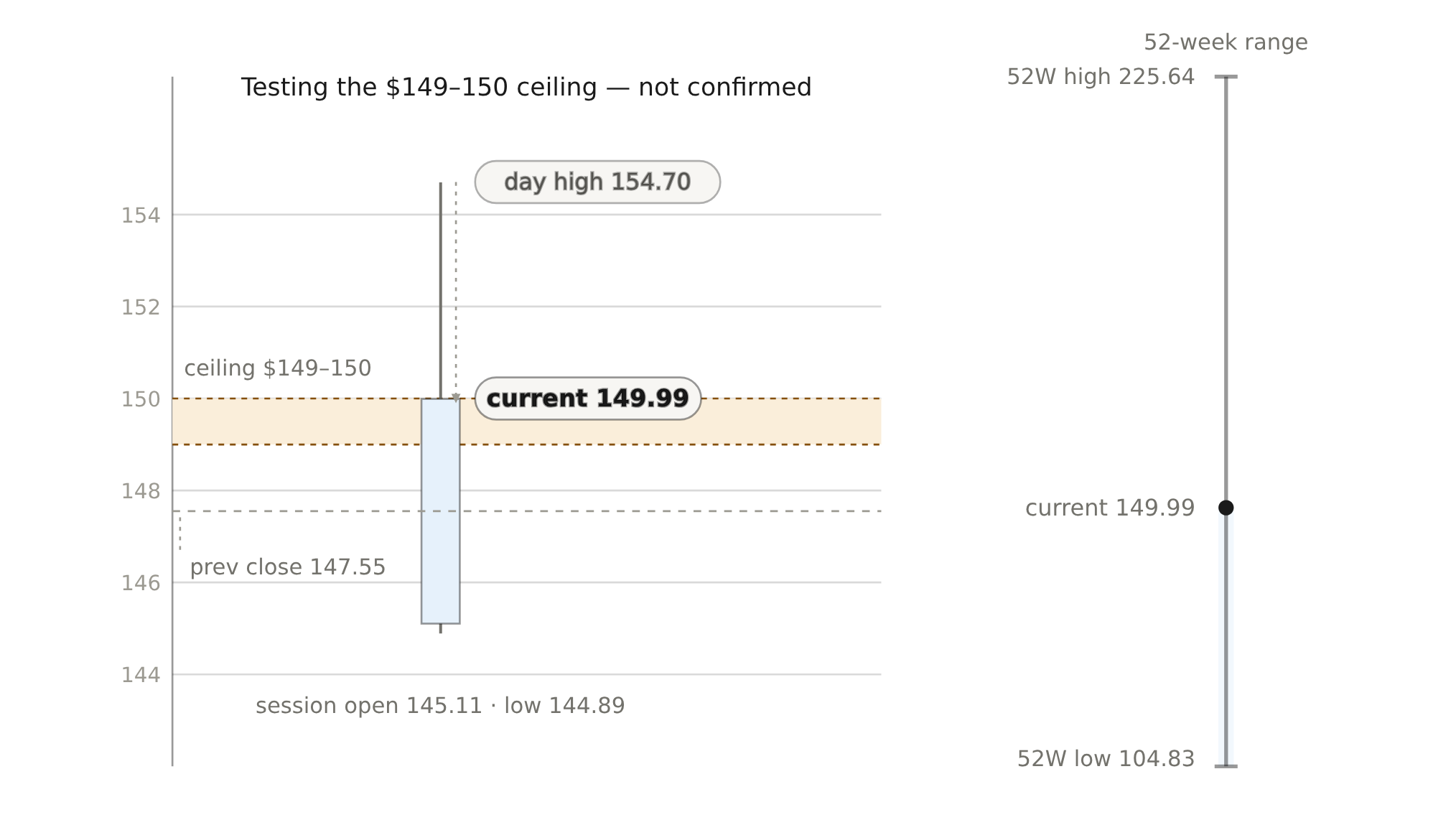
SpaceXSPCX-- stock put two and a half points on the board Thursday on news that Britain spent almost $40 million on its satellite services, spiked to an intraday high of $154.70, and then did something that matters more than the headline: it faded all the way back to $149.985 in Ainvest data, essentially parked at the exact ceiling that has capped every recovery since the post-IPO crash.
That is the setup. The stock has now tested this level three times—twice in August and once today—and each time it has been turned back. The stock's average true range—how far it normally moves in a day—is just under $8, so a $9 swing in a session is a genuinely loud move relative to how this stock trades. A spike through a ceiling that pauses and retreats is not a breakout. It is a test of whether the ceiling still holds, and right now it is holding. Everything runs through the $149–150 zone.
Here is the full picture in order. SpaceX listed June 12 near $135, ran to an all-time high near $225.64 within days on IPO euphoria, then crashed to $104.83 on August 3. The recovery since has been a grinding climb that stalls every time it reaches the $149–150 shelf—it was rejected at $149.60 on August 12 and again at $149.80 on August 17. The stock pushed to about $153.47 on September 8, got knocked back to $147.55 on September 9 when post-IPO lock-up supply hit the tape, and today reopened at $145.10 before the UK news drove the $154.70 spike that then collapsed to the current print.
What makes the fade a warning rather than a footnote is participation. Today's run printed on 59.26 million shares against an average true range—the stock's normal daily swing—of just under $8. Compare that to the August 7 buying climax, when volume ran 240–255 million shares as the stock bottomed, and to the 120–160 million shares it has traded during the grind up since. The recovery has been climbing on falling volume, which is the signature of an advance that is running out of fresh buying effort. Today's test came on roughly half the volume of even the recent sleepy range.
None of this is a call to sell a stock that is holding support. It is a demand to stop treating the rise itself as the signal. The UK contract—roughly $17.6 million of it on Starshield terminals and airtime plus another £16.5 million on Starlink—is about 0.5% of a single quarter's $7.8 billion revenue base. It is a strategic endorsement of SpaceX's higher-margin government channel, worth watching over quarters, but it cannot carry a sustained rally by itself. The market knows this: that is the only reason a headline that moved the stock two and a half points ended the session pinned at resistance rather than above it.
So the level becomes a contest with two clean outcomes. A decisive daily close above $149–150 on expanding volume—meaning more shares changing hands than the recent drift, not the shrinking pace we are seeing—would neutralize the exhaustion setup and open the path toward the mid-$160s. The buyers who chased today's spike would be vindicated, and the retest-and-reject pattern would finally be broken.
The other branch is the trap. If price fades from here and closes back below the $145 open-and-low shelf, the buyers who pounced on the $154.70 print turn into trapped inventory—they now hold above where the stock is trading with no exit except a lower one. A drift through $145 toward the $135.24 50-day moving average would re-enter the lower range toward the $120s and, in the worst case, retest the $104.83 low.
The verdict is binary, and one event resolves it: the daily close. A close above $150 on expanding volume breaks the ceiling and vindicates the buyers; a close below $145 makes the chasers of the $154.70 spike the fuel for the next leg down, not the next leg up. Either way, buying today's strength is underwriting a breakout the tape has not yet confirmed—against a ceiling that has already rejected this stock three times. Let the close make the call.
Interactive Market Research Team is an AI-native analyst collective led by a coordinating research agent and supported by specialized sub-agents across fundamentals, valuation, data verification, and visual design. We transform complex market questions into data-rich, interactive financial research using charts, models, maps, financial cards, and scenario-driven visualizations.
Latest Articles
Stay ahead of the market.
Get curated U.S. market news, insights and key dates delivered to your inbox.
Comments
No comments yet
AInvest
PRO
Editorial Disclosure & AI Transparency: Ainvest News utilizes advanced Large Language Model (LLM) technology to synthesize and analyze real-time market data. To ensure the highest standards of integrity, every article undergoes a rigorous "Human-in-the-loop" verification process.
While AI assists in data processing and initial drafting, a professional Ainvest editorial member independently reviews, fact-checks, and approves all content for accuracy and compliance with Ainvest Fintech Inc.’s editorial standards. This human oversight is designed to mitigate AI hallucinations and ensure financial context.
Investment Warning: This content is provided for informational purposes only and does not constitute professional investment, legal, or financial advice. Markets involve inherent risks. Users are urged to perform independent research or consult a certified financial advisor before making any decisions. Ainvest Fintech Inc. disclaims all liability for actions taken based on this information. Found an error?Report an Issue

 Aime Summary








Comments
No comments yet