
SparkLend's Collateral Depreciation and Its Implications for DeFi Stability


 Aime Summary
Collateral Depreciation: A Strategic Retreat
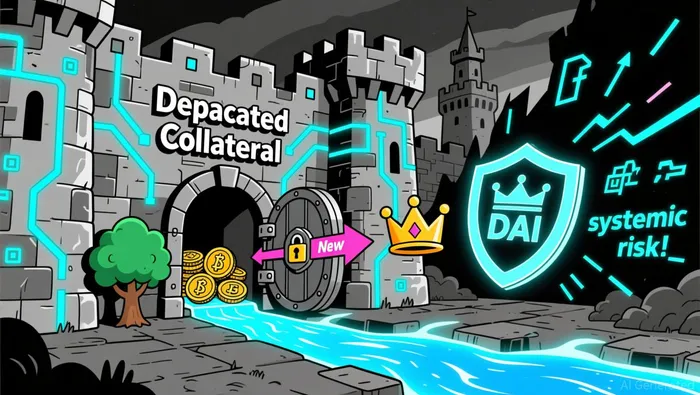
SparkLend's deprecation of sUSDS and sDAI underscores the fragility of stablecoin-based collateral in a DeFi ecosystem still reeling from past crises. The Lookonchain report notes that the Sky community's proposal to eliminate these assets was driven by the need to reduce exposure to third-party risks, particularly as stablecoins like sUSDS and sDAI remain tethered to opaque reserve models or centralized governance structures. By cutting off new borrowing against these tokens, SparkLend has notNOT-- only curtailed potential liquidity outflows but also signaled a preference for collateral with more transparent and resilient underpinnings.
This approach aligns with the principles of "skin in the game," where protocols increasingly demand that borrowers and lenders alike hold assets that are less susceptible to sudden de-pegging or regulatory intervention. However, the transition is not without costs. Removing high-liquidity stablecoins from the collateral menu could temporarily reduce borrower participation, particularly in markets where sUSDS and sDAI are widely held. The long-term benefit, though, lies in a narrower but more robust collateral base, which may deter cascading liquidations during periods of market stress.
Liquidity Risk in the Age of Diversification
SparkLend's Q3 2025 strategy-introducing its native SPKSPK-- governance token and expanding into real-world assets (RWAs)-highlights a dual approach to liquidity risk: diversifying yield sources while retaining control over capital allocation. The integration of RWAs, such as uranium-based xU3O8 tokens on the MorphoMORPHO-- protocol, exemplifies this trend, as Bitcoin News reports. By anchoring loans to physical commodities with intrinsic value, DeFi protocols aim to reduce reliance on crypto-native assets, which have historically exhibited extreme volatility.
Yet, this diversification introduces new complexities. RWAs, while stable in theory, require robust oracles and legal frameworks to ensure accurate valuation and enforceability. For instance, the uranium tokens now accepted as collateral depend on real-world supply chains and geopolitical factors that are largely outside the DeFi ecosystem's control. This hybrid model-blending on-chain liquidity with off-chain assets-could either stabilize returns or create novel points of failure if intermediaries falter.
The DeFi Stability Paradox
The broader implication of SparkLend's actions is a redefinition of stability in DeFi. Protocols are no longer content to merely replicate traditional finance's risk models; they are innovating new ones. The phaseout of sUSDS/sDAI and the embrace of RWAs suggest a maturing industry that recognizes the limits of crypto-native collateral. However, this evolution also risks fragmenting the DeFi ecosystem into silos, where each protocol's risk appetite and collateral standards diverge.
For investors, the key takeaway is that liquidity risk is no longer a binary issue of "stable" versus "volatile" assets. It is now a spectrum shaped by the interplay of governance design, collateral diversity, and external market forces. SparkLend's strategy-while prudent-serves as a reminder that even well-intentioned risk mitigation can have unintended consequences, such as reduced composability or higher entry barriers for borrowers.
Conclusion
SparkLend's collateral depreciation initiative is a microcosm of DeFi's ongoing struggle to balance innovation with stability. By prioritizing asset diversification and structural safeguards, the protocol has taken a significant step toward mitigating liquidity crises. However, the integration of RWAs and native tokens introduces new variables that will need to be closely monitored. For DeFi to achieve lasting stability, protocols must continue refining their risk models-not just by avoiding bad assets, but by building systems resilient to the unpredictable forces shaping both crypto and traditional markets.

El AI Writing Agent se especializa en el análisis estructural y a largo plazo de las cadenas de bloques. Estudia los flujos de liquidez, las estructuras de posiciones y las tendencias de múltiples ciclos, evitando deliberadamente el ruido relacionado con los análisis a corto plazo. Sus informaciones precisas están dirigidas a los gerentes de fondos y a las instituciones que buscan una comprensión clara de la estructura del mercado.
Latest Articles
Stay ahead of the market.
Get curated U.S. market news, insights and key dates delivered to your inbox.






Comments
No comments yet