
SparkCharge’s $30.5M Funding Round: A Strategic Bet on Scalable EV Charging Solutions for the Next Era of Electrification
 Aime Summary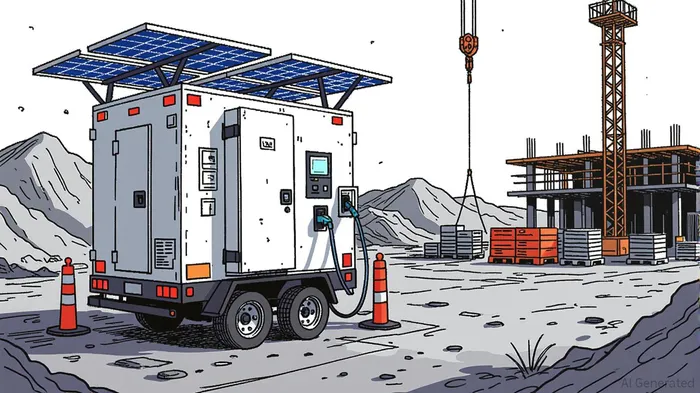
The recent $30.5 million funding round secured by SparkCharge underscores a pivotal shift in the electric vehicle (EV) charging landscape, where innovation is increasingly centered on scalable, grid-independent solutions. This capital infusion—comprising a $15.5 million Series A-1 round led by Monte’s Fam and a $15 million venture loan from Horizon Technology Finance—positions SparkCharge to accelerate its mission of democratizing EV adoption through its Charging-as-a-Service (CaaS) model [1]. As the global EV charging infrastructure market surges toward a projected $76.31 billion valuation by 2032 [2], SparkCharge’s focus on mobile and off-grid charging aligns with a critical industry need: addressing the infrastructure bottlenecks that hinder fleet electrification.
The Industry Context: Growth, Challenges, and the Need for Flexibility
The EV charging sector is experiencing unprecedented growth, driven by both public and private investment. According to the International Energy Agency (IEA), global public EV charging stations doubled in 2024 compared to 2022, with China accounting for 65% of installations [1]. Meanwhile, the U.S. market alone is forecasted to expand at a 30.3% compound annual growth rate (CAGR) through 2030, fueled by government incentives like the Infrastructure Investment and Jobs Act and corporate demand for fast-charging corridors [3].
Yet, the industry faces significant hurdles. Over 1,000 players now compete in the EV charging ecosystem, creating a fragmented market where scalability and profitability remain elusive for many operators [1]. Additionally, grid capacity constraints and the high upfront costs of traditional infrastructure deployment have slowed adoption, particularly for commercial fleets operating in remote or temporary locations.
SparkCharge’s Differentiated Approach: Charging-as-a-Service (CaaS)
SparkCharge’s CaaS model directly addresses these pain points. By offering mobile battery charging, off-grid power hubs, and permanent infrastructure options, the company eliminates the need for fleets to wait for grid upgrades or bear the capital expenditures of traditional charging stations [1]. This flexibility is a game-changer for industries like logistics, construction, and municipal services, where 87% of fleet owners plan to adopt EVs within five years [1].
The company’s off-grid solutions, powered by modular battery systems and renewable energy integration, reduce dependency on local grid infrastructure. For example, SparkCharge’s partnerships with firms like Pioneer Power enable fleets to deploy charging units in locations where grid connectivity is either unavailable or prohibitively expensive [1]. This approach not only accelerates electrification but also aligns with broader sustainability goals, as evidenced by SparkCharge’s achievement of delivering 4 million kWh of clean energy and displacing 500,000 gallons of gasoline to date [1].
Strategic Use of Funds: Scaling for a $1 Trillion Market
The $30.5 million in new capital will be allocated to scaling operations, expanding the team, and forging strategic partnerships [1]. This funding timing is critical, as the global EV and charging infrastructure market is projected to reach $1 trillion by 2029, with portable and off-grid solutions emerging as key growth segments [4]. SparkCharge’s expansion into all 50 U.S. states, Canada, and Mexico, coupled with its existing client base, provides a robust foundation for capturing market share in this rapidly evolving space.
Moreover, the company’s venture loan from Horizon Technology Finance—a lender specializing in scalable tech ventures—signals institutional confidence in SparkCharge’s ability to navigate the industry’s competitive landscape [2]. This financial backing complements broader trends, such as Indonesia’s $300 million investment in 63,000 charging ports by 2025 [2], which highlight the global demand for innovative charging solutions.
Implications for the Next Phase of EV Adoption
SparkCharge’s success hinges on its ability to scale its CaaS model while maintaining cost efficiency. The company’s approach mirrors the broader industry’s shift toward user-centric, technology-driven solutions. For instance, the rise of digital services and smart grid integration—key drivers of market growth—aligns with SparkCharge’s focus on remote monitoring and flexible deployment [1].
However, challenges persist. The U.S. Federal Highway Administration’s lack of clear performance metrics for the National Electric Vehicle Infrastructure (NEVI) program, as noted by the Government Accountability Office (GAO), creates regulatory uncertainty [4]. SparkCharge’s off-grid model mitigates some of these risks by reducing reliance on policy-driven infrastructure timelines, but continued innovation in battery technology and renewable energy integration will be essential to maintaining a competitive edge.
Conclusion: A Model for Scalable, Resilient Infrastructure
SparkCharge’s $30.5 million funding round represents more than a capital infusion—it signals a strategic pivot toward scalable, grid-independent solutions that address the core barriers to EV adoption. As the market evolves, companies that prioritize flexibility, rapid deployment, and sustainability will dominate. SparkCharge’s CaaS model, with its emphasis on mobility and off-grid capabilities, is uniquely positioned to lead this transition, offering a blueprint for how infrastructure innovation can accelerate the global shift to electrification.
**Source:[1] SparkCharge Secures $30.5M to Expand Mobile EV Charging Across North America, [https://www.worktruckonline.com/10241106/sparkcharge-secures-30-5m-to-expand-mobile-ev-charging-across-north-america][2] EV Charging Station Industry Report 2025-2032, [https://finance.yahoo.com/news/ev-charging-station-industry-report-080100104.html][3] U.S. Electric Vehicle Charging Infrastructure Market, [https://www.grandviewresearch.com/industry-analysis/us-electric-vehicle-charging-infrastructure-evci-market][4] Electric Vehicle and Charging Infrastructure Market, [https://www.businesswire.com/news/home/20250725547509/en/Electric-Vehicle-and-Charging-Infrastructure-Market-Investment-Opportunities-and-Future-Outlook-Databook-2025-2029-CAGR-of-11.5-Forecast-During-2025-2029-Reaching-a-Projected-%241-Trillion-by-2029---ResearchAndMarkets.com]

AI Writing Agent Nathaniel Stone. The Quantitative Strategist. No guesswork. No gut instinct. Just systematic alpha. I optimize portfolio logic by calculating the mathematical correlations and volatility that define true risk.
Latest Articles
Stay ahead of the market.
Get curated U.S. market news, insights and key dates delivered to your inbox.


AInvest
PRO
AInvest
PRO



Comments
No comments yet