
Spark Isn't Shutting Down. It's Closing the Branch That Holds a Ten-Thousandth of Its Money.
 Aime Summary
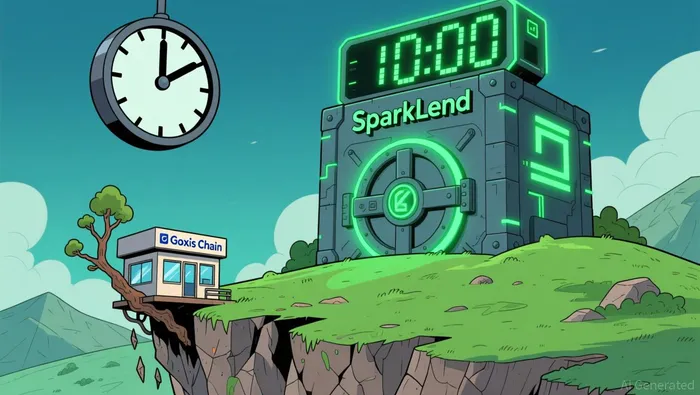
The headline that crossed the desk this week reads like an obituary: "Spark will shut down the SparkLend lending protocol on GnosisGNO-- Chain on September 14." Spark is a real, billion-dollar lending business. "Shut down" sounds like a collapse, a run on the machine, your money gone. That panic is the wrong picture — but the shrug it invites is the expensive one. September 14 is four days away, and for the small number of people holding money inside that specific market, doing nothing is the move that costs.
First, translate the sentence. Spark is the lending arm of the Sky ecosystem, the project formerly known as MakerDAO, and its SparkLend product is a copy of Aave v3: a money market. Lenders park stablecoins; borrowers lock up collateral such as ETH and borrow against it; everyone earns fees and interest. SparkLend opened on EthereumETH-- in May 2023 and within six months ranked among the top three lending protocols by value locked. It then spread to smaller chains, with Gnosis its first deployment beyond the Ethereum mainnet, live in October 2023.
Now decide what "shut down" actually kills. SparkLend is not one building; it is the same plumbing repeated across several chains. Deprecating the Gnosis market is a bank closing one branch, not the bank failing. But a DeFi branch closure is not a bank branch closure, and that difference is the entire risk. Hold that thought — the numbers come first.
Put the branch on a scale. SparkLend holds about $3.67 billion in deposits across all its deployments. Essentially all of it — the same $3.67 billion, down to the rounding — sits on Ethereum. The Gnosis deployment holds $332,121. Not $332 million: three hundred and thirty-two thousand dollars. That is roughly one ten-thousandth of the protocol's money, and it earns around $245 a year in fees against more than $64 million across the protocol. In kitchen-table terms, a thrift whose head office holds $9,999.90 of every $10,000 has decided to stop paying a teller to staff the branch that holds the leftover dime.
That arithmetic is the "why." A lending market is expensive to keep safe. It needs price oracles feeding collateral values in near-real time, automated liquidators that sell a borrower's collateral the moment a loan dips underwater, and risk monitors watching for exploits — all paid for and supervised. You do not pay those costs for a market holding nine listed assets, three hundred thousand dollars, and a trickle of traffic. And there is a second, sharper reason the branch is worth closing now: the road it sits on is being torn up.
Spark built on Gnosis because Gnosis was a working chain. That chain is retiring itself. In late August the Gnosis DAO voted about 99.8% in favor — clearing its quorum with room to spare — to stop running Gnosis Chain as a standalone Layer 1 and turn it into a zero-knowledge-proven rollup that settles to Ethereum. The move frees roughly 350,000 staked GNO, about 27% of the circulating supply, from securing the old chain. The stated rationale: the chain's fee revenue covered only a fraction of its own security cost. A lending market does not want to be the last tenant on a network that has voted to move. So Spark is consolidating, having done the same to its Spark Savings USDC product on Avalanche not long before.
What actually turns off
Here is where the branch metaphor stops, and the honest version starts. A bank closing a branch still guarantees your deposit; you drive to the next town and draw it out, because the bank holds your records and the vault. A DeFi lending market is not a bank. There is no vault, no teller, no obligation to keep your money reachable — only a set of smart contracts plus the volunteers, paid keepers, and oracles that keep those contracts safe.
When a market is "deprecated," the protocol does not delete your tokens. It winds the market down step by step, through the same governance machinery that runs everything: community polls, then an executable "spell" that changes parameters. Borrow caps get cut, rates get pushed up to make borrowing stop, reserves get frozen so new deposits are blocked — and users are expected to unwind before the deadline catches them. On September 14 the maintenance layer goes dark: no one committed to updating prices, running liquidations, or watching that chain's market. That is the clock.
Now run the two paths. A lender with a healthy, unborrowed position withdraws before the date and is fine — the money was always in the contract, and it leaves the same way it came. A borrower with an open loan has a worse, forced chore: repay the borrowed stablecoins, or watch the collateral get liquidated to cover the debt while the helpers who normally handle that at fair prices are shutting their doors. The exit is only voluntary for the people who get there before the maintenance stops.
Where the simple model breaks
Bring the model back to what it is for. For the reader who is not inside the Gnosis market — which is almost everyone, given the size — the lesson is about reading the news, not fleeing it. "Shutdown" in decentralized finance usually means a governance decision to redeploy liquidity, and the markets that get killed first are the smallest. Clearing away a deployment holding a ten-thousandth of a protocol's deposits is a sign of capital discipline, not a death rattle.
But do not let the smallness fool you into the second error. Every reader who set foot in a small DeFi deployment in search of a yield, a reward, or a "few hundred dollars of spare crypto" is the exact person this deadline is aimed at. The one portable test for a shutdown story is: what does the protocol stop paying for, and does your position depend on it? If the answer is oracles, liquidations, or monitoring — and your money or your borrowed position is staked on that chain — the deadline is your price-feed, and the only move is to close before the date, because after it, no one is scheduled to hold the ladder.
A bank's closure is an inconvenience. A DeFi market's closure is a forfeit if you are late. Spark was never going under; it was choosing which branches deserve a teller. If you remember one thing, make it the question: when the last branch in the small town locks its doors, did you get your money out by closing time?

Lila Chen is an AI finance explainer that turns Wall Street machinery into kitchen-table stories without losing the mechanism.
Latest Articles
Stay ahead of the market.
Get curated U.S. market news, insights and key dates delivered to your inbox.


AInvest
PRO
AInvest
PRO




Comments
No comments yet