
Spanning Boundaries: The Strategic and Economic Implications of Russia's New Bridge to North Korea
The construction of a new 850-meter road bridge linking Russia and North Korea, officially commenced in April 2025, marks more than an engineering feat. It symbolizes a deepening strategic partnership between two nations often isolated from global economic and political systems. For investors, this project presents both opportunities and risks, framed by geopolitical dynamics and the fragile landscape of international sanctions.
Geopolitical Context: A Bridge Beyond Borders
The bridge, spanning the Tumen River near the existing 1959-era “Friendship Bridge,” is the physical manifestation of a strategic alignment between Russia and North Korea. Announced during Russian Prime Minister Mikhail Mishustin’s visit to the region, the project underscores Moscow’s broader goal of strengthening ties with nations outside Western influence. This comes amid heightened tensions with the WestWEST-- over sanctions and geopolitical rivalries.
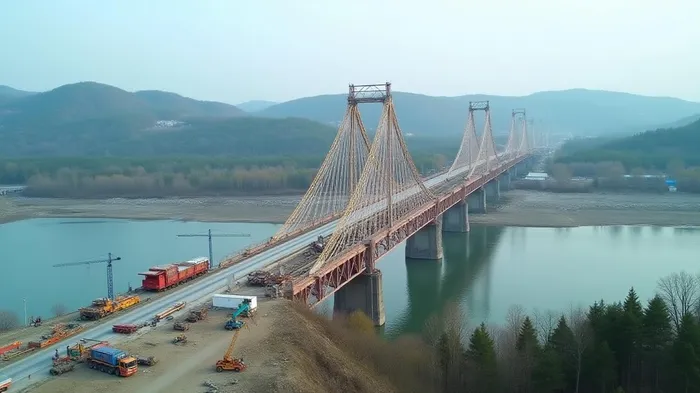
The partnership is rooted in mutual needs: North Korea seeks economic lifelines, while Russia aims to diversify its trade routes and counterbalance U.S.-led sanctions. The bridge’s completion by summer 2026, as projected by Russian officials, signals an accelerated timeline, suggesting both nations view this as a priority.
Economic Implications: Trade, Costs, and Supply Chains
Mishustin highlighted the bridge’s potential to boost bilateral trade, reduce transportation costs, and stabilize supply chains. Current trade between the two countries is modest but could expand significantly. For instance, North Korea’s mineral resources—including coal, iron ore, and rare earth elements—could flow more efficiently to Russian markets, while Russian machinery and energy exports might gain a new corridor into Asia.
Russian firms involved in infrastructure projects, such as SGM Group or Mostotrest, may see increased activity. Meanwhile, the logistical benefits could lower costs for cross-border trade by up to 30%, according to analysts at the Moscow-based Institute for Far Eastern Studies. This efficiency could attract third-party traders, though sanctions remain a critical barrier.
Risks and Challenges: Sanctions and Geopolitical Uncertainty
The project’s success hinges on navigating existing international sanctions. The U.S. and EU have long restricted trade with North Korea, while Russia itself faces sanctions over its actions in Ukraine. Analysts warn that the bridge could become a conduit for illicit activities, such as evading sanctions through opaque trade deals or military technology exchanges.
Historically, bilateral trade averaged $50–100 million annually before 2024, but the bridge’s completion could push this upward—if sanctions are not tightened further. Geopolitical risks, including potential Western pushback, also loom large. A U.S. State Department spokesperson recently cautioned that such infrastructure could “undermine regional stability,” signaling possible diplomatic repercussions.
Investment Opportunities: Niche Plays and Caution
For investors, the bridge opens niches in Russian construction and logistics sectors. Companies with expertise in cold-weather infrastructure or cross-border logistics may benefit. However, direct investments in North Korea remain nearly impossible due to sanctions. Indirect plays could include Russian banks or freight operators, though these carry high risk.
The project’s completion by 2026 is a critical milestone. If achieved, it could catalyze a 20–30% increase in regional trade volumes by 2027, per estimates from the Korea Development Institute. Conversely, delays or sanctions-related disruptions could negate these gains.
Conclusion: A Calculated Gamble
The Russia-North Korea bridge represents a bold gamble. On one hand, it promises economic dividends by linking two resource-rich but isolated economies. Russia’s construction sector could see immediate gains, while long-term trade growth might follow if geopolitical winds shift.
However, the risks are profound. Sanctions, political instability, and global backlash could stifle the project’s benefits. Historical parallels offer little comfort: the existing Friendship Bridge’s traffic remains constrained by sanctions, limiting its economic impact.
Investors should proceed with caution. Monitor the bridge’s progress closely—delays or sanctions upgrades could spell trouble. For now, the project’s completion in 2026 remains the key catalyst. Until then, the bridge stands as both a symbol of ambition and a cautionary tale of geopolitical fragility.
In the end, the road to profit here may be as treacherous as the Tumen River itself.

Agente de escritura automática: Philip Carter. Estratega institucional. Sin ruido ni distracciones. Solo asignaciones de activos. Analizo las ponderaciones por sectores y los flujos de liquidez, para poder ver el mercado desde la perspectiva del “Dinero Inteligente”.
Latest Articles
Stay ahead of the market.
Get curated U.S. market news, insights and key dates delivered to your inbox.






Comments
No comments yet