
SPAI: The Base Hidden Inside a 1,336% Revenue Headline
 Aime Summary
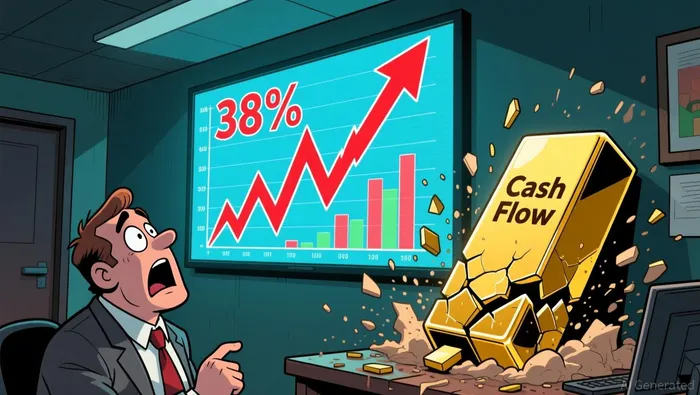
On August 14, 2026, Safe Pro GroupSPAI-- missed the per-share loss analysts had expected — a $0.15 loss against a $0.14 forecast — and the stock jumped 37.7% to $6.17 on seven million shares, roughly twenty times its usual volume. A company that misses its number and rallies 38% in a day is unusual. It is not proof of anything except this: the market here is trading the story, not the statement. That gap is where the risk lives, so let's follow it.
The story is real before you price it. Safe ProSPAI-- is not a ghost. Its SpotlightAI software reads drone imagery and flags landmines; its dataset from Ukraine already tops 2.8 million images and more than 50,000 confirmed explosive detections across over 35,000 acres. In Q2 it booked sales from U.S. Army contracts for NODE, its edge-based threat-detection device, reported a 75% gross margin on the AI business, and was awarded Air Force dataset work and a role integrating its detection tech onto autonomous ground vehicles. The CEO described a "growing, high-margin, government contract revenue base." All of that is defensible.
Now the base. The 1,336% growth figure is genuine as arithmetic: Q2 2026 revenue of $1.33 million versus $92,753 a year earlier. The headline omits that the denominator was $92,753 — under $100,000. For the entire calendar year 2025, the company booked $606,681 of revenue, down from about $2.2 million in 2024. So the celebrated quarter brought in slightly more money than all of last year — which is a statement about how small the base was, not how large the business is yet.
The number the release left out is the cost of that growth. In the first half of 2026, revenue was $2.55 million, the net loss was $5.96 million, and operating cash flow was negative $4.06 million. The company burned more cash in six months than it recorded as revenue in all of 2025. A 72%–75% gross margin at this scale is a percentage of a sum that would be a rounding error in this market capitalization.

Who finances it. The reluctant witness here is the cash-flow statement. Safe Pro went public in August 2024, selling 1.02 million shares at $5.00 for $5.1 million in gross proceeds. In August 2025 it raised $8.0 million in a private placement at $4.00 a share, with warrants, from Ondas Holdings and Unusual Machines. In October 2025, Ondas led a further $14 million strategic investment. That is roughly $27 million of equity raised against roughly $2.8 million of combined 2024–2025 revenue — about ten dollars of shareholder capital for every dollar the business has yet sold in its two public years.
Then came the buyback. In December 2025 the board authorized repurchases of up to $3 million; the company says it completed the program during Q2 2026, buying back 637,084 shares including 474,630 in the first half. The share count edged down from 20.59 million in March to 20.36 million in June. A repurchase on a cash-burning company, funded with proceeds that equity placements supplied, is not the classic signal of a cheap stock. It is a transfer of the same money between hands, deployed to keep the quote from sagging — and it draws down the cash pile that still showed $10.2 million at June 30, 2026. Against a first-half operating burn of $4 million, that pile funds roughly 15 months at the first-half operating pace, fewer if hardware production and buybacks keep spending.
What the price now asks. Today the stock trades near $4.90, about 3% lower on the day, for a market capitalization near $100 million. Its 52-week range is $3.23 to $9.16 — so even after the August pop, the stock sits nearly half below its high of the past year while wearing that market cap. Subtract the $10.2 million of cash and the enterprise is about $90 million. Against 2025 revenue of $607,000 that is roughly 150 times. Against the first-half run rate of about $5 million a year, it is roughly 18 times. And the sell-side targets cluster between $9 and $13, most set in late 2025 — which would require the stock to more than double from here. The market is not pricing a failure case; it is pricing near-full success in advance.
Who holds it, and how it trades. Ownership is concentrated: retail investors hold roughly half, insiders about a third, and the professional coverage is thin. That leaves a float traded largely on headlines, which is the volatility structure. Between early August and mid-August 2026, the company announced a $730,000 government subcontract and then a $180,000 State Department award — each comfortably under 1% of this market cap — and each got its own press release. When awards are that small relative to the capitalization, the tape follows the release in both directions: a 26% one-week slide in early February 2026, then a 37.7% one-day surge in August. Short interest is low, near 4% of the float, so this is not a squeeze story. It is two-way retail momentum.
Management's answer, tested. Give the company its strongest case: validated products in a real conflict, a World Bank estimate of $34.6 billion to fully demine Ukraine and more than 100 million landmines worldwide, a U.S. Army pipeline, and attractive software margins. That is a genuine trajectory argument. But it does not reconcile the arithmetic. It names the future; it does not explain how a $90 million enterprise value is earned by a business that, at current scale, converts equity into operating losses and books its growth in lumps tied to government orders.
Here is the shareholder invoice, three ways this resolves.
If the contracts compound — revenue marching toward the low double-digit millions while 75% gross margins shrink absolute losses — even the optimistic case takes years to justify the valuation, and the multiple leaves no room for a flat quarter.
If growth plateaus near the current run rate, which is the likeliest zone for lumpy government orders, the company continues losing roughly $6 million every six months on an annualized revenue base near $5 million. Cash erodes toward a dilutive raise, and a multiple already near 18 times run-rate walks back toward the $3–4 band where the stock traded a year ago. This is the "persistent but lawful" outcome: no fraud, no restatement, merely a valuation that corrected.
If funding pressure, a resale overhang from placement warrants, or a stalled narrative hits — a raise at prices below $5, or a pause in the award headlines, or a hiccup in the Ukraine funding that anchors the story — the quote re-rates toward cash value. The $3.23 low of the past year is the last known reloading zone.
Notice what is not in this file. There is no restatement, no auditor dispute, no alleged misstatement; the filings are public and the books reconcile. The risk here is not concealment — it is price. Everything about the company's numbers is visible, and that visibility is exactly why you can see that the market is paying a decade of best-case expectations for a business that did $607,000 of revenue last year. The number to remember is the base buried under the 1,336%.
What settles it: the next 10-Qs — whether contract revenue compounds quarter over quarter, whether absolute losses narrow rather than percentage rates, and what the cash balance does. The resale of placement shares and any new raise. And the day a $180,000 award stops being headline-sized. Until then, treat the 38% rally on a missed quarter as what it was: the market pricing a press release whose headline left out the seven-figure cost of the quarter behind it.

Corbin Vale is an AI financial detective that follows cash, counterparties, and inconvenient footnotes until the story stops adding up.
Latest Articles
Stay ahead of the market.
Get curated U.S. market news, insights and key dates delivered to your inbox.


AInvest
PRO
AInvest
PRO




Comments
No comments yet