
SpaceX's Valuation Surge Amid Strategic Shifts and Market Optimism


 Aime Summary
The space industry is undergoing a seismic transformation, driven by SpaceX's unprecedented valuation surge and its cascading effects on the broader market. As of late 2025,
SpaceX's private valuation has soared to an estimated $800 billion, fueled by secondary share sales and the explosive growth of its Starlink satellite internet service. This valuation not only positions SpaceX as the most valuable private company in the world but also redefines industry benchmarks, creating both opportunities and challenges for investors in space-related equities.
SpaceX's Valuation Trajectory and Strategic Shifts
SpaceX's valuation has more than doubled in 2025, rising from $400 billion in mid-year to a projected $800 billion by late 2025. This leap is attributed to a combination of strategic initiatives, including the expansion of Starlink, advancements in reusable rocket technology, and
the company's preparation for a secondary share sale. According to a report by Augustus Wealth,
the valuation is derived from tender offers and private secondary transactions, mechanisms that highlight investor confidence in SpaceX's ability to dominate satellite internet and launch systems.
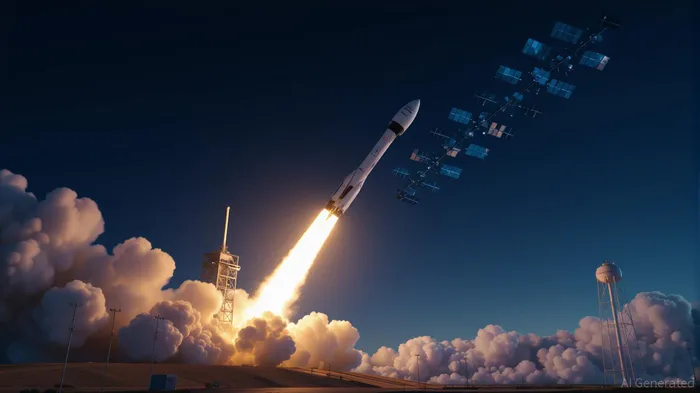 The economic advantages of SpaceX's operations are stark. For instance, its per-launch costs are 90% lower than traditional expendable rockets,
enabling a record 203 orbital missions in the first 10 months of 2024. This efficiency has allowed SpaceX to undercut competitors like ViasatVSAT--,
whose single satellite launch costs 15 times what SpaceX spends on 60 Starlink satellites. Such cost leadership cements SpaceX's role as a disruptor,
with ARK Investment Management projecting its enterprise value could reach $2.5 trillion by 2030.
Impact on Traditional Aerospace Giants and Competitors
The valuation surge of SpaceX has cast a long shadow over traditional aerospace firms.
Companies like Boeing and Lockheed Martin, long stalwarts of the sector, now face a $400 billion private competitor that outpaces them in innovation and cost efficiency. Boeing, for example, has struggled with technical delays and regulatory scrutiny, while
Virgin Galactic reported a net loss of $64 million in Q3 2025 despite modest revenue from space tourism.
However, the sector is not entirely stagnant.
Blue Origin's New Glenn rocket achieved a reusable launch in 2024, reducing per-launch costs by 60% compared to older models. Rocket Lab USA and other firms have also secured government and commercial contracts,
signaling a diversification of the market. Yet, SpaceX's dominance remains unchallenged, with its valuation dwarfing even the combined market caps of its public counterparts.
The Role of Space ETFs and IPOs in Capturing Sector Growth
For investors seeking exposure to the space economy, ETFs and IPOs have emerged as critical vehicles. The ARK Space Exploration & Innovation ETF (ARKX) and the Procure Space ETF (UFO) have delivered robust returns,
with ARKX posting a 34.38% year-to-date gain and a 70.99% return over one year. These funds capitalize on the sector's momentum, allocating capital to companies aligned with SpaceX's ecosystem, such as satellite manufacturers and launch service providers.
Recent IPOs, including Firefly Aerospace's Nasdaq debut under the ticker FLY, further illustrate the sector's appeal.
Firefly's successful Moon landing with its Blue Ghost lander underscored the commercial viability of private space ventures. Meanwhile,
the shift from SPACs to traditional IPOs reflects maturing investor sentiment, with companies like Innovative Rocket Technologies planning SPAC mergers to access public markets.
Risks and Challenges in the Space Investment Landscape
Despite the optimism, the space sector is not without risks.
Regulatory hurdles, such as space debris management and spectrum allocation for satellite internet, pose long-term challenges. Technical complexities, including the sustainability of Mars colonization projects, also remain unresolved. Additionally,
the performance of Virgin Galactic and Boeing highlights the sector's volatility, with Virgin's stock falling 8.15% post-earnings despite cost-cutting measures.
Investors must also weigh the speculative nature of space equities. While
SpaceX's valuation is backed by tangible revenue streams (Starlink generated $2.5 billion in 2024), many space-focused companies lack profitability. This raises questions about valuations that rely heavily on future potential rather than current cash flows.
Conclusion
SpaceX's valuation surge is a watershed moment for the space industry, redefining what is possible in satellite internet, launch systems, and interplanetary exploration. For investors, this creates a dual dynamic:
opportunities to capitalize on a $1.8 trillion space economy by 2035, but also risks tied to overvaluation and sector-specific challenges. Space ETFs like ARKX and UFO offer diversified access to this growth, while IPOs provide direct stakes in emerging ventures. However, a balanced approach-combining exposure to SpaceX-aligned innovations with caution toward speculative plays-is essential for navigating this high-stakes frontier.

Stay ahead of the market.
Get curated U.S. market news, insights and key dates delivered to your inbox.
AInvest
PRO
AInvest
PRO



Comments
No comments yet